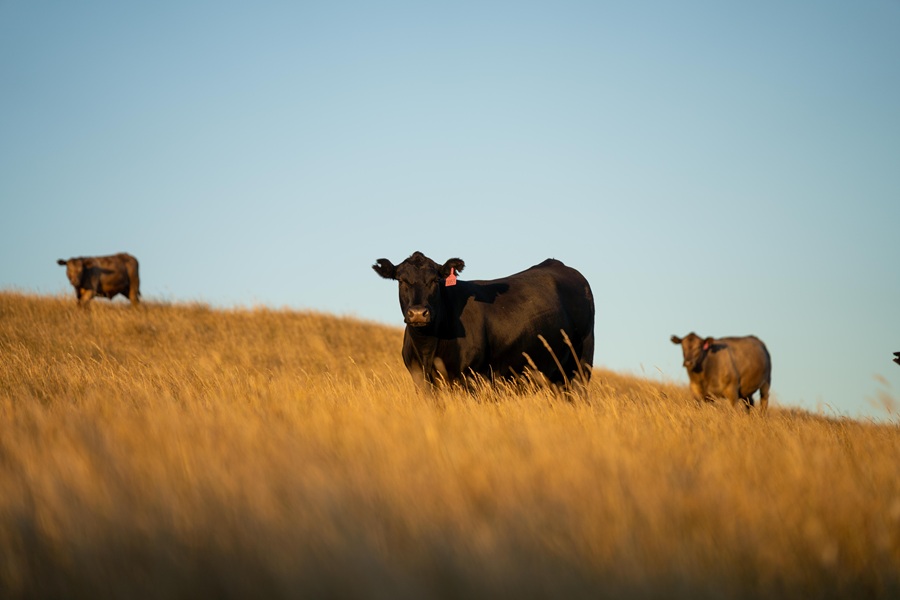
The US cattle inventory has dropped to a 75-year low, but ASX agribusinesses react with contrasting margins. Compare balance sheet exposure with rural agency turnover.
The US has a beef problem. Its cattle herd is at its lowest level in more than 75 years, domestic beef production is constrained and rebuilding supply takes time. Australia, meanwhile, is producing beef at record levels, with the US now its largest export market.
That sounds like an easy Australian cattle story but it isn't because as it turns out, two ASX companies sitting inside the same commodity cycle can experience it in completely different ways.
Australian Agricultural Company (ASX: AAC | MT5: AAC.ASX) owns cattle, land and premium beef brands while on the other hand, Elders (ASX: ELD | MT5: ELD.ASX) sits around the transaction, through livestock agency, farm supplies and rural services. So, same cattle market, very different earnings engines.
Why Australia matters to the beef story
Australia matters because the US is trying to meet beef demand with a historically tight cattle base, while Australia has been operating with high processing volumes, strong productivity and record export capacity. That makes Australia an important source of supply when US production cannot respond quickly, particularly as American buyers look offshore for more beef.
The result is a simple but powerful divergence: constrained US supply on one side, and a well-developed Australian export system positioned to help fill the gap on the other.| What matters | United States | Australia |
|---|---|---|
| Cattle herd | 86.2 million head as at 1 January 2026, with beef cow numbers down 1% YoY. | 30.8 million head forecast for 2026. The herd is expected to contract gradually, but productivity remains high. |
| Cattle processed | Domestic cattle availability remains tight, limiting the speed at which US beef supply can recover. | Nearly 9.6 million cattle were processed in FY2025-26, the highest financial-year total since 1978. |
| Import and export position | Mexican cattle imports have been disrupted by New World screwworm controls. USDA began a phased reopening of southern cattle ports from August 2026. | Australia has established tariff-free access to the US beef market under AUSFTA, increasing its ability to respond to US import demand. |
| Price pressure | US beef and veal prices were 5.9% higher YoY in August, with uncooked ground beef up 7.2%. | Strong international demand has supported Australian processor demand and cattle prices, although prices still vary by region and season. |
| Production outlook | Rebuilding cattle supply is a slow process, so domestic production constraints may persist even as producers respond to higher prices. | Beef production is forecast to exceed 3 million tonnes in 2026, a new Australian record, despite a gradually smaller herd. |
1. Australian Agricultural Company (MT5: AAC.ASX)

Australian Agricultural Company (AAC) is the easier company to place on the commodity map. It operates one of Australia's largest integrated cattle and beef businesses, with stations, feedlots and premium beef brands sold globally. In other words, AAC sits close to the thing whose value is moving: cattle, beef, land, and export pricing.
But higher beef prices do not automatically mean higher profits.
If US production remains constrained, demand for imported beef may stay strong. For AAC, the question is whether that demand flows through to stronger realised prices and demand for its premium brands, including Wagyu.
That makes AAC partly a commodity story and partly a premium consumer story.
Here is where the neat thesis gets messy. Higher cattle prices can support livestock values, but they can also raise replacement costs. Feed, freight, labour and processing still have to be paid.
So the real question is not simply whether beef prices rise. It is whether AAC's selling prices improve faster than its costs.
AAC sells beef internationally, so currency matters too. A stronger Australian dollar can affect export competitiveness and the local value of offshore revenue, depending on pricing and hedging.
Suddenly, the cattle story has an FX leg.
What AAC investors are really watching
- Export demand: Strong overseas demand can support volumes and pricing. If buyers pull back, an important support for the beef story weakens.
- Realised beef prices: What AAC actually receives matters more than a headline cattle-price move.
- Cattle and feed costs: Rising livestock values can help asset values but also make replacement and production more expensive.
- Rainfall: Good pasture can support cattle condition and reduce feeding costs.
- The Australian dollar: Currency moves can influence export competitiveness and offshore earnings.
In short: AAC is closer to what the cattle and beef are worth but the catch is what it costs to produce and sell them.
2. Elders (MT5: ELD.ASX)
Elders does not need to own the cattle to be exposed to the cycle. Think of it as infrastructure around Australian agriculture where farmers use its network to sell livestock, buy products and access agronomy and other rural services.
That means the key word for Elders is not simply price; it is activity. How many cattle are moving? What are they worth? Are farmers restocking? Are they spending? Elders cares about the business happening around everybody else's.
Higher cattle prices can increase the value passing through livestock markets, but price alone is not enough.
If producers hold animals back because they expect better prices later, transaction activity may slow. An expensive cow sitting in a paddock does not generate the same agency activity as one changing hands.
Improved seasonal conditions can encourage producers to restock or hold breeding animals. That can affect cattle prices and livestock volumes, but it can also influence spending on fencing, pasture, animal health, fertiliser and other farm inputs.
This is where Elders tells you something about confidence across the rural economy.
Australia can have strong beef demand and still run into a pricing problem. High cattle prices, currency moves, freight costs and competition from other exporters can change what processors are willing to pay.
If processor economics weaken, bidding for cattle may soften, affecting saleyard prices and livestock turnover.
What Elders investors are really watching
- Livestock turnover: This is the heartbeat of the agency business. Higher prices help, but animals still need to change hands.
- Cattle prices: They affect the value moving through livestock markets, but very high prices can also change buying and selling behaviour.
- Seasonal conditions: Rainfall can influence restocking, forced selling and demand for farm inputs.
- Farmer spending: Stronger farm incomes and confidence can flow into agronomy, fertiliser, chemicals and other rural products.
- Export economics: What processors can afford to pay feeds back into cattle prices and market activity.
In short: Elders is less about the value of one cow and more about how much activity that cow creates across the rural economy.
Same commodity. Different exposure.
Same US beef shortage. Same Australian cattle market. Two very different ways for the cycle to show up in the numbers. And that is why these companies are worth watching together. Not because "beef is going up". Because they show how one global commodity shock can travel through two very different business models.

The information provided is of general nature only and does not take into account your personal objectives, financial situations or needs. Before acting on any information provided, you should consider whether the information is suitable for you and your personal circumstances and if necessary, seek appropriate professional advice. All opinions, conclusions, forecasts or recommendations are reasonably held at the time of compilation but are subject to change without notice. Past performance is not an indication of future performance. Go Markets Pty Ltd, ABN 85 081 864 039, AFSL 254963 is a CFD issuer, and trading carries significant risks and is not suitable for everyone. You do not own or have any interest in the rights to the underlying assets. You should consider the appropriateness by reviewing our TMD, FSG, PDS and other CFD legal documents to ensure you understand the risks before you invest in CFDs. These documents are available here.
Any references to Australian or international shares, sectors, indices, ETFs, crypto-related stocks or other instruments are provided for market commentary and watchlist purposes only and do not constitute a recommendation, offer or solicitation to buy, sell or hold any financial product or adopt any investment strategy. International markets may involve additional risks, including currency fluctuations, regulatory differences, market structure differences, reduced liquidity and higher volatility. Company-specific, sector-specific and macroeconomic risks may also affect performance.
Commentary on geopolitical developments, economic data, central bank decisions, earnings, policy changes and other global or financial market events is based on information available at the time of publication and may change without notice. Such events can lead to sudden market moves, price gaps, reduced liquidity, wider spreads and increased volatility, particularly in leveraged products such as CFDs. Forward-looking statements, expectations and scenario analysis are inherently uncertain and should not be relied on as guarantees of future market behaviour or outcomes.