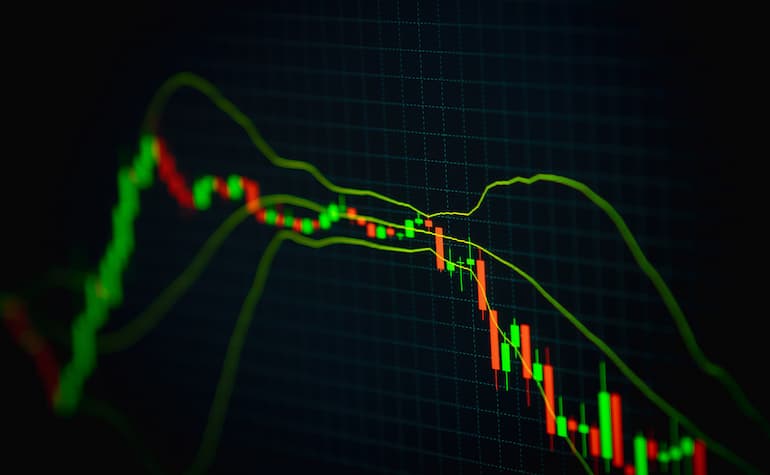
Bollinger Bands – what are they and how can you use them in FX day trading
Lachlan Meakin
22/9/2023
•
0 min read
Share this post
Copy URL
Bollinger Bands are one of the most popular indicators that FX and CFD traders use, invented in the 1980’s they are a technical analysis tool that are widely used by short and long term traders. The main uses for Bollinger Bands is determining turning points in the market at oversold and overbought levels and also as a trend following indicator. Like any technical indicator Bollinger Bands should be used with your own analysis to confirm trades and help set entry and exit levels, they are a fairly simple indicator that focuses on price and volatility only and shouldn’t, in my opinion be used in isolation.
While effective, to use them successfully you will need to be aware of the fundamentals and other technical indicators such as major support or resistance levels. How Bollinger Bands are calculated Bollinger Bands are composed of three lines. The middle line is a simple moving average (SMA), the default period being 20.
The upper and lower bands are the SMA plus or minus 2 standard deviations by default, the SMA period and Deviations can be adjusted in the settings of the indicator if desired, but the standard settings are the most popular settings among traders. When the price hits the upper band the market could be seen as “overbought” when it hits the lower band it could be seen as “oversold”, they can also be used as levels where trends are confirmed, e.g. hitting upper band could be seen as the start of a strong uptrend and vice versa. Day Trading strategies using Bollinger Bands Bollinger Bands are used mainly in two different trading styles, for contrarians looking for overbought and oversold levels to enter fade trades, or confirmation of trend for trend following systems. Both systems have their pros and cons, as with most indicators it will depend on the market “fee” for the time used, a choppy whipsawing market will see the fading system work very well, a strong trending market will see the trend following system work very well.
As with any technical system, the selection of the market to trade and being aware of the fundamentals driving the FX market at that time are critical.. Just had a Fed meeting where they surprised with a 100bp rate hike? Don’t use the fade system on USD pairs!
A good technical system I have found is useful is a mixture of both of these strategies, using the Bollinger Bands to confirm a trend, then using the fading strategy to trade pullbacks of this trend. Lets look at the example below from the AUDNZD – 5 minute chart from the 23 rd March 2023 In the above example, which is a common price action across all FX pairs, you would be using the Bolling Bands to confirm a down trend after a close below a major low. Once the possible trend is confirmed, we will be using the “overbought” level of the upper band to enter a short trade, with a take profit exit on 2 closes below the lower band, indicating the market may have gone into “oversold” territory and was time to take some money off the table.
This process would be repeated while lower highs were being made, a close above a major recent high along with a close above the upper Bollinger Band would indicate the trend may have come to an end. This can be seen on the chart below, later in the session on the same pair. At this point you would exit the short selling of the down trend and reverse to a long bias, or if your analysis on fundamentals were negative for this pair, wait for a new downtrend to form for another shorting run.
The Bollinger Squeeze Strategy Another strategy popular with FX traders is known as the Bollinger squeeze strategy. A squeeze occurs when the price has a big move, then consolidates in a tight range, this also sees the Bollinger bands go from wide to “squeeze” in a much narrower range, hence the name of the strategy. A trader would be looking for a breakout and close below or above the Bollinger bands of this squeezed range for a trade entry, see the example below from the EURUSD 5 Minute chart on 23 rd of March 2023 When the price breaks through the upper or lower band after this period of consolidation a buy or a sell signal is generated.
An initial stop is traditionally placed just above (or below in a long position) the range of the consolidation. TP rules could be similar to the previous strategy, i.e. multiple closes below the lower Bollinger Bans in the case of a short, or using the middle Bollinger Band as a trailing stop in the move is explosive and looks to continue. Summary As you can see there are multiple uses for Bollinger Bands in a FX day traders toolbox, including using them for overbought and oversold trade signals in a trending market and the Squeeze strategy where an explosive move often follows a period of consolidation.
There are also many more strategies using this indicator which I encourage you to research for yourself.
By
Lachlan Meakin
Head of Research, GO Markets Australia.
The information provided is of general nature only and does not take into account your personal objectives, financial situations or needs. Before acting on any information provided, you should consider whether the information is suitable for you and your personal circumstances and if necessary, seek appropriate professional advice. All opinions, conclusions, forecasts or recommendations are reasonably held at the time of compilation but are subject to change without notice. Past performance is not an indication of future performance. Go Markets Pty Ltd, ABN 85 081 864 039, AFSL 254963 is a CFD issuer, and trading carries significant risks and is not suitable for everyone. You do not own or have any interest in the rights to the underlying assets. You should consider the appropriateness by reviewing our TMD, FSG, PDS and other CFD legal documents to ensure you understand the risks before you invest in CFDs.

With the Iran conflict reshaping energy markets, central banks turning hawkish, and gold in freefall despite the chaos, the safe haven playbook in 2026 is more complicated than ever.
Quick facts
Gold has fallen more than 20% from its all-time high, despite an active war in the Middle East
The Singapore dollar is near its strongest level against the USD since October 2014
The Reserve Bank of Australia (RBA) hiked rates to 4.10% in March 2026 as Iran-driven oil prices push Australian inflation higher
1. Gold (XAU/USD)
Gold remains the most widely traded safe haven globally. It benefits from geopolitical stress, US dollar weakness, and negative real interest rate environments. However, its short-term behaviour in 2026 demands explanation.
Despite an active war in the Middle East, gold has sold off sharply. The likely cause is the Fed trimming its 2026 rate cut projections, citing hotter-than-expected producer inflation and Strait of Hormuz-driven oil prices creating inflation persistence.
Ultimately, gold's bull case rests on falling real yields and a weaker dollar, and right now neither condition is in place. Traders should be aware that during an inflationary supply shock like the one the Iran conflict has delivered, gold does not always behave as expected.
However, if you zoom out, the longer-term picture reinforces gold’s safe-haven status, ending 2025 as one of its strongest years on record.
Key variables to watch: US Federal Reserve guidance, real yields, and USD direction.
2. Japanese Yen (JPY)
The yen has long functioned as a safe-haven currency thanks to Japan's status as the world's largest net creditor nation. In times of stress, Japanese investors tend to repatriate capital, driving the yen higher.
However, that dynamic seems to have shifted in 2026 so far. The yen is down 6.63% YoY, near its weakest level since July 2024, and surging oil import costs are weighing on the currency.
The yen's safe-haven role has not disappeared, though. It tends to reassert itself during sharp equity selloffs and liquidity events. But in an oil-driven inflation shock, it faces structural headwinds.
Key variables to watch: BOJ rate decisions, US-Japan yield differentials, and any intervention signals from Japanese authorities.
3. Swiss Franc (CHF)
Switzerland's political neutrality, account surplus, and strong institutional framework make the franc a reflexive safe-haven currency. Unlike the yen, the CHF is holding up in the current environment, with the franc gaining against the dollar in 2026, and EUR/CHF remaining stable.
For traders across Europe and the Middle East, CHF is often the first port of call during stress events.
Key variables to watch: Swiss National Bank intervention language, European geopolitical developments, and global risk indices.
4. US Treasury Bonds (US10Y)
Under normal conditions, US government bonds are some of the deepest, most liquid safe-haven instruments in the world. But 2026 is not normal conditions…
Yields have been rising, not falling, meaning bond prices are moving in the wrong direction for anyone seeking safety.
When yields rise during a risk-off event, it signals the market is treating bonds as an inflation risk rather than a safety asset.
However, short-duration Treasuries like bills and 2-year notes are a different story. They may offer higher income with less duration risk than longer-dated bonds, which is why some investors use them more defensively in volatile periods.
Key variables to watch: Fed communication, CPI and PCE data, and whether the 10Y yield breaks above 4.50% or pulls back below 4.00%.
5. Australian Dollar vs. US Dollar (AUD/USD): inverse play
The Australian dollar is widely considered a risk-on currency, tied closely to global commodity demand and Chinese growth.
In risk-off environments, AUD/USD typically falls. A falling AUD/USD can serve as a leading indicator of broader global stress, which can be useful context for traders with regional exposure.
The RBA hiking cycle (two hikes since the start of 2026) is providing some floor under the AUD, but in a sustained global risk-off move, that support has limits.
Key variables to watch: RBA forward guidance, Chinese PMI data, iron ore prices, and oil's impact on Australian inflation expectations.
6. US Dollar Index (DXY)
The US dollar acts as the world's reserve currency and a reflexive safe haven during acute stress. When liquidity dries up, global demand for USD tends to spike regardless of the underlying trend.
Over the past 12 months, the dollar has lost ground as global confidence in US fiscal trajectory has wavered. But over the past month, it has firmed, supported by a hawkish Fed and elevated geopolitical risk.
In risk-off environments, the USD continues to attract safe-haven flows. However, rising oil prices can increase inflation risks, complicating Federal Reserve policy expectations.
Key variables to watch: Fed rate path, US inflation data, and global liquidity conditions.
7. Singapore Dollar (SGD)
Less discussed globally but highly relevant across Southeast Asia, the SGD is one of the most quietly resilient currencies in the current environment.
The Singapore dollar has advanced to near its highest level since October 2014, supported by safe haven flows and investors drawn to Singapore's AAA-rated bonds, a dividend-heavy stock market, and predictable government policies.
The MAS manages the SGD through a nominal effective exchange rate band rather than an interest rate, giving it a different character from other safe-haven currencies.
For traders with exposure to Indonesia, Malaysia, Thailand, Vietnam, and the broader ASEAN region, USD/SGD can act as a practical benchmark for regional risk appetite.
Key variables to watch: MAS policy band adjustments, regional trade flows, and USD/Asia dynamics more broadly.
8. Cash and Short-Duration Fixed Income
Sometimes, the most effective safe haven can be to simply reduce exposure. With central bank rates still elevated across major economies, cash and short-duration government bonds can offer a meaningful yield while sitting outside market risk.
The RBA raised the cash rate to 4.10% at its March meeting. The Bank of England held at 3.75%, while the ECB kept its deposit facility rate at 2.00% and main refinancing rate at 2.15%.Across all major economies, short-duration government paper is offering a real return for the first time in years.
In a volatile environment, capital preservation can sometimes matter more than return maximisation.
Key variables to watch: Central bank meeting calendars across all major economies, and any shifts in forward guidance on the rate path.
What to Watch Next
Fed inflation data. Core PCE is the single most important data point for gold, bonds, and the dollar right now. Any surprise in either direction could move all three simultaneously.
Yen intervention risk. The yen is near levels that have previously triggered action from Japanese authorities. Traders with Asia-Pacific exposure should monitor closely.
RBA's next move. With Australia now at 4.10% and inflation still above target, the question is whether the hiking cycle has further to run. The next RBA meeting is on 5 May.
Geopolitical trajectory. Any move toward de-escalation in the Middle East would quickly reduce safe haven demand and rotate capital back into risk assets. The reverse is equally true.
China's growth signal. A stronger-than-expected Chinese recovery could lift commodity currencies and reduce defensive positioning across Asia-Pacific.
The Longer-Term Lens
The 2026 environment is exposing that the effectiveness of safe haven assets depends on the type of shock, not just its severity.
An inflationary supply shock like the Iran conflict has delivered is one of the most difficult environments for traditional safe havens.
Gold falls as real yields rise. Bonds sell off as inflation expectations climb. Even the yen can weaken as Japan's import costs surge.
What has held up are assets with institutional credibility, managed frameworks, and deep liquidity regardless of macro conditions. The Swiss franc, Singapore dollar, and short-duration cash instruments fit that description better than gold or long bonds do right now.
In 2026, the question for traders is not "which safe haven?" It is "a safe haven from what?"
Jika Anda menghabiskan waktu melihat terminal perdagangan, Anda telah melihatnya. Judul berita pecah, garis grafik terputus, dan tiba-tiba semua orang bergegas menuju pintu keluar yang sama atau pintu masuk yang sama. Sepertinya kekacauan. Dalam praktiknya, seringkali merupakan rantai respons mekanis.
Ini penting karena beberapa alasan. Banyak pembaca menganggap cerita itu adalah perdagangan. Itu tidak. Ceritanya, apakah itu keputusan suku bunga, kejutan pasokan atau kehilangan pendapatan, adalah bahan bakar dan pedoman adalah mesinnya.
Di bawah ini adalah tujuh strategi inti yang sering digunakan dalam perdagangan kontrak untuk perbedaan (CFD). Dengan CFD, Anda tidak membeli aset yang mendasarinya. Anda berspekulasi tentang perubahan nilai. Itu berarti seorang pedagang dapat mengambil posisi panjang jika harga naik, atau posisi pendek jika turun.
Tujuh strategi yang harus dipahami terlebih dahulu
1. Mengikuti tren (permainan pendirian)
Trend follow bekerja pada gagasan bahwa pasar yang sudah bergerak dapat tetap bergerak sampai bertemu dengan hambatan struktural yang jelas. Beberapa pelaku pasar melihatnya sebagai pendekatan berbasis grafik karena berfokus pada arah yang berlaku daripada mencoba menyebut titik balik yang tepat.
Alasannya: Tujuannya adalah untuk mengidentifikasi bias arah yang jelas, seperti tertinggi yang lebih tinggi dan terendah yang lebih tinggi, dan mengikuti momentum itu daripada posisi melawannya.
Apa yang dicari pedagang: Rata-rata pergerakan eksponensial (EMA), seperti EMA 50 hari atau 200 hari, biasanya digunakan untuk menafsirkan kekuatan tren, meskipun indikator dapat menghasilkan sinyal palsu dan tidak dapat diandalkan dengan sendirinya.
Sumber: GO Markets | Contoh pendidikan saja.
Cara kerjanya: EMA 50-periode dapat bertindak sebagai level support dinamis yang naik seiring kenaikan harga. Dalam tren naik, beberapa pedagang mengawasi pasar untuk membuat level tertinggi baru yang lebih tinggi (HH), kemudian menarik kembali ke arah EMA sebelum bergerak lebih tinggi lagi. Setiap level rendah yang lebih tinggi (HL) mungkin menunjukkan pembeli masih memegang kendali.
Ketika harga menyentuh atau mendekati EMA 50-periode selama pullback itu, beberapa pedagang memperlakukan area itu sebagai zona keputusan potensial daripada mengasumsikan tren akan berlanjut secara otomatis.
Apa yang harus ditonton: Urutan HH dan HL adalah bagian dari bukti struktural suatu tren. Jika urutan itu rusak, misalnya jika harga turun di bawah HL sebelumnya, tren mungkin melemah dan pengaturan mungkin tidak lagi bertahan.
2. Range trading (permainan ping-pong)
Pasar dapat menghabiskan waktu lama bergerak ke samping. Itu menciptakan rentang, di mana pembeli dan penjual berada dalam keseimbangan sementara. Perdagangan rentang dibangun di sekitar perilaku ini, dengan fokus pada pergerakan di dekat bagian bawah dan atas kisaran yang ditetapkan.
Alasannya: Harga bergerak antara lantai, yang dikenal sebagai support, dan plafon, yang dikenal sebagai resistensi. Bergerak di dekat batas-batas tersebut dapat membantu menentukan lebar rentang.
Apa yang dicari pedagang: Beberapa pedagang menggunakan osilator seperti Relative Strength Index (RSI) untuk membantu menilai apakah aset terlihat overbuy atau oversold di dekat setiap batas.
Sumber: GO Markets | Contoh pendidikan saja.
Cara kerjanya: Level support adalah zona harga di mana minat beli secara historis cukup kuat untuk menghentikan pasar turun lebih jauh. Level resistensi adalah di mana tekanan jual secara historis mencegah kenaikan lebih lanjut.
Ketika harga mendekati support, beberapa pedagang mencari tanda-tanda potensi rebound. Ketika mendekati resistensi, mereka mencari tanda-tanda bahwa momentum mungkin memudar. Pembacaan RSI di bawah 35 dapat menunjukkan pasar oversold di dekat support, sementara pembacaan di atas 65 dapat menunjukkan bahwa pasar berada di atas pembelian di dekat resistensi.
Apa yang harus ditonton: Risiko utama dalam range trading adalah breakout, ketika harga mendorong secara tegas melalui kedua level dengan momentum yang kuat. Ini mungkin menandakan dimulainya tren baru dan menggunakan stop-loss tepat di luar kisaran pada setiap perdagangan dapat membantu mengelola risiko itu.
3. Breakouts (permainan pegas melingkar)
Akhirnya, setiap rentang berada di bawah tekanan. Terobosan terjadi ketika keseimbangan bergeser dan harga mendorong melalui support atau resistance. Pasar bergantian antara periode volatilitas rendah, di mana harga bergerak menyamping dalam kisaran yang ketat, dan ledakan volatilitas tinggi di mana harga dapat membuat pergerakan arah yang lebih besar.
Alasannya: Konsolidasi yang tenang terkadang dapat diikuti oleh ekspansi volatilitas yang lebih luas. Semakin ketat kompresi, semakin banyak energi yang dapat disimpan untuk langkah berikutnya.
Apa yang dicari pedagang: Bollinger Bands sering digunakan untuk menafsirkan perubahan volatilitas. Saat pita mengencang, tekanan terbentuk. Beberapa pelaku pasar melihat pergerakan di luar band sebagai tanda bahwa kondisi mungkin berubah.
Sumber: GO Markets | Contoh pendidikan saja.
Cara kerjanya: Bollinger Bands terdiri dari garis tengah, rata-rata pergerakan 20 periode, dan 2 pita luar yang berkembang atau berkontraksi berdasarkan volatilitas harga baru-baru ini. Ketika band-band menyempit dan saling berdekatan, tekanan, pasar menjadi sangat tenang.
Ini sering digambarkan sebagai pegas melingkar. Energi mungkin sedang berkembang, dan gerakan yang lebih tajam dapat mengikuti. Beberapa pedagang memperlakukan langkah pertama melalui pita luar sebagai petunjuk awal tentang arah, bukan sinyal definitif tersendiri.
Apa yang harus ditonton: Tidak setiap tekanan menyebabkan terobosan yang kuat. Terobosan palsu terjadi ketika harga bergerak sebentar di luar band, kemudian dengan cepat berbalik kembali ke dalam. Menunggu lilin menutup di luar band, alih-alih memasuki pertengahan lilin, dapat mengurangi risiko terjebak dalam gerakan yang salah.
4. Perdagangan berita (permainan deviasi)
Ini adalah perdagangan yang digerakkan oleh peristiwa. Fokusnya adalah pada kesenjangan antara apa yang diharapkan pasar dan apa yang sebenarnya disampaikan oleh data atau judul. Rilis data ekonomi, seperti angka inflasi (IHK), laporan ketenagakerjaan dan keputusan bank sentral, dapat menyebabkan pergerakan tajam dan cepat di pasar keuangan.
Alasannya: Rilis berdampak tinggi, seperti data inflasi atau keputusan bank sentral, dapat memaksa repricing aset dengan cepat. Semakin besar kejutan relatif terhadap harapan, semakin besar pergerakannya.
Apa yang dicari pedagang: Pedagang sering menggunakan kalender ekonomi untuk melacak waktu. Beberapa fokus pada bagaimana pasar berperilaku setelah reaksi awal, daripada memperlakukan langkah pertama sebagai definitif.
Sumber: GO Markets | Contoh pendidikan saja.
Cara kerjanya: Sebelum berita, harga dapat bergerak dalam kisaran yang tenang dan ketat saat pedagang menunggu. Ketika data dirilis, jika pembacaan aktual berbeda secara signifikan dari ekspektasi konsensus, harga ulang dapat terjadi dengan cepat.
Emas, misalnya, dapat melonjak tajam pada pembacaan CPI yang berada di atas ekspektasi. Namun, lilin juga dapat mencetak sumbu atas yang sangat panjang, yang berarti harga mencapai lonjakan tertinggi tetapi kemudian ditolak dengan kuat. Penjual dapat masuk dengan cepat, dan harga dapat kembali. Pola spike-and-retrace ini adalah salah satu pengaturan yang lebih dikenal dalam perdagangan berita.
Apa yang harus ditonton: Arah dan ukuran lonjakan awal tidak selalu menceritakan kisah lengkapnya. Panjang sumbu dapat menawarkan petunjuk penting. Sumbu panjang mungkin menunjukkan gerakan awal ditolak, sementara sumbu yang lebih pendek setelah rilis data dapat menunjukkan gerakan arah yang lebih berkelanjutan.
5. Pembalikan rata-rata (permainan karet gelang)
Harga terkadang bisa bergerak terlalu jauh, terlalu cepat. Pembalikan rata-rata dibangun di atas gagasan bahwa gerakan yang terlalu panjang dapat melayang kembali ke rata-rata historisnya, seperti karet gelang yang ditarik terlalu kencang, kemudian putus kembali.
Alasannya: Ini adalah pendekatan yang berlawanan. Ini mencari rentang optimisme atau pesimisme yang mungkin tidak berkelanjutan, dan posisi untuk kembali ke keseimbangan.
Apa yang dicari pedagang: Contoh umum adalah harga bergerak jauh dari rata-rata pergerakan 20 hari (MA) sementara RSI juga mencapai pembacaan ekstrem. Dalam pengaturan itu, pedagang memperhatikan pergerakan kembali ke rata-rata daripada kelanjutan menjauh darinya.
Sumber: GO Markets | Contoh pendidikan saja.
Cara kerjanya: MA 20-periode mewakili harga rata-rata pasar baru-baru ini. Ketika harga bergerak ke zona ekstrim, seperti lebih dari 3 standar deviasi di atas atau di bawah rata-rata itu, harga telah bergerak jauh dari tren baru-baru ini.
RSI di atas 70 dapat menunjukkan pasar membentang ke atas, sementara di bawah 30 dapat menunjukkan hal yang sama untuk sisi negatifnya. Beberapa pedagang reversi rata-rata menggunakan sinyal gabungan ini sebagai tanda bahwa kemunduran menuju MA 20-periode mungkin terjadi, daripada mengasumsikan pergerakan akan terus berlanjut.
Apa yang harus ditonton: Strategi reversi rata-rata dapat membawa risiko signifikan di pasar yang sedang tren. Pasar dapat tetap diperpanjang lebih lama dari yang diharapkan, dan posisi yang masuk melawan tren jangka pendek dapat menghasilkan penurunan besar. Ukuran posisi dan stop-loss yang jelas sangat penting.
6. Tingkat psikologis (permainan tokoh besar)
Pasar didorong oleh orang-orang, dan orang cenderung fokus pada angka bulat. US $100, US $2.000 atau paritas 1.000 pada pasangan mata uang dapat bertindak sebagai magnet. Di pasar keuangan, tingkat harga tertentu dapat menarik jumlah aktivitas jual beli yang tidak proporsional, bukan karena analisis teknis saja, tetapi karena psikologi manusia.
Alasannya: Pesanan besar, stop-loss, dan level take-profit dapat mengelilingi angka-angka besar ini, yang dapat memperkuat dukungan atau resistensi. Perilaku yang memperkuat diri ini adalah salah satu alasan penolakan ini bisa menjadi bermakna bagi para pedagang.
Apa yang dicari pedagang: Pedagang sering memperhatikan bagaimana harga berperilaku saat mendekati angka bulat. Pasar mungkin ragu, menolak level atau menerobosnya dengan momentum. Beberapa penolakan sumbu pada tingkat yang sama dapat membawa lebih banyak bobot daripada satu penolakan.
Sumber: GO Markets | Contoh pendidikan saja.
Cara kerjanya: Ketika harga mendekati angka bulat dari bawah, beberapa pedagang memperhatikan sumbu atas yang panjang, garis vertikal tipis di atas badan lilin. Sumbu atas yang panjang berarti harga mencapai level itu, tetapi penjual melangkah masuk secara agresif dan mendorongnya kembali ke bawah sebelum lilin ditutup.
Satu penolakan sumbu mungkin penting. Tiga dalam satu cluster mungkin lebih signifikan. Beberapa pedagang menggunakan penolakan akumulasi ini sebagai bagian dari kasus untuk pengaturan pendek (jual) pada level itu.
Apa yang harus ditonton: Tingkat psikologis juga dapat bertindak sebagai magnet ke arah yang berlawanan. Jika harga menembus dengan keyakinan, level tersebut kemudian dapat bertindak sebagai dukungan. Penutupan yang menentukan di atas level, bukan hanya jeda sumbu, bisa menjadi tanda awal bahwa pengaturan penolakan tidak lagi bertahan.
7. Rotasi sektor (permainan musim ekonomi)
Ini adalah strategi makro. Ketika latar belakang ekonomi berubah, modal dapat berpindah dari sektor yang tumbuh lebih tinggi ke sektor yang lebih defensif, dan kembali lagi. Tidak semua bagian pasar saham bergerak ke arah yang sama pada saat yang bersamaan.
Alasannya: Dalam perekonomian yang melambat, pengeluaran diskresioner dapat melemah sementara permintaan untuk layanan penting dapat tetap lebih stabil. Investor dapat merotasi modal antar sektor sesuai dengan itu.
Apa yang dicari pedagang: Dengan CFD, beberapa pedagang mengekspresikan pandangan ini melalui kekuatan relatif, mengambil eksposur ke sektor yang lebih kuat sambil mengurangi atau mengimbangi eksposur ke sektor yang lebih lemah.
Sumber: GO Markets | Contoh pendidikan saja.
Cara kerjanya: Selama fase pertumbuhan, ketika ekonomi berkembang, investor cenderung lebih memilih sektor yang berorientasi pertumbuhan seperti teknologi. Ketika lingkungan ekonomi bergeser, mungkin karena kenaikan suku bunga, memperlambat pendapatan atau meningkatnya risiko resesi, titik rotasi mungkin muncul.
Pada fase perlambatan, polanya bisa berbalik. Teknologi dapat melemah sementara utilitas dapat menguat, karena investor memindahkan modal ke sektor defensif yang menghasilkan pendapatan. Sinyal awal dapat mencakup kinerja relatif kurang di sektor pertumbuhan dikombinasikan dengan kekuatan yang tidak biasa dalam pertahanan.
Apa yang harus ditonton: Rotasi sektor biasanya bukan peristiwa semalam. Biasanya berlangsung selama berminggu-minggu hingga berbulan-bulan. Melacak rasio antara dua sektor, yang sering ditunjukkan dalam grafik kekuatan relatif, dapat membuat pergeseran ini terlihat sebelum menjadi jelas dalam hal harga absolut.
Mengapa manajemen risiko adalah mesin kelangsungan hidup
Langkah judul adalah satu hal. Implikasi pasar untuk akun Anda adalah hal lain. Jika Anda tidak mengelola mekaniknya, strateginya tidak masalah.
Karena CFD diperdagangkan dengan margin, pergerakan pasar kecil mungkin memiliki dampak besar pada akun. Jika leverage terlalu tinggi, bahkan goyangan kecil dapat memicu margin call atau penutupan posisi otomatis, tergantung pada persyaratan penyedia. Ini bukan risiko teoretis. Ini adalah alasan umum pedagang baru kehilangan lebih dari yang mereka harapkan pada perdagangan yang benar secara arah.
Pasar tidak selalu bergerak dalam garis lurus. Terkadang, kesenjangan harga dari satu level ke level lainnya, terutama setelah akhir pekan atau acara berita besar dan dalam kondisi tersebut, stop-loss mungkin tidak diisi dengan harga yang diminta tepat. Ini dikenal sebagai slippage. Ini adalah salah satu alasan mengapa posisi besar dapat membawa risiko tambahan ke dalam pengumuman besar.
Intinya
Kendaraan ini kuat, tetapi pedoman adalah apa yang membantu Anda tetap berada di jalan.
Perdagangan yang jelas seringkali sudah dihargai. Yang lebih penting adalah memahami kondisi pasar mana yang ada di depan Anda. Apakah itu sedang tren, rentang, pecah atau hanya bereaksi terhadap berita utama?
Pembaca yang menilai produk leverage sering fokus pada ukuran posisi, batas risiko, dan pengungkapan produk sebelum memutuskan apakah produk tersebut sesuai untuk mereka. Berita utama akan terus berubah. Matematika manajemen risiko tidak.
Siap untuk berdagang di luar mata uang utama? Buka akun · Masuk
Penafian: Artikel ini hanya informasi umum dan dimaksudkan untuk tujuan pendidikan. Ini menjelaskan konsep perdagangan umum dan perilaku pasar dan bukan merupakan saran produk keuangan, rekomendasi, atau sinyal perdagangan. Contoh apa pun hanya ilustratif dan tidak memperhitungkan tujuan, situasi keuangan, atau kebutuhan Anda. CFD adalah produk leverage yang kompleks yang membawa tingkat risiko tinggi. Sebelum bertindak, pertimbangkan PDS dan TMD dan apakah perdagangan CFD sesuai untuk Anda. Carilah saran independen jika diperlukan. Kinerja masa lalu bukanlah indikator yang dapat diandalkan untuk hasil masa depan.
Jika Anda telah mengikuti kisah teknologi selama dekade terakhir, Anda telah dilatih untuk melihat bidang real estat yang sangat spesifik dan sangat kecil di California Utara. Tetapi ketika kita duduk di sini pada awal 2026, momen “hubungkan titik-titik” bagi investor adalah ini: perdagangan AI telah berhenti menjadi tentang demo perangkat lunak yang mengkilap di Palo Alto dan mulai tentang industrialisasi fisik komputasi.
Kami telah memasuki “Tahun Bukti”. Perusahaan terbesar di dunia, hyperscalers, diproyeksikan menghabiskan US$650 miliar untuk belanja modal tahun ini. Tapi inilah bagian yang kebanyakan orang lewatkan: uang itu tidak tinggal di Lembah Silikon. Ini mengalir ke pemain “pick and shovels” di Idaho, Washington, Colorado, dan bahkan luar negeri.
Jika Anda ingin memahami di mana pengembalian investasi aktual (ROI) mungkin mendarat di musim pendapatan ini, Anda harus melihat di luar kode area 650. Pergeseran dari hype AI ke industrialisasi AI mengubah peta.
The full AI stack: from capex to consulting — GO Markets
Five companies · AI infrastructure play · 2026
The full AI stack: from capex to consulting
Infrastructure builders compared to the implementation bridge across the AI value chain
Note: Hyperscalers shown as 2026 CapEx spend. Accenture shown as cumulative advanced AI bookings ($11.5B through Q1 FY2026), reflecting its role as the adoption layer rather than the infrastructure layer.
Infrastructure (2026 CapEx projected)Implementation bridge (cumulative AI bookings)
Hyperscaler CapEx: Early 2026 analyst estimates, midpoint of ranges. Amazon approx. 100% YoY, Alphabet approx. 100%, Meta approx. 87%, Microsoft approx. 50%.
Accenture: Cumulative advanced AI bookings $11.5B through Q1 FY2026. Q1 AI bookings $2.2B (up 76% YoY), AI revenue $1.1B (up 120% YoY) across 1,300+ clients.
Lima perusahaan membentuk fase AI berikutnya
Teknologi Mikron (MU), Boise, Idaho
Micron adalah “tulang punggung memori” dari siklus saat ini. Sementara semua orang menonton desainer chip, banyak yang mengabaikan fakta bahwa chip AI jauh kurang berguna tanpa memori bandwidth tinggi (HBM). Micron saat ini dipandang oleh beberapa analis sebagai pembelian yang kuat karena kapasitasnya dilaporkan terjual habis hingga akhir 2026. Analis juga mengincar lonjakan 457% dalam laba per saham (EPS) karena siklus memori mencapai apa yang digambarkan oleh beberapa orang sebagai puncak yang kuat.
Microsoft (MSFT), Redmond, Washington
Microsoft adalah tulang punggung perusahaan dari transisi ini. Ini telah bergerak melampaui chatbot sederhana dan sekarang membangun apa yang oleh analis disebut “Pabrik Intelijen”. Sementara saham telah menghadapi tekanan baru-baru ini atas kendala kapasitas, permintaan yang mendasari untuk Azure AI dilaporkan masih berjalan di atas kapasitas. Kasus besar yang lebih luas adalah bahwa Microsoft pindah ke “Agentic AI”, sistem yang tidak hanya berbicara dengan pengguna tetapi juga dapat menjalankan alur kerja bisnis multi-langkah.
Amazon memainkan permainan integrasi vertikal jangka panjang. Untuk mengurangi ketergantungannya pada perangkat keras pihak ketiga yang mahal, ia membangun chip AI-nya sendiri di rumah. Amazon Web Services (AWS) tetap menjadi pendorong utama profitabilitas, dan perusahaan menggunakan data ritelnya untuk melatih model khusus yang mungkin sulit ditiru oleh banyak startup Silicon Valley.
Teknologi Palantir (PLTR), Denver, Colorado
Jika Micron menyediakan memori dan Microsoft platform, Palantir menyediakan “sistem operasi” untuk pabrik AI modern. Perusahaan telah membukukan momentum yang kuat, dengan penjualan komersial AS baru-baru ini tumbuh 93% dari tahun ke tahun. Ini sering dibingkai sebagai jembatan antara data mentah dan profitabilitas perusahaan, yang tetap menjadi fokus utama bagi investor pada tahun 2026.
Accenture (ACN), Dublin, Irlandia
Anda tidak bisa hanya “mencolokkan” AI. Bisnis sering perlu mendesain ulang proses di sekitarnya, dan di situlah Accenture masuk.
Perusahaan dipandang sebagai jembatan implementasi, dengan seorang analis berpendapat bahwa “GenAI membutuhkan Accenture” untuk beralih dari program percontohan ke produksi meskipun sudut peringatan adalah bahwa kisah AI belum sepenuhnya menggairahkan investor di sini karena pendapatan konsultasi dapat memakan waktu lebih lama untuk muncul daripada penjualan chip.
Apa yang bisa terjadi selanjutnya?
Grafik tersebut memetakan tiga cakrawala waktu yang kemungkinan akan membentuk fase berikutnya dari perdagangan industrialisasi AI.
Dalam waktu dekat, pasar masih bereaksi terhadap pendapatan pembuat chip, panduan, dan tanda-tanda ketegangan kapasitas. Selama bulan berikutnya, perhatian bergeser ke input dunia nyata di balik pertumbuhan AI, terutama kekuatan, pembiayaan, dan infrastruktur. Pada jendela 60 hari, pertanyaan kuncinya adalah apakah pengeluaran AI meluas ke peringkat ulang pasar yang lebih luas atau berjalan menjelang pengembalian jangka pendek.
Di ketiga periode, fokusnya sama: bukti. Investor mencari tanda-tanda bahwa belanja modal AI diterjemahkan ke dalam permintaan nyata untuk energi, lahan, dan kapasitas industri. Itulah sebabnya pembaruan dari perusahaan yang terkait dengan daya dan pembangunan pusat data lebih penting dari sebelumnya.
What could happen next — GO Markets
Scenario planning · March 2026
What could happen next
Three time horizons, three scenarios to watch across the AI industrialisation cycle
Next 2 weeks
Chipmaker reports
Possible
Market volatility continues as traders digest the latest reports from chipmakers like Micron
Upside scenario
"Bulletproof" guidance from remaining infrastructure names triggers a sector-wide relief rally
Watch for
Any mention of "capacity constraints" or "supply bottlenecks" in earnings calls
Next 30 days
Energy and rates
Possible
Focus shifts to "real economy" energy players like NextEra that power the data centres
Downside scenario
Rising oil prices from Middle East conflict act as a tax on tech margins, rotating into defensives
Action point
Monitor Fed language on rates. Higher for longer makes $650B capex bills far more expensive to finance
Next 60 days
The great dispersion
Possible
Market rewards companies with real AI revenue and punishes those still stuck in experimentation
Upside scenario
NextEra Energy (NEE) data centre announcements in late April/May trigger a utility renaissance rally
Downside scenario
An "air pocket" in profits occurs where debt-funded investment outpaces revenue gains
Watch
May reports from Texas Pacific Land (TPL) — is data centre land demand still "red hot"?
Action point
Review your portfolio for geographic diversity. The AI story is now a global power race
Perangkap psikologis
Perangkap emosional yang dialami banyak pedagang saat ini adalah bias kebaruan. Anda telah melihat NVIDIA dan “Magnificent 7" menang begitu lama sehingga rasanya seperti mereka adalah satu-satunya cara untuk memainkan ini. Tetapi perdagangan yang “jelas” seringkali merupakan perdagangan yang sudah dihargai. Sebelum bertindak, tanyakan pada diri sendiri: “Apakah saya membeli saham ini karena saya memahami perannya dalam rantai pasokan AI fisik, atau karena saya takut melewatkan leg berikutnya dari reli yang dimulai dua tahun lalu?”
Siap untuk berdagang di luar mata uang utama? Buka akun · Masuk
Penafian: Konten ini hanya informasi umum dan tidak boleh diandalkan sebagai saran keuangan pribadi atau rekomendasi untuk membeli, menjual, atau memegang produk keuangan apa pun. Referensi ke perusahaan atau tema, termasuk saham terkait AI, hanya ilustratif. Pasar saham dan derivatif dapat bergerak tajam, dan sektor terkonsentrasi seperti AI dan teknologi mungkin mengalami peningkatan volatilitas, risiko penilaian, dan risiko likuiditas. Jika Anda memperdagangkan derivatif seperti CFD, leverage dapat memperbesar keuntungan dan kerugian. Kinerja masa lalu bukanlah indikator kinerja masa depan yang dapat diandalkan.
Markets enter May with the federal funds target range at 3.50% to 3.75%, the Fed having concluded its 28-29 April meeting, and the next decision not due until 16-17 June. Brent crude is trading near US$108 per barrel, with the IEA describing the ongoing Iran conflict as the largest energy supply shock on record as the Strait of Hormuz remains effectively closed.
The macro tension this month is straightforward but uncomfortable: an oil-driven inflation impulse landing into a labour market that surprised to the upside in March, while Q1 growth came in soft.
The Federal Reserve has revised its 2026 PCE inflation projection to 2.7% and continues to signal one cut this year, though the timing remains contested. With no FOMC scheduled in May, every high-impact release may carry more weight than usual into the June meeting.
Fed Funds Rate
3.50% to 3.75%
Next FOMC
16-17 June 2026
Brent Crude
~US$108
Key data events
6+ high-impact releases
Growth: business activity and demand
The growth picture entering May is mixed. The Q1 GDP advance estimate landed on 30 April, while softer retail sales and inventory data have made the demand picture harder to read.
ISM manufacturing has been a quieter source of optimism, with recent prints holding in expansionary territory. Energy costs and tariff effects are now the variables most likely to shape the next move in business activity.
Key dates (AEST)
02
May
ISM Manufacturing PMI (April)
Institute for Supply Management · 12:00 am AEST
High
06
May
ISM Services PMI (April)
Institute for Supply Management · 12:00 am AEST
Medium
15
May
Retail Sales (April)
US Census Bureau · 10:30 pm AEST
High
What markets look for
Whether manufacturing PMI holds above 50, with the prices paid sub-index giving a read on input cost pressure
Services PMI as a check on the larger share of the US economy, particularly employment and prices
Retail sales control group, which feeds into consumption forecasts
Any sign that sustained Brent crude above US$100 is starting to affect household spending
How this data may move markets
Scenario
Treasuries
USD
Equities
Activity data prints firmer
↑ Yields rise
↑ Firmer
Mixed - depends on valuation stretch
Activity data softens
↓ Yields fall
↓ Softer
Support if inflation cooperates
Labour: payrolls and employment data
The April Employment Situation is one of the most concentrated risk events of the month. March payrolls came in stronger than expected, while earlier data revisions left the trend less clear. April will help show whether the labour market is genuinely re-accelerating or simply absorbing seasonal noise.
Key dates (AEST)
06
May
Job Openings and Labor Turnover Survey (JOLTS)
Bureau of Labor Statistics · 12:00 am AEST
Medium
06
May
ADP National Employment Report (April)
ADP Research Institute · 10:15 pm AEST
Medium
08
May
Employment Situation, April (NFP)
Bureau of Labor Statistics · 10:30 pm AEST
High
What markets may watch
Headline non-farm payrolls (NFP) and the size of any prior-month revisions
Average hourly earnings, with energy-driven cost pressure keeping wage growth in focus
Unemployment rate and labour force participation
Sector mix, including whether goods-producing payrolls show signs of disruption
Market sensitivities
Scenario
Treasuries
USD
Equities
Firm NFP/wage growth
↑ Yields rise
↑ Strength
Pressure on valuations
Soft NFP/weak print
↓ Yields fall
↓ Softer
Mixed - risk of growth scare
Inflation: CPI, PPI and PCE
April inflation lands as the most market-relevant data block of the month. The March consumer price index (CPI) rose 3.3% over the prior 12 months, with energy up 10.9% on the month and gasoline up 21.2%, accounting for almost three quarters of the headline increase. With Brent holding near US$105 to US$108 through the latter half of April, a further passthrough into the April CPI energy component looks plausible.
Core CPI and core personal consumption expenditures (PCE) remain the better read on underlying trend.
Key dates (AEST)
12
May
CPI (April)
Bureau of Labor Statistics · 10:30 pm AEST
High
15
May
Producer Price Index (PPI), April
Bureau of Labor Statistics · 10:30 pm AEST
Medium
29
May
Personal Income and Outlays/PCE (April)
Bureau of Economic Analysis · 10:30 pm AEST
High
What markets may watch
Headline CPI year on year, especially the gasoline component
Core CPI, including shelter, services excluding shelter and core goods
PPI as a read on producer-level passthrough from energy and tariffs
Core PCE, which remains the Fed’s preferred inflation gauge
Market sensitivities
Scenario
Treasuries
USD
Commodities
Inflation cools/surprises lower
↓ Yields fall
↓ Softer
Gold consolidation
Headline runs hot/core sticky
↑ Yields rise
↑ Strength
Gold supported on stagflation risk
Policy, trade and earnings
May has no FOMC meeting, so policy attention shifts to Fed speakers, the path of any leadership transition, and the dominant geopolitical backdrop. Chair Jerome Powell's term concludes around the middle of the month. President Donald Trump has nominated Kevin Warsh as the next Fed chair, with the Senate Banking Committee having held a confirmation hearing.
The Iran conflict, now in its ninth week, remains the single largest source of macro tail risk, with the Strait of Hormuz blockade and stalled US-Iran talks setting the tone for energy markets and broader risk appetite. Q1 earnings season is in its peak weeks, with peak weeks expected between 27 April and 15 May, and 7 May the most active reporting day.
What to monitor this month
Iran-US negotiations and the operational status of the Strait of Hormuz
Fed speakers and any change in tone between meetings
Q1 earnings, especially from retail, energy and cyclical names
Weekly EIA crude inventories
Any tariff-related announcements that may affect inflation expectations
Bottom line
May is not a quiet month just because there is no FOMC meeting. Payrolls, CPI, PPI, retail sales and PCE all land before the June policy decision, while oil remains the dominant external shock.
For markets, the key question is whether the data points to a temporary energy-driven inflation lift, or a broader inflation problem arriving at the same time as softer growth. That distinction may shape the next major move in bonds, the US dollar, gold and equity indices.
Asia-Pacific markets start May with a more complicated macro backdrop than earlier in 2026. Regional growth has shown resilience, but higher energy prices are testing inflation expectations, trade balances and policy flexibility across fuel-importing economies.
For traders, the month's focus is likely to sit across three linked areas.
China Focus
Activity data
April CPI, PPI and purchasing managers' index (PMI)
Japan Focus
BOJ signals
Corporate goods prices and April CPI
Australia Focus
RBA decision
Statement on Monetary Policy and April CPI
Main Regional Risk
Energy volatility
Trade-sensitive sentiment
China
China remains central to the May Asia-Pacific market drivers outlook because its data can influence commodity demand, regional equities and the Australian dollar. The April data round may help traders assess whether the early-year recovery is broadening or still reliant on production, exports and policy support.
Key Dates (AEST)
30
Apr
Official PMI
National Bureau of Statistics · 11:30 am AEST
Medium
11
May
CPI and industrial producer price index (PPI)
National Bureau of Statistics · 11:30 am AEST
High
18
May
April activity data
Industrial production, retail and property · 12:00 pm AEST
High
27
May
Industrial economic benefits
National Bureau of Statistics · 11:30 am AEST
Medium
What markets may look for
Whether CPI data suggest demand-led inflation or continued subdued household pricing power
Whether PPI data point to improving factory margins or cost pressure from energy and raw materials
Whether retail sales show a firmer household sector or continued reliance on production and exports
Whether property data continue to weigh on confidence, construction demand and local government revenue
Why China matters for the region
China data can influence sentiment toward Asian equities, iron ore, copper, energy markets and the Australian dollar. Stronger domestic demand may support commodity-linked sentiment, while softer retail or property figures may keep markets focused on policy support and downside growth risks.
Japan inflation and BOJ signals
Japan's May calendar is less about a fresh BOJ rate decision and more about how markets interpret the April policy meeting, inflation data and wage-sensitive price trends. That matters because Japanese government bond yields and the yen remain sensitive to any shift in policy normalisation expectations.
Key Dates (AEST)
07
May
Minutes of the March BOJ meeting
Bank of Japan · 8:50 am AEST
Medium
12
May
Summary of Opinions – April BOJ meeting
Most market-sensitive Japan event · 9:50 am AEST
High
15
May
Corporate goods price index
Tracks input cost inflation · 9:50 am AEST
Medium
22
May
National April CPI
Statistics Bureau · 9:30 am AEST
High
29
May
Tokyo May CPI
Leading indicator for national trends · 9:30 am AEST
High
What markets may look for
Whether the BOJ still sees conditions for gradual policy normalisation, or whether energy-driven inflation complicates the outlook.
Whether goods and services inflation remain consistent with the 2% inflation objective.
Whether corporate goods prices reflect energy cost pass-through into producer pricing.
Whether Tokyo CPI points to firm or easing near-term price pressure ahead of the June meeting.
Why Japan matters
Japan’s data can influence yen volatility, Japanese government bond yields and the Nikkei 225. A stronger inflation pulse may support expectations for tighter policy over time, but energy-driven inflation can also pressure households and corporate margins. That balance may keep yen and equity reactions data-dependent.
Australia and the RBA decision
Australia has one of the clearest domestic policy events in the region in May. The RBA's Monetary Policy Board meets on 4 and 5 May, with the decision statement and Statement on Monetary Policy due at 2:30 pm AEST on 5 May. The Governor's media conference follows at 3:30 pm AEST.
Key Dates (AEST)
29
Apr
March CPI
Final read before RBA decision · 11:30 am AEST
High
05
May
RBA decision and Statement on Monetary Policy
Key domestic volatility event · 2:30 pm AEST
High
19
May
Minutes of the May RBA meeting
Reserve Bank of Australia · 11:30 am AEST
Medium
27
May
April CPI
First read on energy pass-through · 11:30 am AEST
High
What markets may look for
Whether the RBA gives more weight to inflation persistence or household demand risks in its decision statement.
Whether the Statement on Monetary Policy adjusts inflation, growth or labour market assumptions from the February update.
Whether April CPI confirms or challenges the inflation narrative after the May decision.
Whether labour conditions remain firm enough, with unemployment at 4.3% in March, to keep services inflation in focus.
Why Australia matters
Australia’s May data may influence AUD/USD, ASX 200 rate-sensitive sectors and short-end bond yields. A firmer inflation profile could support expectations for a restrictive RBA stance, while softer activity or household signals may limit how far markets price additional tightening. For index CFDs and forex CFDs, this is the highest-signal domestic event of the month.
Regional swing factors
Energy remains the main cross-market risk for May. Higher oil and gas prices can lift inflation, widen trade gaps and reduce policy space, particularly for economies dependent on imported fuel such as Japan, South Korea and parts of South-East Asia.
Regional themes to watch
ASEAN purchasing managers' index releases may indicate whether manufacturing momentum is broadening or losing speed. The Australian dollar, New Zealand dollar and Asian FX may remain sensitive to China data and global risk appetite. Iron ore and energy prices may influence Australia and China-linked equities. The RBA, BOJ and People's Bank of China face different inflation and growth trade-offs, and energy supply concerns may continue to shape inflation expectations and risk sentiment across the region.
Key watchlist
01
Top China Data Point
18 May activity data, particularly retail sales and property indicators
02
Top Japan Event
12 May BOJ Summary of Opinions from the April meeting
03
Top Australia Event
5 May RBA decision and Statement on Monetary Policy
04
Main Regional Wildcard
Energy price volatility linked to Middle East developments
05
Most Sensitive Market
AUD/USD, given its link to China demand and RBA repricing risk
06
Key Condition Shift
Evidence that inflation pressure is becoming persistent rather than mainly energy-led
Bottom Line
May’s Asia-Pacific calendar gives markets several points to reassess the region’s inflation, growth and policy mix. China data may shape commodity and risk sentiment, while Japan’s inflation signals and the RBA decision will guide rate pricing.
Energy remains the primary regional risk. If inflation pressure appears more persistent rather than energy-led, markets will become increasingly sensitive to central bank communication and yield repricing.
ASIA SESSION IN FOCUS
Watching Asia-Pacific moves today?
Track Asia-Pacific themes and monitor moves as they unfold.
As we enter May 2026, the global FX market is attempting a difficult high-wire act. April was defined by "civilisation-ending" ultimatums and a Pakistani-brokered ceasefire that sent Brent crude on a rollercoaster from US$110 down to the mid-US$90s.
For traders, the connect-the-dots moment is this: the peak panic around the Iran conflict has faded, but it has been replaced by a structural regime shift. Markets may be moving from a war premium to a transition premium.
With Kevin Warsh nominated to take the Fed chair in mid-May and the Bank of Japan (BOJ) staring down a generational ceiling near 160.00, the calm in the headlines may be masking a major repricing of global yield differentials.
DXY context
Holding near 100.00 on the “Warsh hawk” floor
Strongest currency
USD, supported by safe-haven demand and yield advantage
Weakest currency
JPY, pressured by the rate gap and energy import exposure
Main central bank theme
The hawkish hold and Fed leadership transition
Main catalyst ahead
RBA (5 May) and US Non-Farm Payrolls (8 May)
Monthly leaderboard — biggest movers
01USD
Rose sharply on safe-haven demand and higher for longer yield expectations.
Strongest
02CHF
Advanced strongly as the preferred European refuge from Middle East risk.
Safe Haven
03AUD
Mixed; caught between domestic energy inflation and a hawkish RBA.
Mixed
04NZD
Under pressure; yield gap and capital outflows remains the primary narrative.
Down
05JPY
Fell to 20-month lows; pressured by the widening rate gap and energy import costs.
Weakest
Strongest mover: US dollar (USD)
The US dollar enters May with a new kind of ballast. While the ceasefire reduced the immediate need for a panic hedge, the nomination of Kevin Warsh, widely viewed as an inflation hawk, has provided a structural floor for the greenback.
Markets may be front-running a shift in Fed independence alongside a stricter approach to inflation targeting. That combination - a credible hawkish signal at the policy level - tends to support the dollar even when the near-term data is mixed.
Key drivers
The Warsh effect:
Markets may be front-running a shift in Fed independence and a stricter approach to inflation targeting.
Energy insulation:
As a net exporter, the US may be better cushioned against any fragile ceasefire-related flare-ups in oil than Europe or Japan.
Yield floor:
The federal funds rate at 3.50% to 3.75% remains a potential magnet for global capital.
What markets are watching next
Traders are watching the 101 level on the DXY. A sustained break above this high-volume area could signal a restart of the primary uptrend and a softer-than-expected US non-farm payrolls report on 8 May may challenge that view.
Weakest mover: Japanese yen (JPY)
If you wanted to design a currency to struggle in 2026, the yen fits the brief. Despite the "TACO" script, short for "Trump always chickens out", providing some relief to equities, the mathematical pressure on JPY remains significant.
The BOJ continues its delicate exit from long-term stimulus, but this process has been slower than many anticipated. The USD/JPY pair remains particularly sensitive to US Treasury yields. A move above 4.5% on the US 10-year could put additional pressure on the BOJ to act.
Key drivers
The yield chasm:
Even if the BOJ hikes to 1.00%, the spread against the US dollar would remain around 275 basis points (bps), which may keep the carry trade attractive.
Import vulnerability:
Japan’s heavy reliance on Middle East oil means energy costs may continue to weigh on its current account, even with oil near US$93.
Intervention fatigue:
Finance Minister Katayama has warned of “bold action”, but past interventions in 2022 and 2024 have tended to provide only short-lived relief.
Strategic outlook
USD/JPY is sitting near 159.80. The generational ceiling around 160.40, reportedly not breached in 35 years, remains the key battleground.
The pair to watch: AUD/USD
The Australian dollar sits at an interesting intersection.
Inflation in Australia has proven more persistent than in other developed economies, which may encourage the Reserve Bank of Australia (RBA) to maintain a cautious, higher-for-longer stance. This could create potential yield support for the AUD that does not exist in the same way for currencies where central banks are already cutting.
What could support the AUD
At the same time, the AUD remains deeply exposed to commodity markets and Chinese demand.
Iron ore and copper are critical inputs for the Australian economy. If global demand remains stable, the Australian dollar could find further support. Any shift in Chinese industrial data will be a key signal for this pair.
The EUR/USD comparison
The EUR/USD dynamic also warrants attention.
The European Central Bank (ECB) is balancing a cooling economy with regional inflation targets. Growth in Germany remains a concern for the eurozone, and markets are pricing in a potential rate cut that could narrow the interest rate differential with the US.
That shift may cause the euro to soften relative to the US dollar. Political developments within the European Union, particularly any fiscal disagreement, could add to volatility in that pair.
Data to watch next
Four events stand out as the clearest catalysts. Each has a direct transmission channel into rate expectations and, by extension, into forex CFDs.
Key dates and FX sensitivity
05
May
RBA Policy Decision
AUD pairs, ASX 200 · 02.30 pm AEST
Markets are pricing a 74% chance of a hike to 4.35% as domestic inflation remains persistent. The outcome may shape AUD direction over the following weeks.
08
May
US Labour Market (NFP)
USD pairs, Gold · 10:30 pm AEST
A second consecutive miss could create an uncomfortable narrative for the new Fed leadership transition. The NFP report provides the clearest picture of US labour market health.
12
May
US consumer price index (CPI), April
USD/JPY, EUR/USD · 10:30 pm AEST
The first clear read on whether the April oil price spike has flowed into core services and sticky inflation. It may influence the Fed’s tone for the remainder of the quarter.
20
May
NVIDIA Q1 Earnings
US Tech, AI Infrastructure · Morning AEST
A key pulse check for the AI infrastructure “invoice phase” and broader risk-on sentiment. It may influence risk-correlated currencies, including AUD and NZD.
Key levels and signals
◆
USD/JPY 160.00
A possible line in the sand for Ministry of Finance intervention. Actual or threatened action here has historically produced sharp reversals in the pair.
◆
AUD/USD 0.7000
A psychological handle that acted as a heavy pivot during the 2025 trade war; remains a near-term directional reference for positioning.
◆
Brent crude US$92.13
Technical resistance where a break lower could confirm the geopolitical floor has weakened, potentially easing pressure on importers.
◆
US 10-year yield 4.5%
A break above this level could create significant valuation pressure for growth-linked FX pairs and emerging market assets.
Bottom line
The FX moves heading into May are being shaped by a normalisation trap. Traders may be betting that the worst of the energy shock is over but a hawkish Fed leadership transition could still re-steepen the yield curve.
Moves are likely to remain highly data-dependent and sensitive to overnight gaps from the Middle East, where geopolitical shifts can gap markets before the next session opens.
The FX market heading into May is being shaped by a normalisation trap. Traders may be betting that the worst of the energy shock is over, but a hawkish Fed leadership transition could still re-steepen the yield curve. Moves are likely to remain highly data-dependent and sensitive to overnight gaps from the Middle East, where geopolitical shifts can gap markets before the next session opens.
Asia-Pacific Coverage
Follow FX through the Asia session
Stay close to Asia-Pacific themes, regional data, sentiment and key crosses.