The information provided is of general nature only and does not take into account your personal objectives, financial situations or needs. Before acting on any information provided, you should consider whether the information is suitable for you and your personal circumstances and if necessary, seek appropriate professional advice. All opinions, conclusions, forecasts or recommendations are reasonably held at the time of compilation but are subject to change without notice. Past performance is not an indication of future performance. Go Markets Pty Ltd, ABN 85 081 864 039, AFSL 254963 is a CFD issuer, and trading carries significant risks and is not suitable for everyone. You do not own or have any interest in the rights to the underlying assets. You should consider the appropriateness by reviewing our TMD, FSG, PDS and other CFD legal documents to ensure you understand the risks before you invest in CFDs. These documents are available here.
Any references to Australian or international shares, sectors, indices, ETFs, crypto-related stocks or other instruments are provided for market commentary and watchlist purposes only and do not constitute a recommendation, offer or solicitation to buy, sell or hold any financial product or adopt any investment strategy. International markets may involve additional risks, including currency fluctuations, regulatory differences, market structure differences, reduced liquidity and higher volatility. Company-specific, sector-specific and macroeconomic risks may also affect performance.
Commentary on geopolitical developments, economic data, central bank decisions, earnings, policy changes and other global or financial market events is based on information available at the time of publication and may change without notice. Such events can lead to sudden market moves, price gaps, reduced liquidity, wider spreads and increased volatility, particularly in leveraged products such as CFDs. Forward-looking statements, expectations and scenario analysis are inherently uncertain and should not be relied on as guarantees of future market behaviour or outcomes.
New Zealand Dollar takes a hit as Fed hawks regain control

- NZD/USD loses 0.68% on Wednesday as the US Dollar strengthens following higher-than-expected US inflation data.
- US consumer prices rise more than expected in October, reinforcing expectations of further monetary tightening.
- Falling Oil prices ease inflationary pressures in New Zealand, reducing the likelihood of interest rate hikes.
NZD/USD comes under renewed selling pressure on Wednesday, falling 0.68% on the day to trade around 0.5565 at the time of writing. The New Zealand Dollar (NZD) struggles against the US Dollar (USD), as stronger-than-expected US inflation data fuels expectations of further interest rate hikes by the Federal Reserve (Fed).
October US Consumer Price Index (CPI) figures, released on Tuesday, showed that headline inflation rose 0.4% MoM in October, exceeding market expectations of 0.3%, although slowing from September's 0.6% increase. Meanwhile, Core CPI, which excludes volatile food and energy prices, increased 0.3% MoM, above the 0.2% forecast and matching September's reading. These figures suggest that underlying inflationary pressures remain persistent, strengthening the case for a more restrictive monetary policy.
Following the inflation release, investors sharply increased their expectations of a December interest rate hike. According to the CME FedWatch tool, markets now assign approximately an 85% chance to a rate increase at the Fed's next meeting, reflecting growing concerns about persistent inflation.
The inflation surprise also triggered a sell-off in US government bonds on Tuesday, pushing the benchmark 10-year US Treasury yield above 5%. Higher bond yields increase the attractiveness of USD-denominated assets, adding further pressure on the NZD/USD pair.
On the New Zealand side, the Kiwi faces additional headwinds from declining Oil prices, which could help ease inflationary pressures and reduce the need for further monetary tightening by the Reserve Bank of New Zealand (RBNZ).
Lower energy costs could contribute to a moderation in consumer prices, encouraging investors to scale back expectations of future RBNZ interest rate hikes. This divergence between monetary policy expectations in the United States and New Zealand continues to weigh on the currency pair.
Meanwhile, political developments in New Zealand remain in focus as investors monitor ongoing coalition negotiations and uncertainty surrounding the Finance Minister position.
Against this backdrop, the combination of a stronger US Dollar, rising US Treasury yields and diminishing expectations of RBNZ monetary tightening could continue to limit the New Zealand Dollar's recovery prospects.
NZD/USD technical analysis
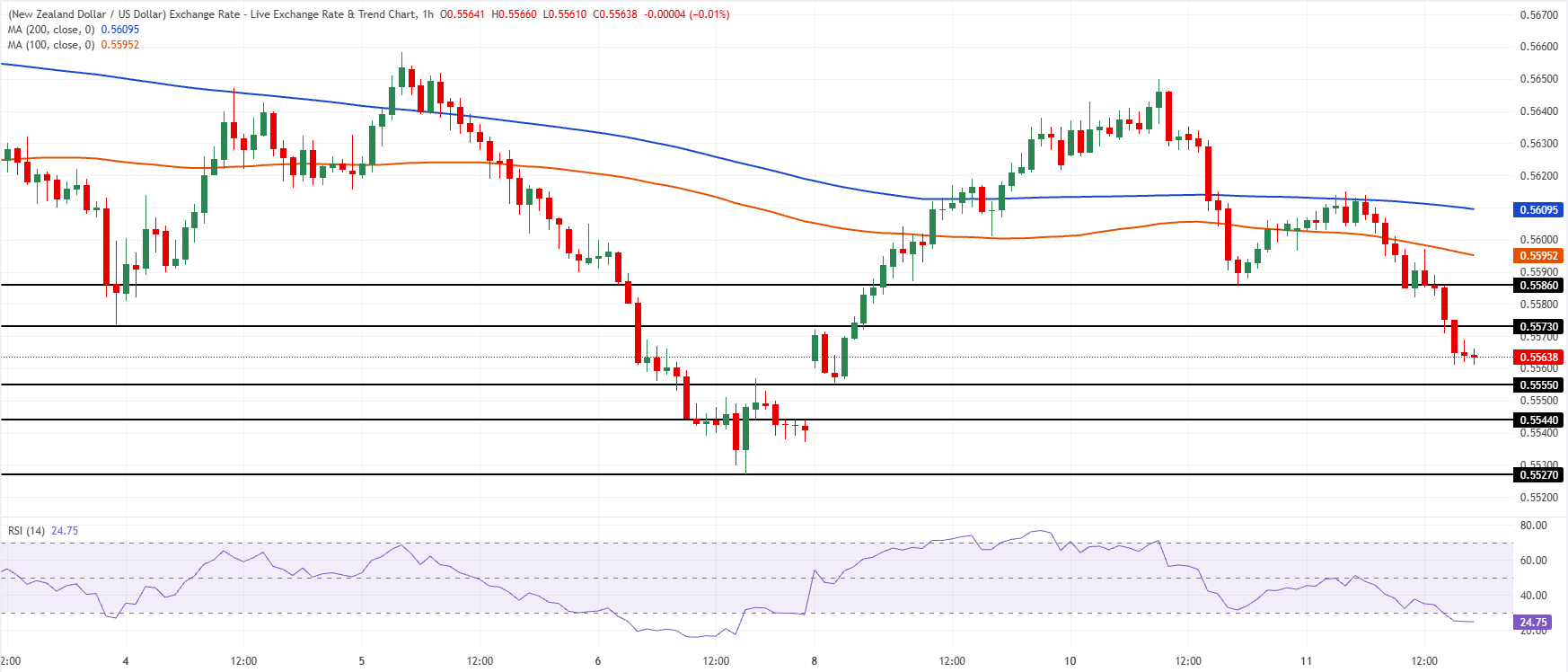
In the one-hour chart, NZD/USD trades at 0.5564, maintaining a bearish near-term bias as it holds beneath the 100-period simple moving average (SMA) at 0.5595 and the 200-period SMA at 0.5609. The pair is pressing the lower end of its recent range, while the Relative Strength Index (14) slides in oversold territory near 25, hinting that downside pressure persists even as the risk of a corrective bounce starts to build.
On the topside, initial resistance is aligned at 0.5573, followed by 0.5586 ahead of the 100-period SMA at 0.5595 and the 200-period SMA at 0.5609, a dense supply zone that would need to give way to ease the current bearish tone. On the downside, immediate support emerges at 0.5555, with subsequent floors at 0.5544 and 0.5527; a break under these levels would expose a deeper decline, while holding above them could allow an oversold rebound toward the nearby resistance band.
(The technical analysis of this story was written with the help of an AI tool. Know more.)
Related Articles