The information provided is of general nature only and does not take into account your personal objectives, financial situations or needs. Before acting on any information provided, you should consider whether the information is suitable for you and your personal circumstances and if necessary, seek appropriate professional advice. All opinions, conclusions, forecasts or recommendations are reasonably held at the time of compilation but are subject to change without notice. Past performance is not an indication of future performance. Go Markets Pty Ltd, ABN 85 081 864 039, AFSL 254963 is a CFD issuer, and trading carries significant risks and is not suitable for everyone. You do not own or have any interest in the rights to the underlying assets. You should consider the appropriateness by reviewing our TMD, FSG, PDS and other CFD legal documents to ensure you understand the risks before you invest in CFDs. These documents are available here.
Any references to Australian or international shares, sectors, indices, ETFs, crypto-related stocks or other instruments are provided for market commentary and watchlist purposes only and do not constitute a recommendation, offer or solicitation to buy, sell or hold any financial product or adopt any investment strategy. International markets may involve additional risks, including currency fluctuations, regulatory differences, market structure differences, reduced liquidity and higher volatility. Company-specific, sector-specific and macroeconomic risks may also affect performance.
Commentary on geopolitical developments, economic data, central bank decisions, earnings, policy changes and other global or financial market events is based on information available at the time of publication and may change without notice. Such events can lead to sudden market moves, price gaps, reduced liquidity, wider spreads and increased volatility, particularly in leveraged products such as CFDs. Forward-looking statements, expectations and scenario analysis are inherently uncertain and should not be relied on as guarantees of future market behaviour or outcomes.
New Zealand Dollar softens below 0.5600, US NFP data looms

- NZD/USD weakens to around 0.5585 in Friday’s Asian session.
- The New Zealand jobless rate climbed to 5.7% in Q3, its highest since 2015.
- Democrats sweeping in Congress could push Treasury yields and US Dollar lower.
The NZD/USD pair attracts some sellers to near 0.5585 during the Asian trading hours on Friday. The New Zealand Dollar (NZD) extends its downside against the US Dollar (USD) due to soft employment data and political uncertainty in New Zealand. The US September jobs report will be in the spotlight later in the day.
Data released by Statistics New Zealand earlier this week showed that Unemployment Rate rose to 5.7% in the three months ended September, its highest level in nearly 11 years. This figure followed 5.6% in the previous quarter and was above the market consensus of 5.5%.
Attention will shift to the New Zealand general election on Saturday. Christopher Luxon's center-right National Party-led coalition is facing mounting pressure to demonstrate that its policies can lift growth and ease cost-of-living strains, with a LPSOS poll earlier this week listing inflation and the cost of living as the top concern for voters ahead of an election contest on November 7.
The Democrats win a majority in both the US Senate and House of Representatives on Tuesday, taking control from Republicans. This achieved major victories in several Republican strongholds for the first time in decades, as tens of millions of voters delivered a sharp rebuke to President Donald Trump.
The sweep of Congress by Democrats dragged oil prices lower on speculation the election would speed an end to the Iran war and prompted traders to trim bets on US Federal Reserve (Fed) rate hikes. Markets are now pricing in nearly a 70.9% odds that the Fed will raise rates in December, according to CME’s FedWatch tool.
RBNZ surprise keeps RBA watchers on edge as New Zealand diverges from Australia
Rabobank’s strategists note that “last week’s decision by the RBNZ to leave rates unchanged blindsided a market that was priced for a hike,” and has “led to some soul searching ahead of this week’s RBA decision.” The central bank underscored the mixed backdrop at its policy meeting, commenting that while “annual inflation is expected to increase to 4.4% in the December quarter (largely on the back of fuel),” “domestic demand remains subdued.”
Rabobank contrasts the macro setting across the Tasman, pointing out that “the performance of the New Zealand economy has been very different from that of Australia in recent years, with the former only emerging from recession in late 2024 to an unbalanced performance last year.” They add that “despite some strong green shoots for New Zealand in Q1 2026, this was ahead of the headwinds caused by the Iran war.”
Against that backdrop, Rabobank argues that “the shock of last week’s RBNZ policy decision has underpinned some concerns over the signals that RBA Governor Bullock may provide this week,” with investors wary of another central bank wrong-footing a market positioned for further tightening.
Barkin flags solid demand and sticky inflation, keeping Dollar bulls alert despite sentiment pullback
Barkin’s speech scores 6/10 on the FXS Speechtracker, essentially in line with the 6.1/10 historical average, signaling a steady, moderately hawkish tone. The emphasis on solid demand, strong earnings, broad-based cost pressures and the need to pass these along, alongside the view that inflation is unlikely to either accelerate or fall, underscores a bias toward maintaining at least neutral-to-restrictive policy, with “gradual makes sense” framing the pace rather than the direction. Comments that AI-driven demand and AI buildout are adding near-term inflationary pressure, while inflation remains the most important risk, reinforce a backdrop where the Dollar is supported by expectations of sustained policy firmness even if the policy rate is described as “somewhere around neutral.”
The FXS Fed Sentiment Index slipped by 0.31 points to 144.92, indicating a modest pullback in perceived hawkishness but still firmly in hawkish territory. Despite the slight decline, the combination of solid demand, sticky inflation and AI-related cost pressures means the FXS Fed Sentiment Index level well above 100 continues to signal a policy stance that should underpin the Dollar, even as markets fine-tune expectations around the pace rather than the direction of future moves.
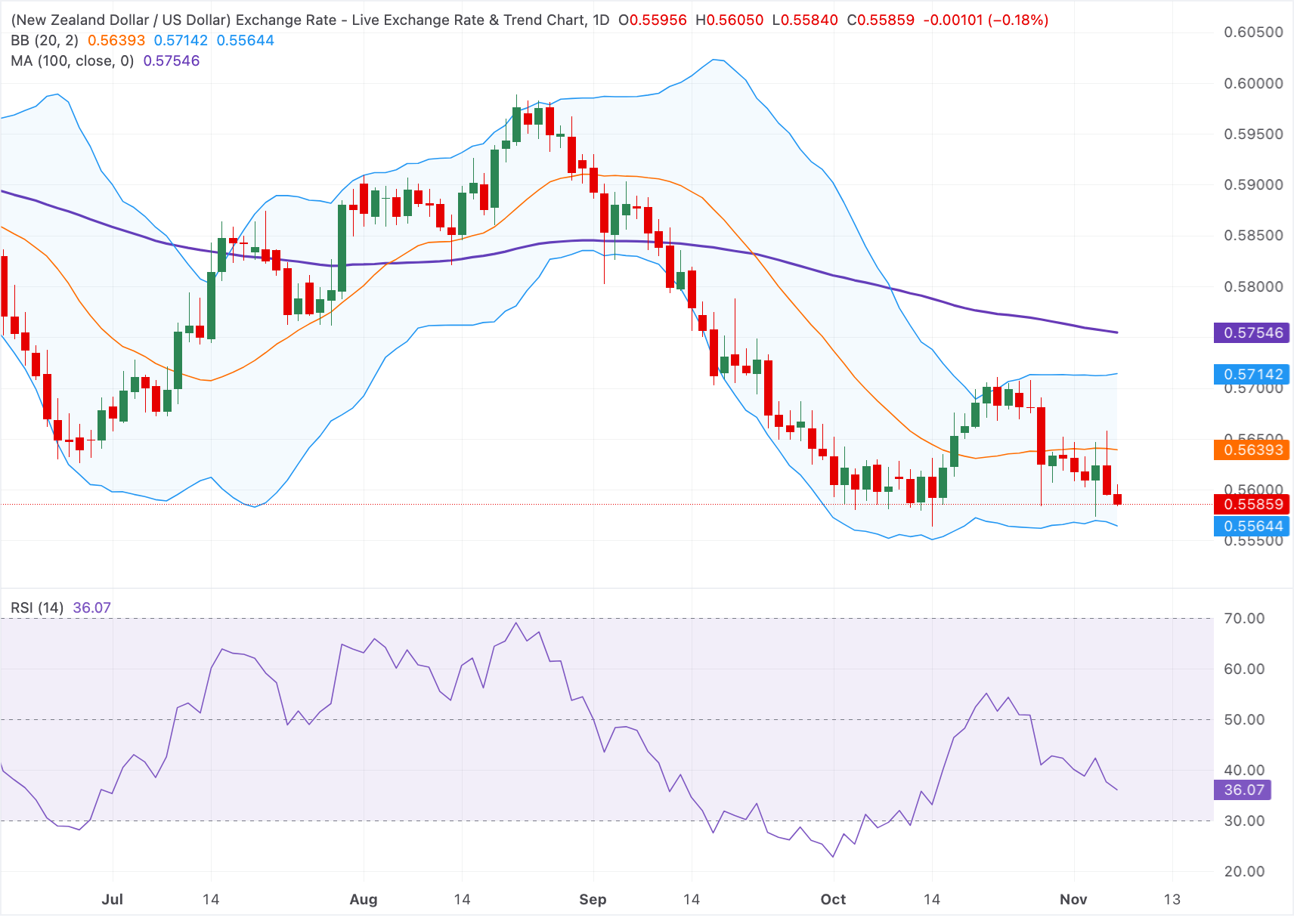
Technical Analysis: NZD/USD keeps a bearish tone below the 100-day SMA
In the daily chart, NZD/USD maintains a bearish near-term bias as spot holds beneath the 100-day simple moving average (SMA) and the Bollinger Bands’ 20-period middle SMA. Price is hovering just above the lower Bollinger Band support, underscoring persistent downside pressure, while the Relative Strength Index (RSI) at 36 shows only a modest recovery from oversold territory, hinting that selling momentum is easing but not yet reversing.
On the topside, initial resistance emerges at the Bollinger 20-period middle SMA around 0.5640, followed by the upper Bollinger Band at 0.5715 before the more substantial hurdle at the 100-day SMA near 0.5755, where stronger supply could cap rebounds. On the downside, the lower Bollinger Band at 0.5565 offers immediate support; a decisive break beneath this floor would likely open the door to further losses, while holding above it keeps the pair in a weakly consolidative phase within the broader bearish structure.
(The technical analysis of this story was written with the help of an AI tool. Know more.)
New Zealand Dollar FAQs
The New Zealand Dollar (NZD), also known as the Kiwi, is a well-known traded currency among investors. Its value is broadly determined by the health of the New Zealand economy and the country’s central bank policy. Still, there are some unique particularities that also can make NZD move. The performance of the Chinese economy tends to move the Kiwi because China is New Zealand’s biggest trading partner. Bad news for the Chinese economy likely means less New Zealand exports to the country, hitting the economy and thus its currency. Another factor moving NZD is dairy prices as the dairy industry is New Zealand’s main export. High dairy prices boost export income, contributing positively to the economy and thus to the NZD.
The Reserve Bank of New Zealand (RBNZ) aims to achieve and maintain an inflation rate between 1% and 3% over the medium term, with a focus to keep it near the 2% mid-point. To this end, the bank sets an appropriate level of interest rates. When inflation is too high, the RBNZ will increase interest rates to cool the economy, but the move will also make bond yields higher, increasing investors’ appeal to invest in the country and thus boosting NZD. On the contrary, lower interest rates tend to weaken NZD. The so-called rate differential, or how rates in New Zealand are or are expected to be compared to the ones set by the US Federal Reserve, can also play a key role in moving the NZD/USD pair.
Macroeconomic data releases in New Zealand are key to assess the state of the economy and can impact the New Zealand Dollar’s (NZD) valuation. A strong economy, based on high economic growth, low unemployment and high confidence is good for NZD. High economic growth attracts foreign investment and may encourage the Reserve Bank of New Zealand to increase interest rates, if this economic strength comes together with elevated inflation. Conversely, if economic data is weak, NZD is likely to depreciate.
The New Zealand Dollar (NZD) tends to strengthen during risk-on periods, or when investors perceive that broader market risks are low and are optimistic about growth. This tends to lead to a more favorable outlook for commodities and so-called ‘commodity currencies’ such as the Kiwi. Conversely, NZD tends to weaken at times of market turbulence or economic uncertainty as investors tend to sell higher-risk assets and flee to the more-stable safe havens.
Related Articles