The information provided is of general nature only and does not take into account your personal objectives, financial situations or needs. Before acting on any information provided, you should consider whether the information is suitable for you and your personal circumstances and if necessary, seek appropriate professional advice. All opinions, conclusions, forecasts or recommendations are reasonably held at the time of compilation but are subject to change without notice. Past performance is not an indication of future performance. Go Markets Pty Ltd, ABN 85 081 864 039, AFSL 254963 is a CFD issuer, and trading carries significant risks and is not suitable for everyone. You do not own or have any interest in the rights to the underlying assets. You should consider the appropriateness by reviewing our TMD, FSG, PDS and other CFD legal documents to ensure you understand the risks before you invest in CFDs. These documents are available here.
Any references to Australian or international shares, sectors, indices, ETFs, crypto-related stocks or other instruments are provided for market commentary and watchlist purposes only and do not constitute a recommendation, offer or solicitation to buy, sell or hold any financial product or adopt any investment strategy. International markets may involve additional risks, including currency fluctuations, regulatory differences, market structure differences, reduced liquidity and higher volatility. Company-specific, sector-specific and macroeconomic risks may also affect performance.
Commentary on geopolitical developments, economic data, central bank decisions, earnings, policy changes and other global or financial market events is based on information available at the time of publication and may change without notice. Such events can lead to sudden market moves, price gaps, reduced liquidity, wider spreads and increased volatility, particularly in leveraged products such as CFDs. Forward-looking statements, expectations and scenario analysis are inherently uncertain and should not be relied on as guarantees of future market behaviour or outcomes.
Japanese Yen strengthens despite robust US jobs data

- USD/JPY weakens to around 158.25 in Monday’s early Asian session.
- BoJ meeting minutes suggested policymakers are prepared to accelerate monetary tightening.
- US NFP climbed by 165,000 in October; Unemployment Rate fell to 4.1%.
The USD/JPY pair loses ground to near 158.25 during the early Asian session on Monday. The Japanese Yen (JPY) edges higher against the US Dollar (USD) as Bank of Japan (BOJ) meeting minutes indicate policymakers are prepared to accelerate monetary tightening.
The BoJ kept rates steady last month but stressed its resolve to combat inflationary risk, reinforcing market bets of a December hike. According to the minutes of September meeting released on Thursday, most of the BoJ policymakers agreed that further interest rate increases would be appropriate as underlying inflation approached the central bank's 2% target.
On Friday, BoJ former top economist Seisaku Kameda said that the central bank is expected to raise interest rates in December and keep lifting borrowing costs next year until they reach 2% to combat mounting inflationary pressure.
US Nonfarm Payrolls (NFP) rose by 165,000 in October, compared to 60,000 recorded in September, the US Bureau of Labor Statistics (BLS) showed on Friday. This figure blew past expectations for a 65,000 gain. The Unemployment Rate in the US fell to 4.1% in October from 4.2% in September.
Stronger-than-expected US jobs report keeps the Federal Reserve (Fed) on track to raise interest rates in December. "The labor market is heating up across-the-board and supports our view that the Fed will raise the policy rate again in December," said Kathy Bostjancic, chief economist at Nationwide.
Financial markets priced in a roughly 79.6% chance of a rate hike at the US central bank's meeting next month, up from 72.8% before the US jobs report, the CME FedWatch tool showed.
Yen gains on haven flows as BoJ normalisation expectations build
Strategists at ABN Amro highlight that “haven demand favoured the JPY over the USD” during the latest bout of risk aversion. They note that the “DXY Index was unchanged at 101.6 despite the equity rout, as falling US yields eroded the greenback’s appeal.” In contrast, the Yen drew support both from safe-haven inflows and domestic policy signals, with ABN Amro pointing out that “the JPY appreciated by 0.5% to 157.70 per USD, underpinned by the Bank of Japan minutes, which reinforced expectations of further normalisation.”
Daly flags inflation as top priority, reinforcing hawkish Fed bias
Fed’s Daly delivers a notably more hawkish tone, with an FXS Speechtracker score of 8/10 compared to the established baseline of 6.4/10, underscoring a stronger emphasis on tightening risks. The key remarks highlight that while the jobs report is “good news” and wage growth “isn’t booming,” real wages are falling and inflation has been “high for too long,” making inflation the number 1 priority and justifying further policy tightening despite a resilient labor market. Daly’s insistence that the strong labor market gives the Fed latitude to act, combined with readiness to raise rates if called for, supports a firmer DOLLAR bias and keeps risk assets on notice.
The FXS Fed Sentiment Index rose by 0.95 points to 143.10, reinforcing a firmly hawkish stance well above the neutral 100 threshold and aligning with the elevated FXS Speechtracker reading. This move signals that, despite acknowledgment of uncertainties around tariffs, war, and AI, the dominant market takeaway is that the Fed remains inclined toward additional tightening, a backdrop that should continue to underpin the DOLLAR against the EURO and YEN.
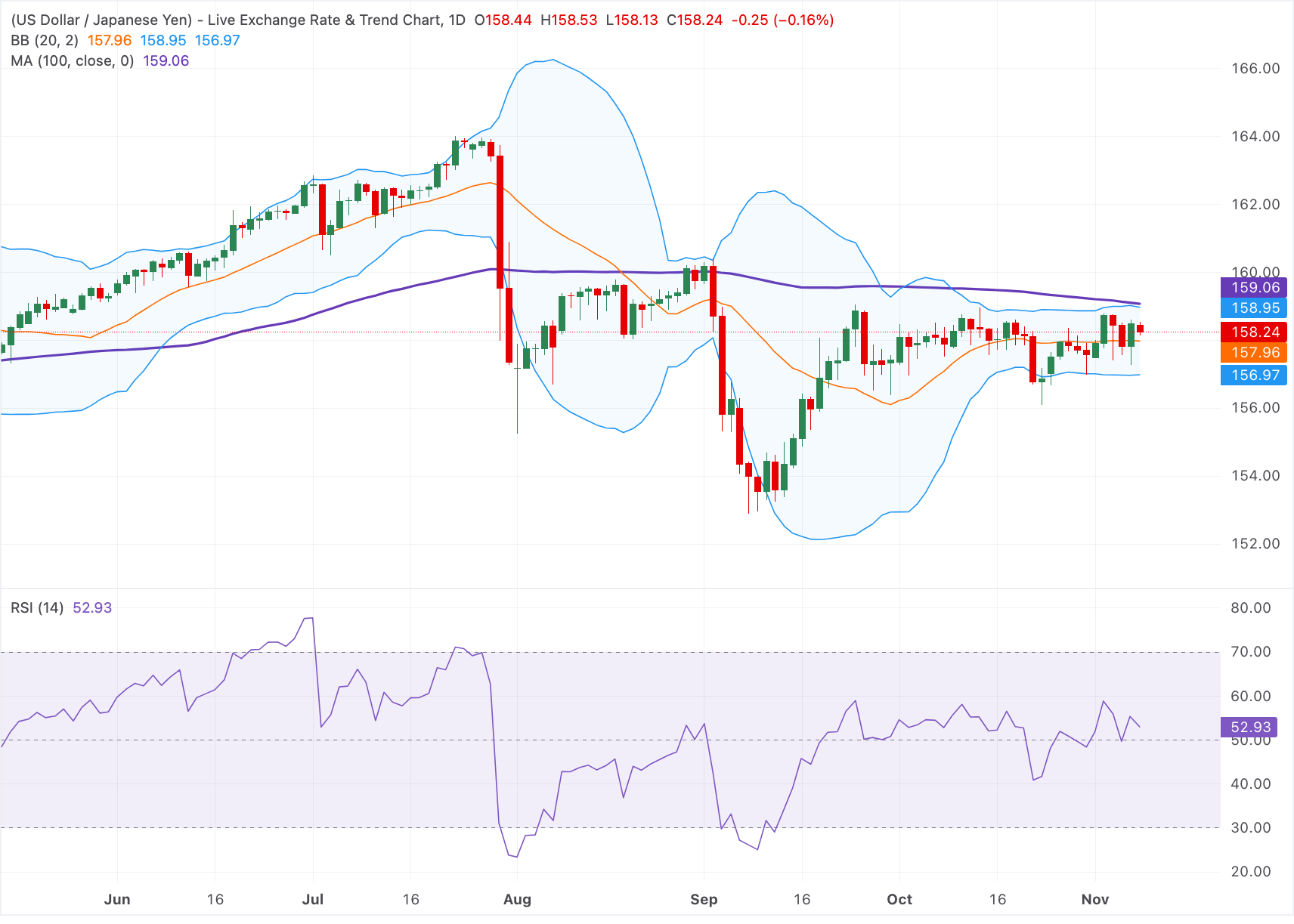
Technical Analysis: USD/JPY remains capped below the 100-day SMA
In the daily chart, USD/JPY holds in a tight range just beneath the 100-day Simple Moving Average (SMA) while hovering above the Bollinger Bands middle line. This configuration suggests a broadly range-bound bias, with price capped by the upper Bollinger Band and the 100-day SMA overhead, even as the Relative Strength Index (14) at 52.93 hints at mildly constructive but non-directional momentum.
On the topside, immediate resistance is clustered near the Bollinger upper band at 158.95, followed by the 100-day SMA at 159.05, where a daily close above would be needed to reopen a more decisive bullish leg. On the downside, initial support aligns with the Bollinger middle band at 157.95, with a deeper floor at the lower band around 156.95; a drop through this lower boundary would shift the focus toward a broader corrective phase in the pair.
(The technical analysis of this story was written with the help of an AI tool. Know more.)
Japanese Yen FAQs
The Japanese Yen (JPY) is one of the world’s most traded currencies. Its value is broadly determined by the performance of the Japanese economy, but more specifically by the Bank of Japan’s policy, the differential between Japanese and US bond yields, or risk sentiment among traders, among other factors.
One of the Bank of Japan’s mandates is currency control, so its moves are key for the Yen. The BoJ has directly intervened in currency markets sometimes, generally to lower the value of the Yen, although it refrains from doing it often due to political concerns of its main trading partners. The BoJ ultra-loose monetary policy between 2013 and 2024 caused the Yen to depreciate against its main currency peers due to an increasing policy divergence between the Bank of Japan and other main central banks. More recently, the gradually unwinding of this ultra-loose policy has given some support to the Yen.
Over the last decade, the BoJ’s stance of sticking to ultra-loose monetary policy has led to a widening policy divergence with other central banks, particularly with the US Federal Reserve. This supported a widening of the differential between the 10-year US and Japanese bonds, which favored the US Dollar against the Japanese Yen. The BoJ decision in 2024 to gradually abandon the ultra-loose policy, coupled with interest-rate cuts in other major central banks, is narrowing this differential.
The Japanese Yen is often seen as a safe-haven investment. This means that in times of market stress, investors are more likely to put their money in the Japanese currency due to its supposed reliability and stability. Turbulent times are likely to strengthen the Yen’s value against other currencies seen as more risky to invest in.
Related Articles