The information provided is of general nature only and does not take into account your personal objectives, financial situations or needs. Before acting on any information provided, you should consider whether the information is suitable for you and your personal circumstances and if necessary, seek appropriate professional advice. All opinions, conclusions, forecasts or recommendations are reasonably held at the time of compilation but are subject to change without notice. Past performance is not an indication of future performance. Go Markets Pty Ltd, ABN 85 081 864 039, AFSL 254963 is a CFD issuer, and trading carries significant risks and is not suitable for everyone. You do not own or have any interest in the rights to the underlying assets. You should consider the appropriateness by reviewing our TMD, FSG, PDS and other CFD legal documents to ensure you understand the risks before you invest in CFDs. These documents are available here.
Any references to Australian or international shares, sectors, indices, ETFs, crypto-related stocks or other instruments are provided for market commentary and watchlist purposes only and do not constitute a recommendation, offer or solicitation to buy, sell or hold any financial product or adopt any investment strategy. International markets may involve additional risks, including currency fluctuations, regulatory differences, market structure differences, reduced liquidity and higher volatility. Company-specific, sector-specific and macroeconomic risks may also affect performance.
Commentary on geopolitical developments, economic data, central bank decisions, earnings, policy changes and other global or financial market events is based on information available at the time of publication and may change without notice. Such events can lead to sudden market moves, price gaps, reduced liquidity, wider spreads and increased volatility, particularly in leveraged products such as CFDs. Forward-looking statements, expectations and scenario analysis are inherently uncertain and should not be relied on as guarantees of future market behaviour or outcomes.
Japanese Yen extends slide vs firm USD as traders keenly await Fed, BoJ policy meetings

- USD/JPY builds on its recovery from a one-month low amid some follow-through USD buying.
- Traders look forward to Fed and BoJ meetings and key US macro releases for a fresh impetus.
- The fundamental backdrop seems tilted in favor of bulls and backs the case for additional gains.
The USD/JPY pair trades with a positive bias for the third straight day on Tuesday, recovering further from an over one-month low, around the 156.00 neighborhood, touched last week. Spot prices, however, lack follow-through buying and currently trade around the 157.70 region, up just over 0.10% for the day, as traders seem hesitant ahead of key central bank events.
The US Federal Reserve (Fed) is scheduled to announce its decision at the end of a two-day policy meeting on Wednesday, though the focus will be on the accompanying rate statement and Fed Chair Kevin Warsh's comments during the post-meeting press conference. Adding to this, the release of the Advance US Q3 GDP report and the Personal Consumption Expenditures (PCE) Price Index on Thursday will influence market expectations about the Fed's future policy path. This, in turn, will drive the US Dollar (USD) and provide some impetus to the USD/JPY pair ahead of the crucial Bank of Japan (BoJ) policy update on Friday.
In the meantime, expectations that the BoJ may hold off on aggressive rate hikes keep the so-called carry trade active and continue to undermine the Japanese Yen (JPY). The USD, on the other hand, attracts some follow-through buyers for the third straight day amid the growing acceptance that the US central bank will stick to its hawkish stance amid inflation fears stemming from elevated energy prices. Moreover, the geopolitical risk premium remains in play amid tensions in the Middle East, lending additional support to the safe-haven Greenback and backing the case for a further appreciating move for the USD/JPY pair.
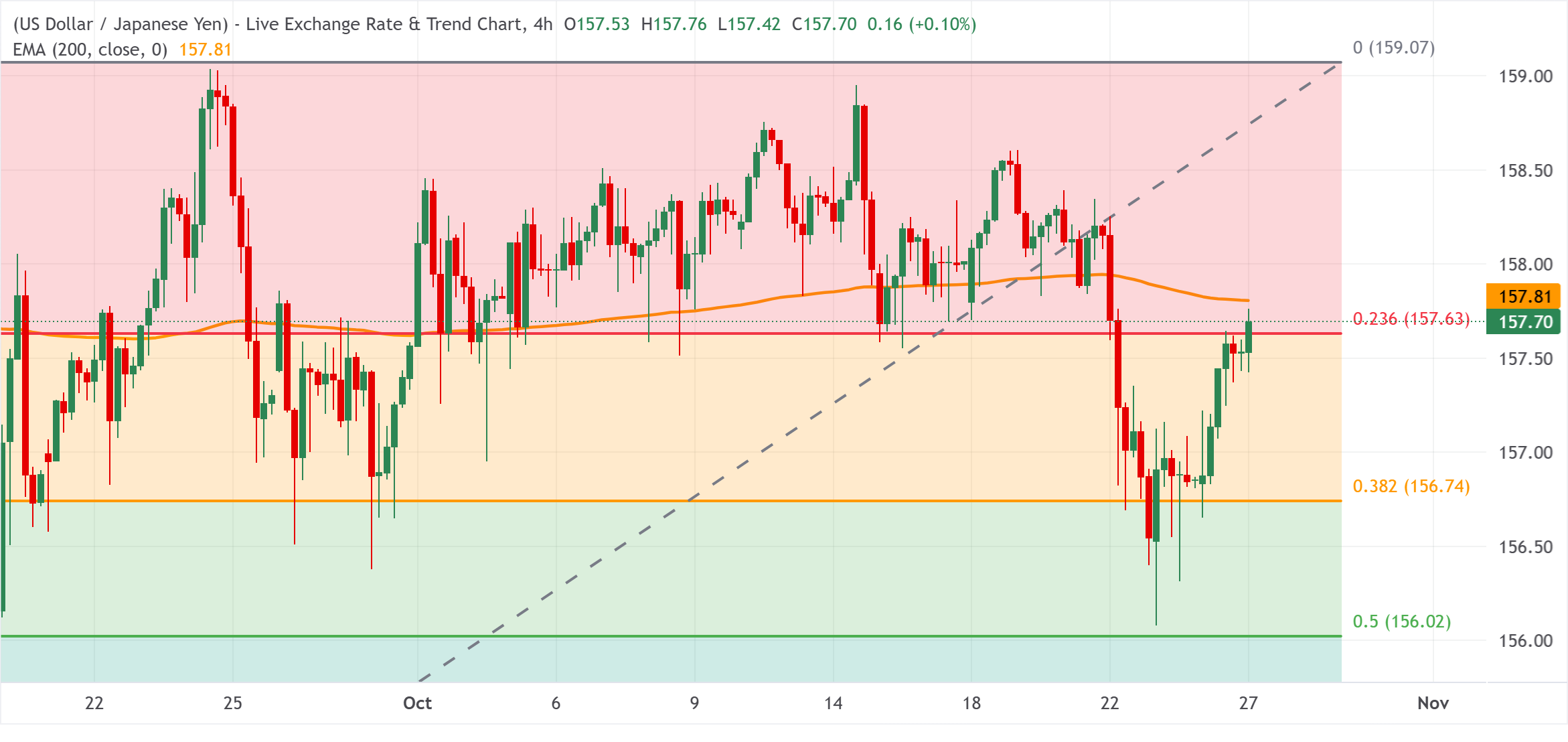
USD/JPY 4-hour chart
Technical Analysis
The USD/JPY pair holds a capped tone and remains below the 200-period Exponential Moving Average (EMA) at 157.81. That said, the nearby 23.6% Fibonacci retracement at 157.63 offers initial cushioning and defines the upper boundary of a corrective pullback zone.
This is followed by the denser retracement cluster between the 38.2% level at 156.74 and the 50.0% level at 156.02, with deeper floors at 155.30 and 154.28. On the topside, strength beyond the 200-period EMA at 157.81 would expose the cycle high near 159.07, which would need to be reclaimed to ease the current bearish bias.
(The technical analysis of this story was written with the help of an AI tool. Know more.)
Bank of Japan FAQs
The Bank of Japan (BoJ) is the Japanese central bank, which sets monetary policy in the country. Its mandate is to issue banknotes and carry out currency and monetary control to ensure price stability, which means an inflation target of around 2%.
The Bank of Japan embarked in an ultra-loose monetary policy in 2013 in order to stimulate the economy and fuel inflation amid a low-inflationary environment. The bank’s policy is based on Quantitative and Qualitative Easing (QQE), or printing notes to buy assets such as government or corporate bonds to provide liquidity. In 2016, the bank doubled down on its strategy and further loosened policy by first introducing negative interest rates and then directly controlling the yield of its 10-year government bonds. In March 2024, the BoJ lifted interest rates, effectively retreating from the ultra-loose monetary policy stance.
The Bank’s massive stimulus caused the Yen to depreciate against its main currency peers. This process exacerbated in 2022 and 2023 due to an increasing policy divergence between the Bank of Japan and other main central banks, which opted to increase interest rates sharply to fight decades-high levels of inflation. The BoJ’s policy led to a widening differential with other currencies, dragging down the value of the Yen. This trend partly reversed in 2024, when the BoJ decided to abandon its ultra-loose policy stance.
A weaker Yen and the spike in global energy prices led to an increase in Japanese inflation, which exceeded the BoJ’s 2% target. The prospect of rising salaries in the country – a key element fuelling inflation – also contributed to the move.
Related Articles