The information provided is of general nature only and does not take into account your personal objectives, financial situations or needs. Before acting on any information provided, you should consider whether the information is suitable for you and your personal circumstances and if necessary, seek appropriate professional advice. All opinions, conclusions, forecasts or recommendations are reasonably held at the time of compilation but are subject to change without notice. Past performance is not an indication of future performance. Go Markets Pty Ltd, ABN 85 081 864 039, AFSL 254963 is a CFD issuer, and trading carries significant risks and is not suitable for everyone. You do not own or have any interest in the rights to the underlying assets. You should consider the appropriateness by reviewing our TMD, FSG, PDS and other CFD legal documents to ensure you understand the risks before you invest in CFDs. These documents are available here.
Any references to Australian or international shares, sectors, indices, ETFs, crypto-related stocks or other instruments are provided for market commentary and watchlist purposes only and do not constitute a recommendation, offer or solicitation to buy, sell or hold any financial product or adopt any investment strategy. International markets may involve additional risks, including currency fluctuations, regulatory differences, market structure differences, reduced liquidity and higher volatility. Company-specific, sector-specific and macroeconomic risks may also affect performance.
Commentary on geopolitical developments, economic data, central bank decisions, earnings, policy changes and other global or financial market events is based on information available at the time of publication and may change without notice. Such events can lead to sudden market moves, price gaps, reduced liquidity, wider spreads and increased volatility, particularly in leveraged products such as CFDs. Forward-looking statements, expectations and scenario analysis are inherently uncertain and should not be relied on as guarantees of future market behaviour or outcomes.
GBP/USD Price Forecast: Holds gains near 1.3450, maintains constructive bias above 100-day SMA

- GBP/USD holds positive ground near 1.3445 in Tuesday’s early European session.
- Constructive outlook for the pair prevails above the 100-day SMA, with bullish RSI momentum.
- The first upside barrier emerges at 1.3500; the initial support level to watch is 1.3400.
The GBP/USD pair trades in positive territory around 1.3445 during the early European session on Tuesday. However, markets might turn cautious later in the day ahead of the release of the US October Consumer Price Index (CPI) inflation report.
Last week, the BoE raised its benchmark interest rate by 25 basis points (bps) to 4.00%, marking its first rate increase in over three years. The UK central bank warned that at least one more increase is likely if the US-Iran conflict continues.
"December's meeting now looks like a coin flip, with the path of oil and natural gas prices set to be the decisive factor," said Andrew Goodwin, chief UK economist at Oxford Economics.
The upbeat US October jobs report on Friday might help limit the US Dollar’s (USD) losses. Traders raise their bets on further US interest rate hike, with markets pricing in nearly an 84% chance of a Federal Reserve (Fed) rate increase next month.
BoE hike matches Fed upper bound as MPC flags further risk-linked tightening
According to analysts at ABN Amro, the BoE “raised the bank rate by 25 bps to 4.00%, matching the upper bound of the 3.75-4.00% Fed Funds Rate range.” They highlight that the decision was firmly hawkish, with “eight members” of the MPC backing the increase, while “one preferred a 50-bps increase.” ABN Amro adds that the committee “projected inflation to reach around 5% by mid-2027 and signalled another increase unless the Middle East conflict is resolved,” underscoring a conditional tightening bias even after bringing UK policy rates into line with the top of the current US range.
BoE’s Pill opens door to 2026 rate cuts as outlook uncertainty rises
Pill’s latest remarks score 4.2/10 on FXS Speechtracker, well below the historic average of 6.4/10, signalling a more cautious and less forceful policy stance. By stressing that “nothing is baked in” for next year and that there is “no preset upward path” for rates from spring, the speech marks a dovish shift away from any assumption of continued tightening.
The acknowledgement that Bank Rate could stay on hold or even fall if growth stalls next year reinforces downside risks for the Pound, especially if UK data underperform peers. Emphasis on margin squeeze dynamics and corporate reactions highlights concern over growth and profitability, supporting the view that the BOE may prioritize economic resilience over further rate hikes, a configuration typically negative for GBP relative to other major currencies such as the Dollar and Euro.
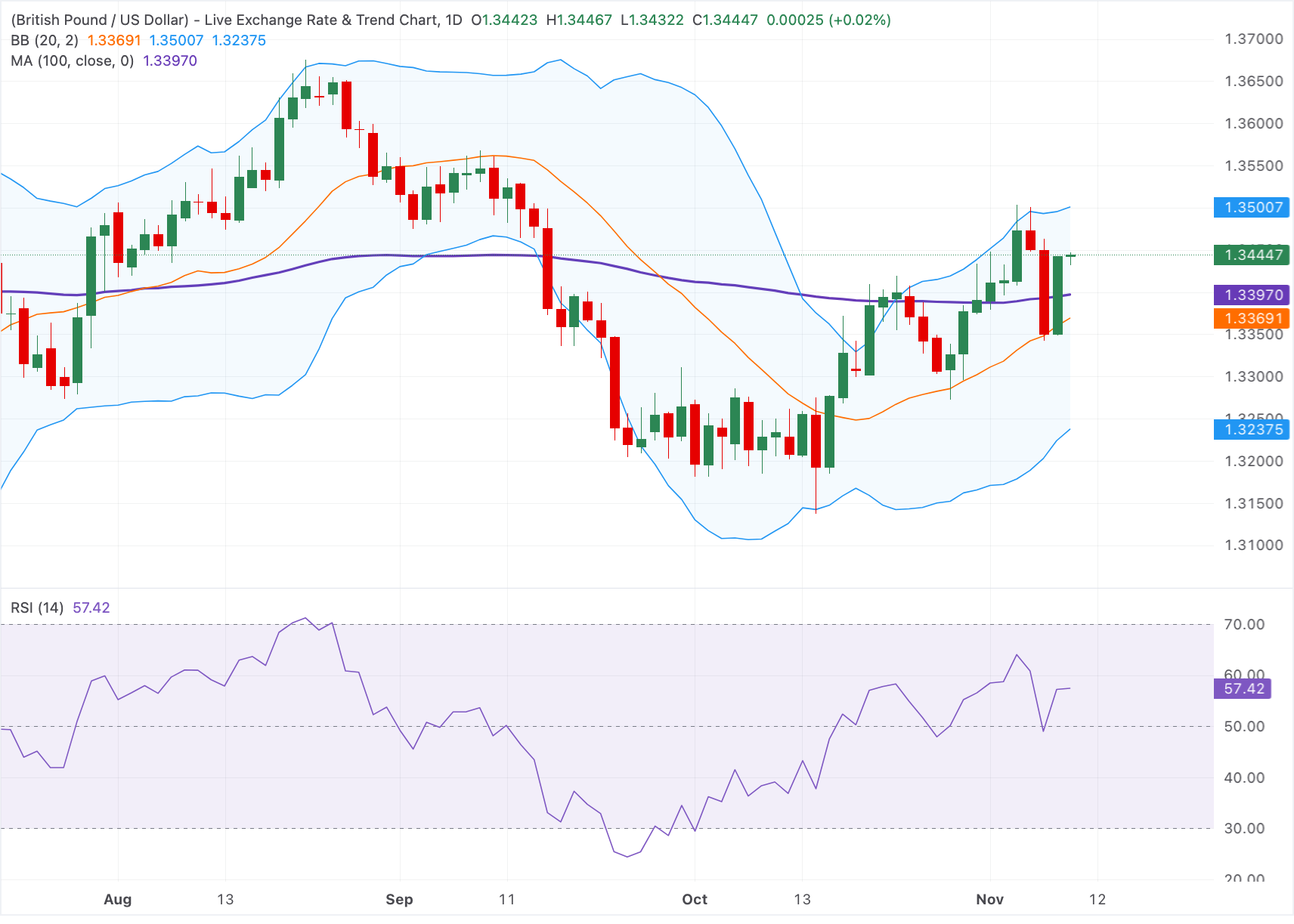
Technical Analysis: GBP/USD maintains a constructive outlook above the 100-day SMA
In the daily chart, GBP/USD holds a modest bullish bias as spot trades above the 100-day simple moving average (SMA) and above the Bollinger middle band, keeping the recent advance underpinned. Price is edging toward the Bollinger upper band, which acts as nearby topside resistance, while a firming Relative Strength Index (RSI) around 57 suggests constructive, but not yet overbought, upside momentum.
On the topside, the upper boundary of Bollinger band at about 1.3500 is the first resistance level to clear. A sustained break above this ceiling would open the door for the September 9 high of 1.3568, en route to the August 21 high of 1.3675.
On the downside, the 100-day SMA at 1.3400 acts as an immediate support level for the cross. Any follow-through selling below this level could expose the Bollinger band mid-line near 1.3370, followed by the October 28 low of 1.3272 and then the lower limit of Bollinger band of 1.3235.
(The technical analysis of this story was written with the help of an AI tool. Know more.)
Pound Sterling FAQs
The Pound Sterling (GBP) is the oldest currency in the world (886 AD) and the official currency of the United Kingdom. It is the fourth most traded unit for foreign exchange (FX) in the world, accounting for 12% of all transactions, averaging $630 billion a day, according to 2022 data. Its key trading pairs are GBP/USD, also known as ‘Cable’, which accounts for 11% of FX, GBP/JPY, or the ‘Dragon’ as it is known by traders (3%), and EUR/GBP (2%). The Pound Sterling is issued by the Bank of England (BoE).
The single most important factor influencing the value of the Pound Sterling is monetary policy decided by the Bank of England. The BoE bases its decisions on whether it has achieved its primary goal of “price stability” – a steady inflation rate of around 2%. Its primary tool for achieving this is the adjustment of interest rates. When inflation is too high, the BoE will try to rein it in by raising interest rates, making it more expensive for people and businesses to access credit. This is generally positive for GBP, as higher interest rates make the UK a more attractive place for global investors to park their money. When inflation falls too low it is a sign economic growth is slowing. In this scenario, the BoE will consider lowering interest rates to cheapen credit so businesses will borrow more to invest in growth-generating projects.
Data releases gauge the health of the economy and can impact the value of the Pound Sterling. Indicators such as GDP, Manufacturing and Services PMIs, and employment can all influence the direction of the GBP. A strong economy is good for Sterling. Not only does it attract more foreign investment but it may encourage the BoE to put up interest rates, which will directly strengthen GBP. Otherwise, if economic data is weak, the Pound Sterling is likely to fall.
Another significant data release for the Pound Sterling is the Trade Balance. This indicator measures the difference between what a country earns from its exports and what it spends on imports over a given period. If a country produces highly sought-after exports, its currency will benefit purely from the extra demand created from foreign buyers seeking to purchase these goods. Therefore, a positive net Trade Balance strengthens a currency and vice versa for a negative balance.
Related Articles