
- AUD/JPY softens to around 109.40 in Friday’s early European session.
- The cross keeps a negative outlook below the 100-day SMA, with bearish RSI momentum.
- The immediate resistance level emerges at 110.00; the initial support level to watch is 109.15.
The AUD/JPY cross trades in negative territory near 109.40 during the early European trading hours on Friday. The Japanese Yen (JPY) edges higher against the Australian Dollar (AUD) as Japan’s Tokyo inflation gauge rose sharply in September, bolstering the case for further interest rate hikes from the Bank of Japan (BoJ).
Data released by the Statistics Bureau of Japan on Friday showed that the headline Tokyo Consumer Price Index (CPI) rose 2.7% in September, versus 1.9% prior. Additionally, Tokyo CPI, excluding fresh food, climbed 2.7% YoY in September, compared to 1.8% in August, above the market consensus of 2.4%. The Tokyo CPI ex Fresh Food, Energy jumped 3.0% YoY in September, compared to the previous reading of 2.0%.
"Core inflation will continue to accelerate as a trend due to rising energy costs from the Middle East conflict and subsequent second-round effects," said Masato Koike, senior economist at Sompo Institute Plus, adding that he anticipated the BoJ to raise its policy interest rate in December.
BoJ caution on rates contrasts with improving Japan business sentiment
Analysts at Rabobank highlight that the BoJ “doesn’t want to keep raising rates rapidly,” with September meeting notes revealing a split Governing Council. While “some hawks” argued for further tightening, others “pointed to weak private consumption and warned against hasty action,” and government representatives “urged weighing the cumulative impact of past rate increases.” However, Rabobank adds that “with the latest Tankan survey the most upbeat for large manufacturers since 2018 the Bank may not have a choice – assuming it is the one choosing, not Bessent,” underscoring the tension between cautious policymakers and increasingly robust corporate sentiment.
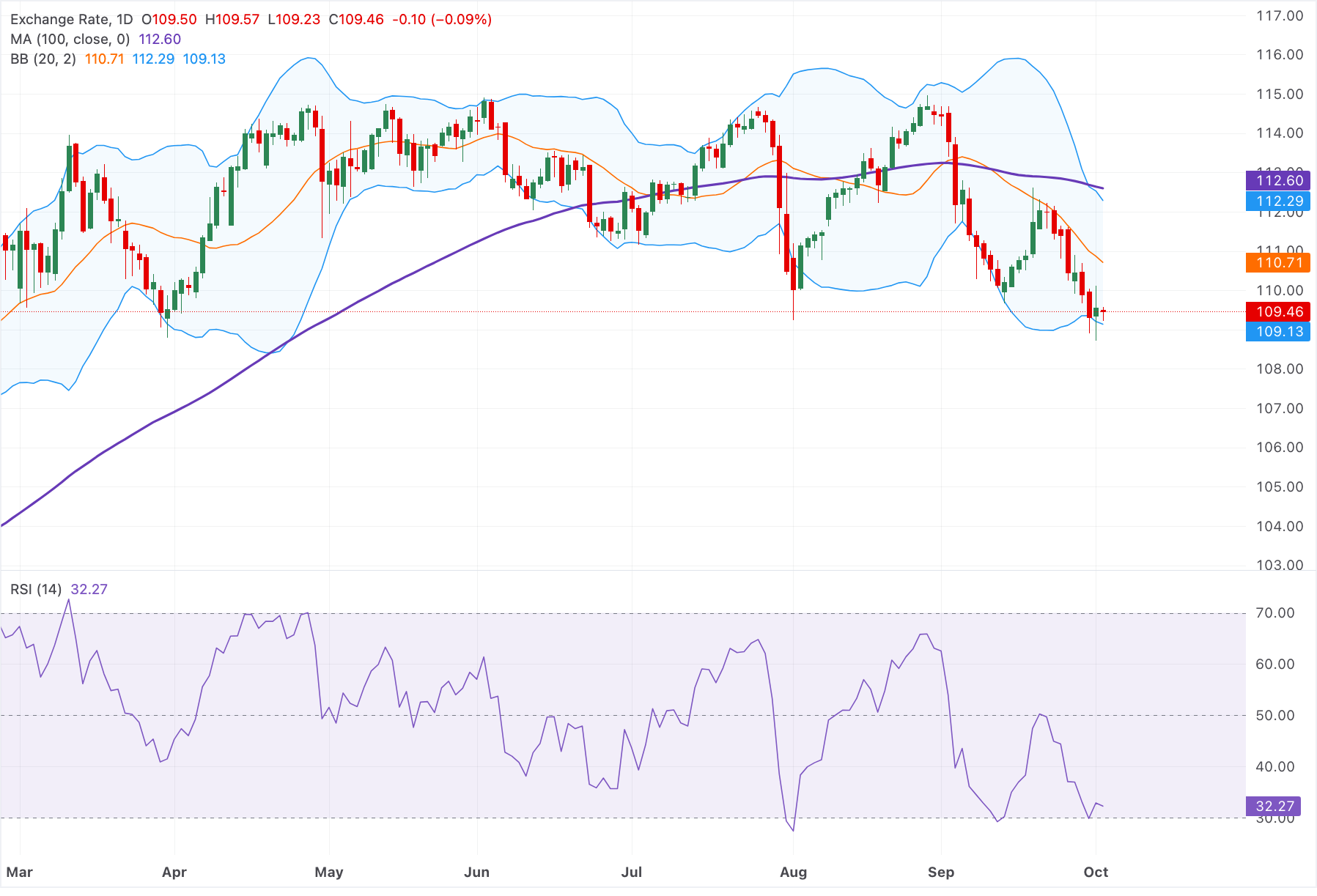
Technical Analysis: Negative tone of AUD/JPY remains intact below the 100-day SMA
In the daily chart, AUD/JPY keeps a bearish near-term tone as spot remains below the 20-period Bollinger middle band and the 100-day simple moving average (SMA). Price is holding closer to the lower end of the Bollinger envelope, while the Relative Strength Index (14) at 32 stays just above oversold territory, hinting that downside momentum is still dominant but could be losing some intensity.
On the topside, initial resistance appears at the 110.00 psychological level, en route to Bollinger SMA middle band near 110.70. Further north, the next hurdle is located at the upper Bollinger band at 112.30 and then the 100-day SMA at 112.60, which together define a broader supply zone capping recovery attempts.
On the downside, the lower limit of Bollinger band at 109.15 offers immediate support. A clean break beneath this level would likely reopen the path toward the October 1 low of 108.71, followed by the February 17 low of 107.69.
(The technical analysis of this story was written with the help of an AI tool. Know more.)
Japanese Yen FAQs
The Japanese Yen (JPY) is one of the world’s most traded currencies. Its value is broadly determined by the performance of the Japanese economy, but more specifically by the Bank of Japan’s policy, the differential between Japanese and US bond yields, or risk sentiment among traders, among other factors.
One of the Bank of Japan’s mandates is currency control, so its moves are key for the Yen. The BoJ has directly intervened in currency markets sometimes, generally to lower the value of the Yen, although it refrains from doing it often due to political concerns of its main trading partners. The BoJ ultra-loose monetary policy between 2013 and 2024 caused the Yen to depreciate against its main currency peers due to an increasing policy divergence between the Bank of Japan and other main central banks. More recently, the gradually unwinding of this ultra-loose policy has given some support to the Yen.
Over the last decade, the BoJ’s stance of sticking to ultra-loose monetary policy has led to a widening policy divergence with other central banks, particularly with the US Federal Reserve. This supported a widening of the differential between the 10-year US and Japanese bonds, which favored the US Dollar against the Japanese Yen. The BoJ decision in 2024 to gradually abandon the ultra-loose policy, coupled with interest-rate cuts in other major central banks, is narrowing this differential.
The Japanese Yen is often seen as a safe-haven investment. This means that in times of market stress, investors are more likely to put their money in the Japanese currency due to its supposed reliability and stability. Turbulent times are likely to strengthen the Yen’s value against other currencies seen as more risky to invest in.