
- AUD/JPY flatlines near 100.05 in Thursday’s early Asian session.
- The negative outlook of the cross prevails below the 100-day SMA, with bearish RSI momentum.
- The first upside barrier emerges at 110.55; the initial support level to watch is 109.00.
The AUD/JPY cross trades on a flat note around 100.05 during the early European trading hours on Thursday. Bank of Japan (BoJ) Governor Kazuo Ueda on Tuesday delivered comments that were less hawkish than markets had expected, which could undermine the Japanese Yen (JPY) against the Australian Dollar (AUD).
On Tuesday, BoJ Governor Kazuo Ueda said that the central bank would "assess the likelihood and risks of the baseline economic and price outlook being realized" when considering the pace and timing of future rate hikes. Meanwhile, BoJ Ayano Sato stated on Wednesday that she supported a gradual approach to raising interest rates in multiple stages.
Market views that the BoJ would take a cautious stance on rate hike at its October monetary policy meeting. Traders are now pricing in nearly a 12% probability of a rate hike this month, down from as high as 40% early last week, according to Bloomberg. The current chance rises to around 90% when the December meeting is included.
On the Aussie front, traders reduce their bets on the Reserve Bank of Australia (RBA) rate increase in the November policy meeting after the latest Consumer Price Index (CPI) came in line with expectations. Former RBA board member Ian Harper said that a further interest rate hike this year is "plausible," but not necessarily likely.
BoJ’s cautious tone tempers hawkish hopes but still chips away at JPY carry appeal
Analysts at Rabobank observe that, “despite announcing an as expected rate hike at its September policy meeting, the BoJ’s guidance was not as hawkish as the market had hoped for.” Even so, they stress that “the BoJ’s policy of gradually raising interest rates is still eroding the JPY’s funding currency appeal,” underscoring that the Yen’s role in traditional carry structures is being steadily undermined despite the central bank’s cautious communication.
BoJ’s Sato backs gradual rate path as price risks edge higher
Sato’s speech score at 6.4/10 matches Sato’s historic average, signaling no major shift in tone but a steady commitment to normalization. Agreement on gradual interest rate adjustment without a preset pace suggests cautious hawkishness, keeping flexibility to respond to evolving data while avoiding market shock.
The emphasis on BoJ independence, even while aligning with proactive fiscal policy, reinforces a message that monetary decisions will not be subordinated to government priorities. Sato’s view that price risks tilt slightly higher due to rising oil costs from Middle East tensions adds a mild upside inflation bias, supporting the case for further gradual tightening and underpinning a modestly supportive backdrop for the YEN in FXS Speechtracker.
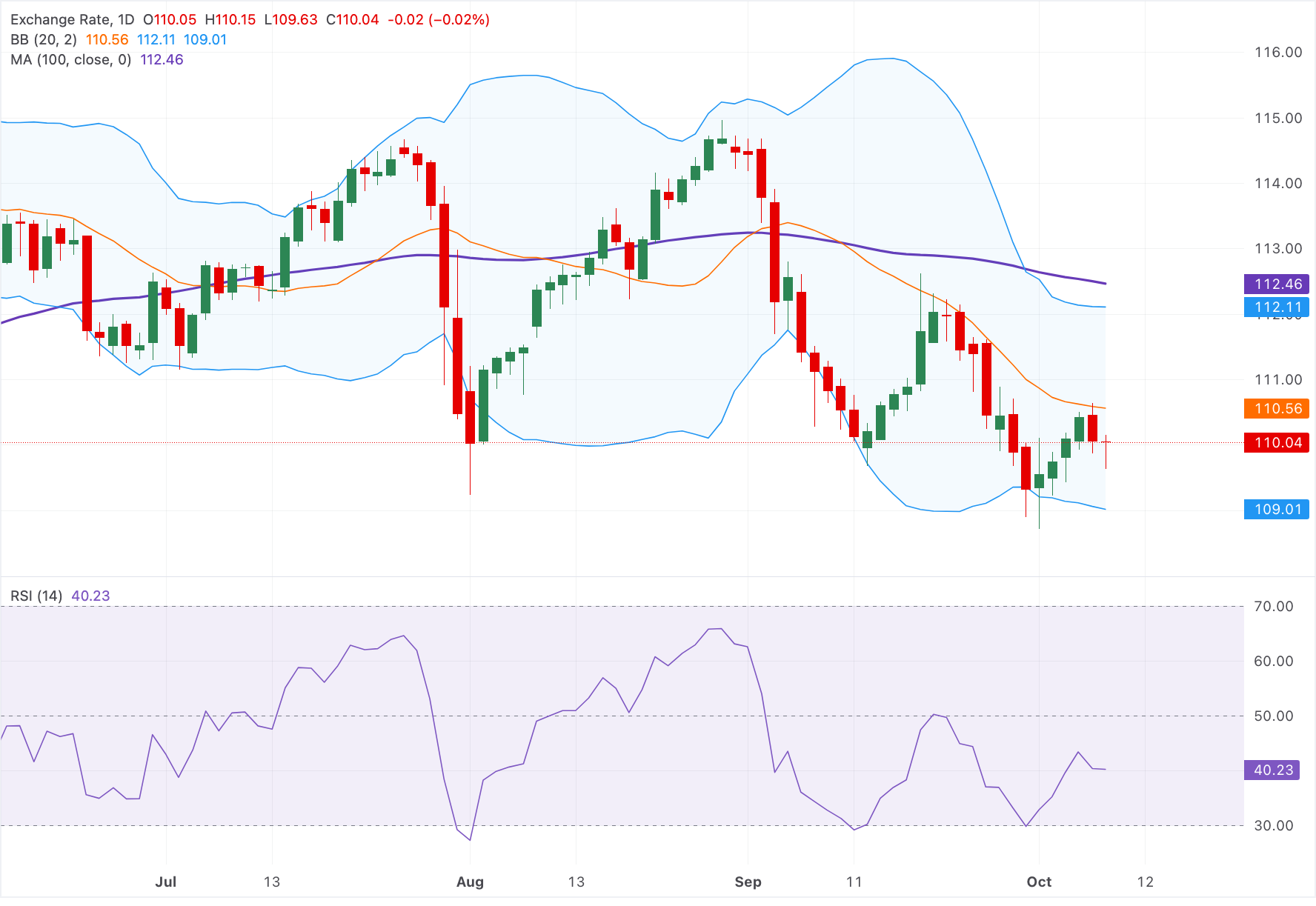
Technical Analysis: AUD/JPY remains capped under the 100-day SMA
In the daily chart, AUD/JPY keeps a bearish tone as it holds below the 100-day simple moving average (SMA) and beneath the Bollinger Bands middle line. Price is also trading under the upper band, suggesting the recent rebound is capped by layered resistance overhead, while the Relative Strength Index (RSI) around 40 points to subdued momentum rather than oversold conditions.
On the topside, initial resistance level appears at the Bollinger Bands middle band at 110.55, en route to the July 3 low of 111.33, and then the upper boundary Bollinger band at 112.10. Any follow-through buying above the mentioned level could pave the way to the 100-day SMA at 112.45, reinforcing a broader supply zone.
On the flip side, the lower limit of Bollinger band at 109.00 acts as the nearest support level. A daily close below this level would likely open the way for a deeper pullback toward the October 1 low of 108.71, followed by the February 13 low of 107.69.
(The technical analysis of this story was written with the help of an AI tool. Know more.)
Japanese Yen FAQs
The Japanese Yen (JPY) is one of the world’s most traded currencies. Its value is broadly determined by the performance of the Japanese economy, but more specifically by the Bank of Japan’s policy, the differential between Japanese and US bond yields, or risk sentiment among traders, among other factors.
One of the Bank of Japan’s mandates is currency control, so its moves are key for the Yen. The BoJ has directly intervened in currency markets sometimes, generally to lower the value of the Yen, although it refrains from doing it often due to political concerns of its main trading partners. The BoJ ultra-loose monetary policy between 2013 and 2024 caused the Yen to depreciate against its main currency peers due to an increasing policy divergence between the Bank of Japan and other main central banks. More recently, the gradually unwinding of this ultra-loose policy has given some support to the Yen.
Over the last decade, the BoJ’s stance of sticking to ultra-loose monetary policy has led to a widening policy divergence with other central banks, particularly with the US Federal Reserve. This supported a widening of the differential between the 10-year US and Japanese bonds, which favored the US Dollar against the Japanese Yen. The BoJ decision in 2024 to gradually abandon the ultra-loose policy, coupled with interest-rate cuts in other major central banks, is narrowing this differential.
The Japanese Yen is often seen as a safe-haven investment. This means that in times of market stress, investors are more likely to put their money in the Japanese currency due to its supposed reliability and stability. Turbulent times are likely to strengthen the Yen’s value against other currencies seen as more risky to invest in.