
- USD/JPY holds positive ground near 158.35 in Wednesday’s early Asian session.
- BoJ board members want more time to gauge how the recent rate hikes have impacted domestic financial conditions.
- Expectations of further Fed rate hike this month fall after weaker US September jobs data.
The USD/JPY pair gathers strength to around 158.35 during the early Asian trading hours on Wednesday. Receding expectations for a rate hike by the Bank of Japan (BoJ) weigh on the Japanese Yen (JPY) against the US Dollar (USD). Traders will closely monitor the Minutes of the Federal Open Market Committee (FOMC) later on Wednesday.
BoJ Governor Kazuo Ueda said on Tuesday that the central bank would "assess the likelihood and risks of the baseline economic and price outlook being realized" when considering the pace and timing of future rate hikes. Market views that the Japanese central bank would take a cautious stance on rate increase at its October monetary policy meeting, weighing on the JPY.
The Bank of Japan's (BoJ) new policymaker Ayano Sato said that she supports the idea of raising interest rates in several stages, Reuters reported on Tuesday.
Pricing in overnight index swaps implies that markets see around a 12% odds of a rate hike this month, down from as high as 40% early last week, according to Bloombegr. The current probability surge to around 90% when the December meeting is included.
On the US’s front, traders reduce their bets on a Federal Reserve (Fed) rate hike this month following the softer-than-expected US jobs data. The US Nonfarm Payrolls (NFP) rose by 29K in September, compared to the 133K increase seen in August, the US Bureau of Labor Statistics (BLS) showed on Friday. This figure came in below the market consensus of 90K. The Unemployment Rate climbed to 4.2% in September from 4.1% in August.
BoJ rate path seen as gradual as Fed tightening bets support elevated USD/JPY
Analysts at Rabobank note that, following the “as expected 25 bps rate rise last month,” market pricing now “suggests only a limited prospect of a policy move at the October 30 meeting, with expectations centring on December for the next policy move.” Even though BoJ Governor Kazuo Ueda reiterated this morning that policymakers intend to “continue raising the policy interest rate” and described the Japanese economy as growing “moderately,” Rabobank argues that “this strengthens the market’s expectation that back-to-back rate hikes BoJ are unlikely.” As they put it, “even so, the Bank is still not widely viewed as being in a position in which back-to-back rate rises are appropriate,” although “this may suggest that a hastened pace of rate hikes is possible, though clearly that depends on how the economy develops in the months ahead.”
On the external side, Rabobank’s house view is that “the market has anticipated too much Fed policy tightening next year.” They contend that, “assuming some Fed rate hike risk is priced out, USD/JPY has the potential to move lower into 2027,” but for now “we maintain a 3-month USD/JPY target of 155.00.” While USD/JPY has moved higher since the September policy meeting, Rabobank highlights that “the market is fearful that a return to levels close to 160, could again trigger further intervention.” Against this backdrop, they judge that the BoJ’s inflation objective “now appears to have reached the point when it can instead shift its focus to stabilising price pressures around the target level,” reinforcing expectations for a measured, rather than aggressive, tightening path.
Fed’s schmid flags ai-driven inflation, keeps fed credibility and short-rate path in focus
Fed’s Schmid delivers a distinctly hawkish tone, with an 8/10 FXS Speechtracker score modestly above the 7.5/10 historical average, underscoring a firmer stance relative to the established baseline. The emphasis that inflation is “frustrating,” that the Fed “still has a way to go,” and that AI is now “one of the largest drivers of inflation” highlights concern about persistent price pressures and emerging structural forces, while the assertion that Fed credibility is at stake and that “the Fed still has work to do on the short rate despite higher long-term yields” signals a willingness to maintain or even tighten policy despite the bond market backdrop.
The FXS Fed Sentiment Index rose by 0.34 points to 137.91, reinforcing that the broader policy tone remains firmly in hawkish territory well above the neutral 100 threshold. This incremental uptick, aligned with the stronger-than-baseline speech score, suggests that Fed communication continues to support a resilient Dollar bias as markets price in a prolonged restrictive stance.
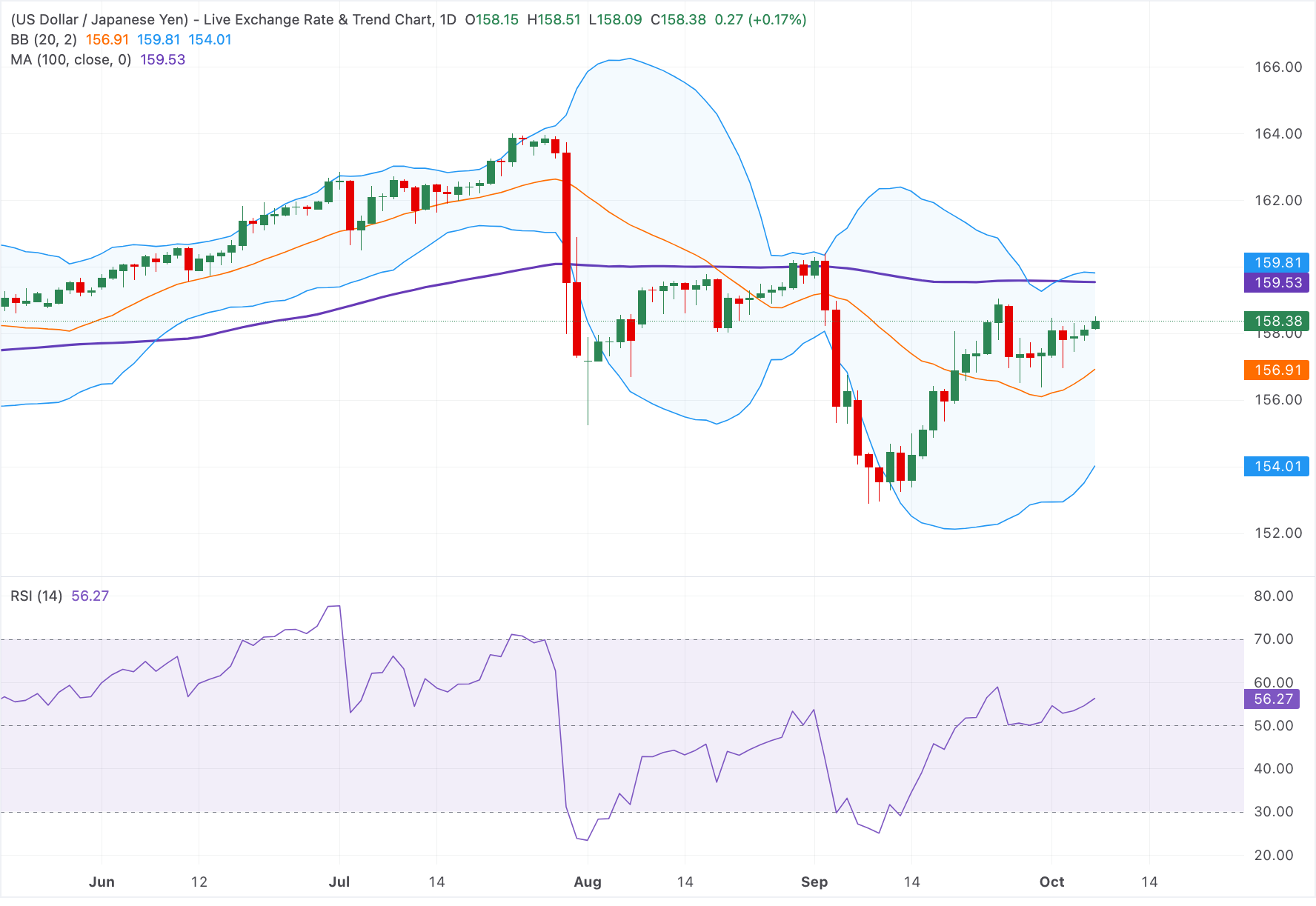
Technical Analysis: USD/JPY keeps a bearish vibe below the 100-day SMA
In the daily chart, USD/JPY remains capped in the near term, with the 100-day simple moving average (SMA) and the upper Bollinger Band forming overhead resistance that restrains recovery attempts. Price holds above the middle Bollinger Band, while the 14-day Relative Strength Index at 56.27 shows moderately constructive momentum that has yet to overcome the prevailing bearish structural bias set by the dominant longer-term average.
On the topside, initial resistance is located at the 100-day SMA at 159.55, followed by the upper Bollinger Band near 159.80. On the downside, immediate support sits at the middle Bollinger Band at 156.90, with a deeper cushion at the lower Bollinger Band around 154.00 should selling pressure reassert below the recent pivot at 158.38.
(The technical analysis of this story was written with the help of an AI tool. Know more.)
Japanese Yen FAQs
The Japanese Yen (JPY) is one of the world’s most traded currencies. Its value is broadly determined by the performance of the Japanese economy, but more specifically by the Bank of Japan’s policy, the differential between Japanese and US bond yields, or risk sentiment among traders, among other factors.
One of the Bank of Japan’s mandates is currency control, so its moves are key for the Yen. The BoJ has directly intervened in currency markets sometimes, generally to lower the value of the Yen, although it refrains from doing it often due to political concerns of its main trading partners. The BoJ ultra-loose monetary policy between 2013 and 2024 caused the Yen to depreciate against its main currency peers due to an increasing policy divergence between the Bank of Japan and other main central banks. More recently, the gradually unwinding of this ultra-loose policy has given some support to the Yen.
Over the last decade, the BoJ’s stance of sticking to ultra-loose monetary policy has led to a widening policy divergence with other central banks, particularly with the US Federal Reserve. This supported a widening of the differential between the 10-year US and Japanese bonds, which favored the US Dollar against the Japanese Yen. The BoJ decision in 2024 to gradually abandon the ultra-loose policy, coupled with interest-rate cuts in other major central banks, is narrowing this differential.
The Japanese Yen is often seen as a safe-haven investment. This means that in times of market stress, investors are more likely to put their money in the Japanese currency due to its supposed reliability and stability. Turbulent times are likely to strengthen the Yen’s value against other currencies seen as more risky to invest in.