
- USD/CAD attracts some dip-buyers during the Asian session, though it lacks bullish conviction.
- Geopolitical risks and a fresh leg up in US bond yields revive USD demand, supporting the pair.
- Recovering oil prices underpin the Loonie, though the divergent BoC-Fed stance caps the upside.
The USD/CAD pair edges higher during the Asian session on Wednesday, stalling the previous day's retracement slide from the vicinity of its highest level since April 2025, touched at the start of this week. Spot prices, however, lack bullish conviction and currently trade just above the 1.4200 mark, up only 0.05% for the day, amid mixed cues.
The US Dollar (USD) attracts some dip-buyers following Tuesday's profit-taking slide and turns out to be a key factor offering some support to the USD/CAD pair. Meanwhile, crude oil prices look to build on the overnight bounce from a one-month low amid concerns over supply disruptions in the Middle East, underpinning the commodity-linked Loonie and capping the upside for the currency pair.
The Saudi-backed Yemeni government claimed control over strategic points along the Red Sea coast, including areas around the Bab al-Mandeb Strait. The Iran-backed Houthi group retaliated by attacking key targets in Saudi Arabia, including an Aramco refinery in Riyadh. Moreover, Iran has ramped up its pace of attacks in the Strait of Hormuz over the past week, keeping the geopolitical risk premium in play.
Adding to this, a fresh leg up in US bond yields helps revive demand for the safe-haven Greenback, which, along with the divergent Bank of Canada (BoC) and the US Federal Reserve (Fed) monetary policy stance, favors USD/CAD bulls. In fact, the BoC has less reason to raise interest rates than the US central bank, as Canada’s weaker economic outlook could contain broader inflationary pressures.
Meanwhile, traders are currently pricing in around an 85% chance that the Fed will raise borrowing costs by the end of this year, though USD bulls might opt to wait for fresh cues about the future policy path. Hence, the focus will be on the release of FOMC meeting Minutes, due later today, which will play a key role in influencing the USD price dynamics and provide some impetus to the USD/CAD pair.
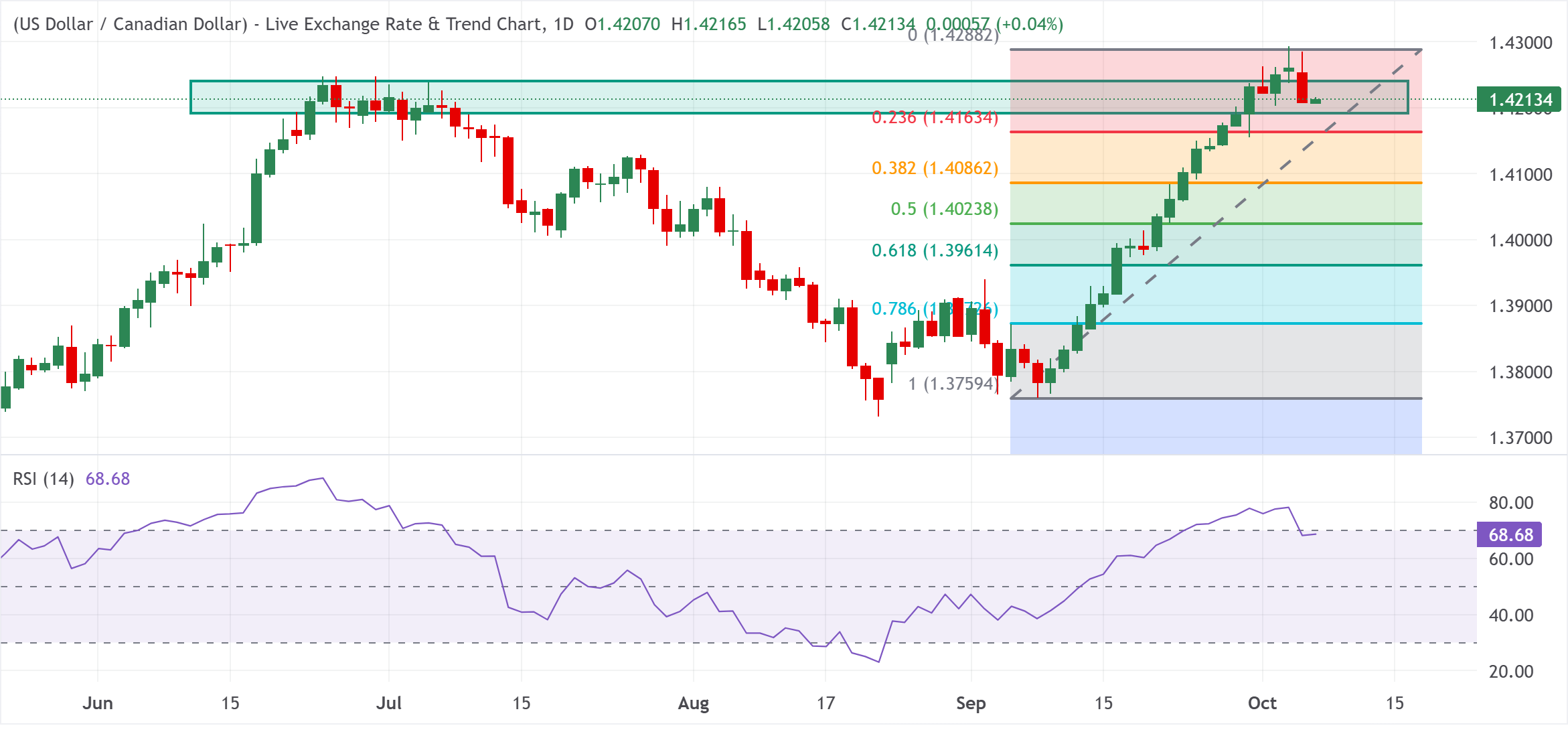
USD/CAD daily chart
Technical Analysis
The overnight fall might still be categorized as a corrective pullback amid the overbought daily Relative Strength Index (RSI), which hints at strong upside momentum rather than an immediate reversal. Moreover, the USD/CAD pair is trading above all visible Fibonacci retracement levels, validating the near-term positive outlook.
Meanwhile, initial support is seen at the 23.6% Fibo. retracement at 1.4163, with deeper pullbacks likely to find buying interest at the 38.2% level at 1.4086 and the 50% retracement at 1.4024. On the topside, the primary hurdle is the structural anchor at 1.4288, a break of which would open the way to fresh highs in the current bullish cycle.
(The technical analysis of this story was written with the help of an AI tool. Know more.)
Canadian Dollar FAQs
The key factors driving the Canadian Dollar (CAD) are the level of interest rates set by the Bank of Canada (BoC), the price of Oil, Canada’s largest export, the health of its economy, inflation and the Trade Balance, which is the difference between the value of Canada’s exports versus its imports. Other factors include market sentiment – whether investors are taking on more risky assets (risk-on) or seeking safe-havens (risk-off) – with risk-on being CAD-positive. As its largest trading partner, the health of the US economy is also a key factor influencing the Canadian Dollar.
The Bank of Canada (BoC) has a significant influence on the Canadian Dollar by setting the level of interest rates that banks can lend to one another. This influences the level of interest rates for everyone. The main goal of the BoC is to maintain inflation at 1-3% by adjusting interest rates up or down. Relatively higher interest rates tend to be positive for the CAD. The Bank of Canada can also use quantitative easing and tightening to influence credit conditions, with the former CAD-negative and the latter CAD-positive.
The price of Oil is a key factor impacting the value of the Canadian Dollar. Petroleum is Canada’s biggest export, so Oil price tends to have an immediate impact on the CAD value. Generally, if Oil price rises CAD also goes up, as aggregate demand for the currency increases. The opposite is the case if the price of Oil falls. Higher Oil prices also tend to result in a greater likelihood of a positive Trade Balance, which is also supportive of the CAD.
While inflation had always traditionally been thought of as a negative factor for a currency since it lowers the value of money, the opposite has actually been the case in modern times with the relaxation of cross-border capital controls. Higher inflation tends to lead central banks to put up interest rates which attracts more capital inflows from global investors seeking a lucrative place to keep their money. This increases demand for the local currency, which in Canada’s case is the Canadian Dollar.
Macroeconomic data releases gauge the health of the economy and can have an impact on the Canadian Dollar. Indicators such as GDP, Manufacturing and Services PMIs, employment, and consumer sentiment surveys can all influence the direction of the CAD. A strong economy is good for the Canadian Dollar. Not only does it attract more foreign investment but it may encourage the Bank of Canada to put up interest rates, leading to a stronger currency. If economic data is weak, however, the CAD is likely to fall.