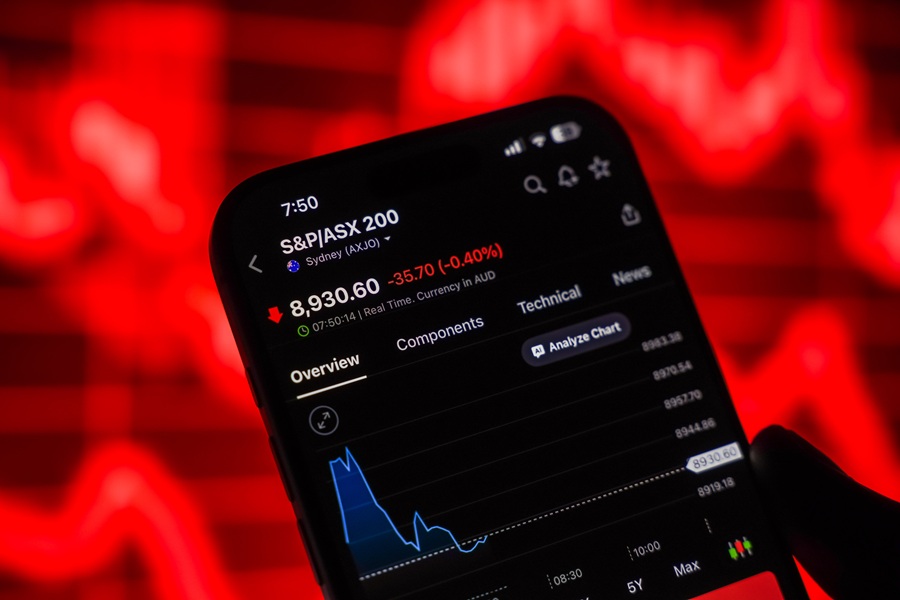
What is the ASX 200? Discover how Australia’s benchmark index works, why banks and miners dominate its weighting, and how Chinese demand moves market prices.
Most traders assume a country's stock index perfectly reflects the health of that country's broader economy. For the ASX 200, that assumption breaks down fast.
Almost a third of the index is composed of banks, and another massive share belongs to mining companies whose fortunes depend heavily on a country on the other side of the world. The ASX 200 is less a picture of how Australia is doing holistically, and more a picture of how Australian banks are performing and how much China wants to buy from Australian miners. Understanding that distinction changes how you read every single ASX 200 move.
Financials and materials dominate the ASX 200 by weight. The index is effectively a concentrated bet on domestic banking conditions and Chinese demand for Australian commodities.
What the ASX 200 actually is
The ASX 200 measures the performance of the 200 largest companies listed on the Australian Securities Exchange. It is weighted by market capitalisation, meaning the largest companies have the most influence over the index's total value.
Retail traders typically access it through CFDs, often labelled as AUS200, or via ETFs and index futures. However, while the mathematical structure is similar to its US counterparts, the types of companies that sit at the top of the Australian index make it a fundamentally different beast.
Tracks top publicly listed companies in Australia, weighted heavily by market capitalisation toward major financials and resource miners.
AUSTRALIAN BENCHMARKTraded via CFDs (AUS200), domestic index ETFs, or ASX index futures contracts for liquid long and short positioning.
TRADABLE INSTRUMENTSWhy banks and miners dominate the index
The defining structural reality of the ASX 200 is severe sector concentration. Financials and materials together make up the substantial majority of the index by weight. It is, in practice, a concentrated bet on just two sectors.
Australia's major banks are among the largest companies in the country by market capitalisation. Their performance is closely tied to domestic interest rate conditions, housing market strength, credit growth, and bad debt levels. Because they are so heavily weighted, when the banking sector moves significantly, it drags the entire index with it, almost regardless of what is happening in healthcare, technology, or consumer goods.
Similarly, Australia is a major global exporter of resources. Its largest mining companies are massive components of the ASX 200. Their profitability is tied directly to global commodity prices, which gives the ASX 200 a massive, built-in exposure to international industrial demand.
Why China matters more than you'd expect
Because the materials sector is so dominant, Chinese economic data can often move the ASX 200 more aggressively than Australian domestic data.
China is the world's largest steel producer and Australia's largest trading partner. When China's manufacturing sector expands, or when the Chinese government announces major infrastructure stimulus or property sector support, demand for Australian iron ore surges. This drives up global commodity prices, which directly boosts the earnings outlook for the ASX 200's largest mining companies.
Conversely, when the Chinese property sector faces stress or manufacturing slows, iron ore prices drop, and the Australian mining sector sells off. This direct demand mechanism is why offshore data is so critical to the local index.
Why the ASX often follows the US overnight
The ASX 200 typically opens with a strong reference to how US markets performed overnight. Because the overnight US session closes before the Australian session opens, the ASX 200 frequently gaps at the open in the exact same direction as the US overnight move.
This gap happens as the market prices in the global risk sentiment changes that occurred while Australia was asleep. During the local session, the market then processes its own domestic news, and that initial gap is either confirmed, extended, or reversed.
What moves the ASX 200
The ASX 200 is driven by four primary forces spanning domestic credit, offshore commodity demand, and global sentiment leads.
Banks represent almost a third of the index. Credit growth and lending margins drive sentiment.
Banks report strong profits, bad debts remain low, credit growth is healthy, and rate conditions support lending margins.
Banks face rising bad debts, credit growth slows, regulatory pressure increases, or compressed margins hurt profitability.
Resource earnings are tied directly to commodity prices set largely by Chinese industrial demand.
Iron ore and metal prices rise, driven by Chinese steel production, infrastructure stimulus, or property recovery.
Iron ore prices fall due to weak Chinese manufacturing, property stress, or steel production cuts.
The US close sets the initial directional tone before Sydney trading begins.
The S&P 500 and Nasdaq close higher overnight, setting a positive global risk tone for the Australian open.
US markets sell off overnight, prompting opening gap declines across local Australian equities.
Two-directional relationship interacting with export revenues and broader risk appetite.
A weaker AUD boosts reported earnings for resource exporters when foreign revenue translates back to local currency.
A stronger AUD pressures exporter earnings, although strong AUD moves often coincide with broader commodity rallies that support miners.
How the ASX 200 connects to the markets you trade
Understanding the ASX 200 means looking at the cross-market forces that drive it on a daily basis.
The AUD/USD pair and the ASX 200 share several common drivers, notably Chinese demand, global risk sentiment, and commodity prices. While they do not always move in lockstep, checking the currency pair alongside the index helps confirm whether a move is genuinely being driven by broader macro themes.
Iron ore is the clearest single confirming indicator for ASX 200 mining sector moves. If the index is rising due to the mining sector, iron ore prices should confirm that direction. If iron ore is flat or falling, the index move is more likely coming from the banking sector or the overnight lead instead.
Checking the overnight US session (the S&P 500) is a standard part of pre-market preparation for ASX traders. It helps distinguish an opening gap driven by global risk sentiment from a genuine local-session move.
The banking sector's immense sensitivity to credit conditions means Reserve Bank of Australia (RBA) rate decisions are a direct driver of a meaningful share of the index. Read how central bank policy moves local assets in our RBA decision weeks playbook.
When the ASX 200 moves most
To effectively trade the ASX 200, pay close attention to specific domestic and international catalysts:
-
Chinese PMI & GDP releases: Manufacturing and growth data out of China directly reprice iron ore demand and major Australian miners.
-
RBA rate meetings: Monetary policy decisions directly alter banking sector credit conditions and consumer debt outlooks.
-
Major bank earnings periods: Profit and bad-debt reports from the big four banks move nearly a third of the index by weight.
-
Overnight US close & iron ore trends: Morning opening gaps take immediate cues from Wall Street closes and global commodity price swings.
The ASX 200 is not a holistic picture of the Australian economy. It is a concentrated snapshot of domestic banking health and Chinese demand for Australian minerals.
Before trading an ASX move, always check whether the momentum is coming from domestic bank credit conditions, Chinese economic stimulus, or an overnight US lead.
Test your knowledge

Disclaimer: Articles are from GO Markets analysts and contributors and are based on their independent analysis or personal experiences. Views, opinions or trading styles expressed are their own, and should not be taken as either representative of or shared by GO Markets. Advice, if any, is of a ‘general’ nature and not based on your personal objectives, financial situation or needs. Consider how appropriate the advice, if any, is to your objectives, financial situation and needs, before acting on the advice. If the advice relates to acquiring a particular financial product, you should obtain our Disclosure Statement (DS) and other legal documents available on our website for that product before making any decisions.