Noticias del mercado & perspectivas
Anticípate a los mercados con perspectivas de expertos, noticias y análisis técnico para guiar tus decisiones de trading.

El anuncio del alto el fuego del 8 de abril y las discusiones paralelas en torno a una tregua de 45 días no han resuelto la interrupción del Estrecho de Ormuz. Por ahora, han puesto un tope al peor escenario posible, pero el tráfico de petroleros se mantiene en una fracción de los niveles normales y la demanda iraní de tarifas de tránsito señala un cambio estructural, no temporal.
Lo que comenzó como un conflicto regional se ha convertido en un shock energético global, y la pregunta para los mercados ya no es si Ormuz fue interrumpido, sino cómo permanentemente la interrupción cambia el piso de precios para el petróleo.
Puntos clave
- Alrededor de 20 millones de barriles por día (bpd) de petróleo y productos derivados del petróleo normalmente pasan por el Estrecho de Ormuz entre Irán y Omán, lo que equivale a aproximadamente una quinta parte del consumo mundial de petróleo y aproximadamente el 30% del comercio mundial de petróleo marítimo.
- Esto es un choque de flujo, no un problema de inventario. Los mercados petroleros dependen del rendimiento continuo, no del almacenamiento de información estático.
- Si la interrupción persiste más allá de unas pocas semanas, el Brent podría pasar de un pico a corto plazo a un shock de precios más amplio, con riesgo de estanflación.
- El tráfico de petroleros a través del estrecho cayó de alrededor de 135 barcos por día a menos de 15 en el pico de interrupción, una reducción de aproximadamente 85%, con más de 150 embarcaciones ancladas, desviadas o retrasadas.
- El 8 de abril se anunció un alto el fuego de dos semanas, con negociaciones de tregua de 45 días en curso. Irán ha señalado por separado una demanda de tarifas de tránsito para los buques que utilizan el estrecho, lo que, de formalizar, representaría un piso geopolítico permanente en los costos de energía.
- Los mercados han comenzado a alejarse del crecimiento y la exposición tecnológica hacia los nombres de energía y defensa, lo que refleja la opinión de que el petróleo elevado se está convirtiendo en un costo estructural en lugar de una prima de riesgo temporal.
El punto de choque petrolero más crítico del mundo
El Estrecho de Ormuz maneja aproximadamente 20 millones de barriles diarios de petróleo y productos derivados del petróleo, lo que equivale a alrededor del 20% del consumo mundial de petróleo y alrededor del 30% del comercio mundial de petróleo marítimo. Con la demanda mundial de petróleo cercana a los 104 millones de bpd y la capacidad sobrante limitada, el mercado ya estaba fuertemente equilibrado antes de la última escalada.
El estrecho también es un corredor crítico para el gas natural licuado. Alrededor de 290 millones de metros cúbicos de GNL transitaron por la ruta cada día en promedio en 2024, lo que representa aproximadamente el 20% del comercio mundial de GNL, siendo los mercados asiáticos el principal destino.
La Agencia Internacional de Energía (AIE) ha descrito a Ormuz como el punto de choque del tránsito petrolero más importante del mundo, señalando que incluso las interrupciones parciales pueden desencadenar movimientos desmedidos de precios. El crudo Brent se ha movido por encima de los 100 dólares el barril, lo que refleja tanto la estanqueidad física como una prima de riesgo geopolítico al alza.

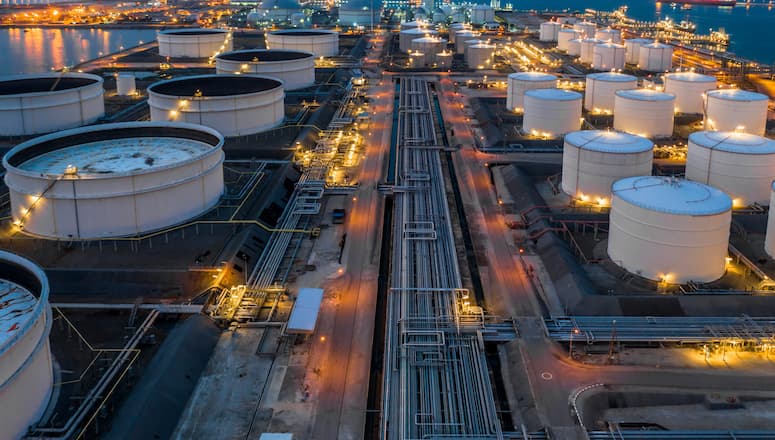
Tanques inactivos a medida que los flujos son lentos
Los datos de envío y seguros ahora apuntan a tensión en tiempo real. Se informa que más de 85 grandes transportistas de crudo están varados en el Golfo Pérsico, mientras que más de 150 embarcaciones han sido ancladas, desviadas o retrasadas a medida que los operadores reevalúan la cobertura de seguridad y seguros. Eso dejaría un estimado de 120 millones a 150 millones de barriles de crudo inactivos en el mar.
Esos volúmenes representan solo de seis a siete días de rendimiento normal de Hormuz, o un poco más de un día de consumo mundial de petróleo.
Los datos actualizados de envío y seguros confirman ahora que más de 150 embarcaciones han sido ancladas, desviadas o retrasadas, por encima de las 85 reportadas inicialmente. Los 1.3 días de cobertura de consumo mundial del crudo inactivo siguen siendo la limitación vinculante: se trata de un shock de flujo, no un problema de almacenamiento, y el alto el fuego aún no se ha traducido en un rendimiento restaurado de manera significativa.
Un mercado basado en el flujo, no en el almacenamiento de información
Los mercados petroleros funcionan en movimiento continuo. Las refinerías, las plantas petroquímicas y las cadenas de suministro mundiales están calibradas para lograr entregas estables a lo largo de rutas marítimas predecibles. Cuando los flujos a través de un punto de choque que lleva aproximadamente una quinta parte del consumo mundial de petróleo y alrededor del 30% del comercio mundial de petróleo marítimo se interrumpen, el sistema puede pasar del equilibrio al déficit en cuestión de días.
La capacidad de producción sobrante, concentrada en gran medida dentro de la OPEP, se estima en sólo 3 millones a 5 millones de bpd. Eso queda muy por debajo de los volúmenes en riesgo si los flujos de Ormuz se ven gravemente perturbados.
Riesgos de inflación y macroderrames
El impacto inflacionario de un choque petrolero suele llegar en oleadas. Los precios más altos del combustible y la energía pueden elevar rápidamente la inflación general a medida que los costos de gasolina, diésel y energía se muevan al alza.
Con el tiempo, los mayores costos de energía pueden pasar por fletes, alimentos, manufactura y servicios. Si la perturbación persiste, la combinación de una inflación elevada y un crecimiento más lento podría elevar el riesgo de un entorno estanflacionario y dejar a los bancos centrales enfrentando una difícil compensación.
Sin compensación fácil, un sistema con poca holgura
Lo que hace que el episodio actual sea particularmente agudo es la falta de holgura en el sistema global.
La oferta y la demanda mundiales cerca de 103 millones a 104 millones de bpd dejan poco colchón de sobra cuando un punto de choque que maneja casi 20 millones de bpd, o cerca de una quinta parte del consumo mundial de petróleo, se ve comprometido. La capacidad sobrante estimada de 3 millones a 5 millones de bpd, en su mayoría dentro de la OPEP, cubriría sólo una fracción de los volúmenes en riesgo.
Las rutas alternativas, incluidas las tuberías que eluden Ormuz y el envío reencaminado, solo pueden compensar parcialmente los flujos perdidos, y generalmente a un costo más alto y con plazos de entrega más largos.
Conclusión
Hasta que se restablezca el tránsito por el Estrecho de Ormuz y se vea como creíblemente seguro, es probable que los flujos mundiales de petróleo sigan deteriorados y las primas de riesgo sean elevadas. Para los inversionistas, los formuladores de políticas y los tomadores de decisiones corporativas, la pregunta central es si el petróleo puede moverse hacia donde necesita ir, todos los días, sin interrupción.


Gold has finally seen some respite in its price after it fell to 12-month lows. With slowing growth forecasts being a key reason as to the drop in price. Recessionary fears can sometimes be good for the price as volatility draws money to gold as it is seen as a haven.
However, with the USD being so strong and investors pulling their money away from Gold, the commodity has struggled to protect its value. The price has shown some interesting action in recent days. The weekly price was able to break through its long terms support at about $1690.
However, as this level was so significant, the price is now retesting zone. In addition, the price has bounced off the 200-week moving average. The 200-week moving average is often seen as an extremely strong support level and rarely gets broken without significant resistance and then combined with the support zone has proven difficult to break down through.
However, the price is no sure thing to continue to bounce. As seen on the chart, the price is also in a consistent downward channel and has so far failed to break through the top of the channel. The daily chart confirms the bounce and shows why the price may have found resistance.
This is because it is currently resting below the 50-day moving average which is acting as long-term resistance and has acted as resistance since May 2022. The question remains, will the price remain at its current level, push up or push down. As more economic data comes out and Central banks either double down on inflation or pivot towards easing interest rates which will hopefully provide some more clarity on which way the price may go.
At this stage it would be best to wait for a confirmation either to the downside or upside of the channel.


The EURAUD buoyed by a weaker Australian Dollar lighter lighter monetary policy from the Reserve Bank of Australia, (RBA) has seen the currency pair move with some momentum in recent days and weeks. The RBA came out in its most recent meeting and raised rates by an unexpectedly low 25 bps vs 50 bps. This helped equities and housing stability but pushed the AUD to very lows levels.
The Euro on the other hand has suffered with geopolitical conflicts and recessionary pressures that have hit major players in the Union. With Germany in particular suffering quite large inflationary issues putting severe pressure on the EUR. After to dipping to as low as 1.42 AUD in both April and August this year, the pair has been able to move back into the major range that the price has been holding since 2013, excluding the commencement of the pandemic.
Technical Analysis The weekly chart as discussed above highlight that this pair does not usually trend and if it does trend it tends not hold the trend for very long. Rather the price tends to hold a range with breaks of range usually the outcome of extreme economic events such as the GFC or the pandemic before retreating into the range. The weekly chart also indicates that the price may be ready to reverse back up as seen by the double bottom pattern that has formed.
The neckline needs to be broken by the price at 1.54 for the pattern to be confirmed. The question is whilst this price is showing signs of a reversal, the price is sitting just on a significant resistance area. The daily chart shows an interesting case for either a breakout or a breakdown.
Firstly, the price has so far not broken out completely and is still consolidating at the neckline. In addition, the price is overbought to a high level and on previous occasions when it was this overbought, it has fallen back down. However, it is possible that the RSI is also just consolidating and getting ready to breakout.
This chart needs a little bit more time to be sure of a direction, however a potential long target if it breaks out to the long side could be 1.60 and to the short side if it fails could be 1.42. With economic still to flow for both Australia and Europe the EURAUD is definitely one to keep an eye on.

Brexit 23rd June 2016 – the day the people of United Kingdom voted to leave the European Union, it’s a day which will go down in the history and will always be remembered. The margin by which people voted to leave was not big (51.9% voted to leave, 48.1% voted to stay) but it will undoubtedly continue to have a big impact on the United Kingdom, European Union and the global financial markets. What does it mean to the UK economy?
Many leading economists before the referendum had been predicting an instant and significant impact on the UK economy and consumer confidence should the country leave the European Union, but so far, these predictions have not been accurate. Latest figures show that UK gross domestic product (GDP) in volume terms was estimated to have increased by 0.7% between Quarter 3 (July to Sept) 2016 and Quarter 4 (Oct to Dec) 2016, revised up 0.1 percentage points from the preliminary estimate of GDP published on 26 January 2017. Upward revisions (due to later data received) within the manufacturing industries is the main reason (these revisions were first published as part of the Index of Production for December 2016 released on 10 February 2017).
UK GDP growth in Quarter 4 2016 saw a continuation of strong consumer spending which is in line with the Retail Sales Index for Quarter 4, which grew by 1.2% (published on 20 January 2017) and strong growth in the output of the services sector with a notable contribution in consumer-focused industries. In Quarter 4 2016, there has been a slowdown within business investment which fell by 1.0%, driven by subdued growth within the “ICT equipment and other machinery and equipment” assets. Quarterly growth and levels of GDP for the UK source: www.ons.gov.uk Currency The pound fell to a to a 31-year low and was on course for its biggest one-day loss in history on the day the people of Britain voted to leave the European Union in June and has been steadily falling against the dollar since the vote.
When Theresa May announced that the UK would begin formal Brexit negations by the end of March, it did not do much to alleviate the concerns of investors about a ‘hard’ Brexit, negatively impacting Sterling once more. But what is keeping the Pound low? It’s uncertainty, uncertainty of how Brexit will turn out.
A notable portion of participants in the Forex market is made up of speculators and the consensus outlook they hold for a currency sometimes has a significant impact on its overall value, regardless of the impact from companies and individuals looking to move money for practical purposes. GBP/USD since the Brexit vote source: www.tradingview.com It is hard to predict to how, when or if, pound sterling will recover but there are some key things to keep an eye out for. > There could be a strong positive movement for pound sterling if the United Kingdom get a favourable exit deal with the European Union. > The Bank of England is not likely going to cut interest rates any further in the near term or put more money in the economy and that will be viewed as signs of confidence in the UK and will most likely make the pound more attractive. > UK Economic data will continue to have a significant impact on Sterling. If enough data suggests that the United Kingdom is in a strong position going into Brexit, for example if companies are continuing to hire and invest in the British economy and not planning to relocate to other EU countries, we should see renewed optimism in Sterling.
Meanwhile, stock markets have been strong since the Brexit vote. The FTSE100 closed at a record high at the end of 2016, up 14.4% during the year. FTSE100 since the Brexit vote Source: www.tradingview.com Key dates this month worth noting in the diary: Tuesday March 7 Deadline to pass the Brexit Bill - The May government wants the Lords to approve the Brexit bill by Tuesday March 7.
It will then need royal assent to become law. Thursday March 9 and Friday March 10 EU Summit: Should the bill pass in time, British Prime Minister May could decide to trigger Article 50 in Brussels. Friday March 31 The Prime Minister has publicly said that she plans to trigger Article 50 by the end of March 2017.
Triggering Article 50 will be followed by the arduous two-year process of the UK's break up with the EU.


Tesla Inc. (NASDAQ: TSLA) reported its Q3 2022 delivery numbers on Sunday. World’s largest automaker delivered a total of 343,830 cars (up by 42.49% year-over-year) in the third quarter – setting a new quarterly record. The deliveries in Q3 consisted of: 18,672 Model S/X 325,158 Model 3/Y The automaker produced 365,923 vehicles in Q3. ''Historically, our delivery volumes have skewed towards the end of each quarter due to regional batch building of cars.
As our production volumes continue to grow, it is becoming increasingly challenging to secure vehicle transportation capacity and at a reasonable cost during these peak logistics weeks. In Q3, we began transitioning to a more even regional mix of vehicle builds each week, which led to an increase in cars in transit at the end of the quarter. These cars have been ordered and will be delivered to customers upon arrival at their destination,'' the company said in the press release.
Tesla will report its Q3 financial results after the closing bell on Wednesday, October 19, 2022. Tesla Inc. (NASDAQ: TSLA) chart Shares of Tesla were down by around 6% on Monday at $247.90 per share. Stock performance 1 month: -1.84% 3 month: +71% Year-to-date: -24.70% 1 year: +65% Tesla price targets JP Morgan: $153 Piper Sandler: $340 Deutsche Bank: $400 Wolfe Research: $360 Jefferies: $350 Morgan Stanley: $383 Wedbush: $360 Tesla is the 6 th largest company in the world and with a total market cap of $825.19 billion.
You can trade Tesla Inc. (NASDAQ: TSLA) and many other stocks from the NYSE, NASDAQ, HKEX and the ASX with GO Markets as a Share CFD. Sources: Tesla Inc., GO Markets MT5, Benzinga, CompaniesMarketCap


The Reserve Bank of Australia, (RBA) has surprised much of the market by raising the country's cash rate by just 25 basis points. With analysts expecting a more aggressive 50 bps hike, the smaller lift will provide relief to much of the country's housing market and equity market. RBA, Chairman, Phillip Lowe outlined how previous rate rises had already begun struggling with the previous rate rises.
International volatility has also become much higher with retirement funds in the UK needing to be bailed out by the Bank of England after the funds found themselves inundated with the liquidity issues due to spikes in yield on many of the UK government bonds that they were holding. With the global financial system so interconnected there was a very real chance that a trillion dollars’ worth of bonds would be exposed without intervention effecting far more then just the UK’s financial system. In addition, worries over both Deutsche Bank and Credit Suisse also being in trouble with their risk of defaulting potentially increasing.
This had the RBA worried that the situation could turn very quickly in Australia and sparked the lower rate. With relatively low rates of inflation the RBA has had more flexibility to adjust the aggressiveness of its hikes as it has gone along and todays changes showed that. The bank still expects inflation for the year to be between 6-7 %.
In response to the hikes the AUD dropped sharply on the news falling by 0.52%. Australian equities saw a large jump increasing by 0.93% for the half an hour after the announcement. With inflation still at elevated levels, there is no guarantee that the lower rate hikes will continue.


I have recently written a piece on the weakening of the Great British Pound (GBP) just the other day, as it looks like the dollar seems to be king at present and getting stronger against all other top currencies around the world. Today is the Chinese Yuan in focus, yesterday was the Sterling pound, who’s your money on tomorrow? We will have to wait and see on that front, but lets quickly dive into why is the Chinese Yuan falling to record lows against the dollar?
The offshore yuan depreciated past 7.2 per dollar, sinking to its lowest levels since data on offshore trading became available in 2011, dragged down by a strong dollar amid expectations for more Federal Reserve rate hikes and a widespread risk aversion in the markets. The yuan also weakened despite efforts by authorities to arrest its slide which are so far having limited impact. In the latest developments, the People’s Bank of China raised the foreign exchange risk reserves for financial institutions when purchasing FX through currency forwards to 20% from the current zero starting on Sept. 28th, making it more expensive to bet against the local currency.
A gloomy domestic outlook also weighed on China’s currency, with Nomura and Goldman Sachs slashing their 2023 economic growth forecast for China sharply, predicting Beijing will stick to its strict zero-COVID strategy well into next year. China’s yuan recovered slightly after falling to a 14-year low against the $$$ Wednesday despite central bank efforts to stem the slide after U.S. interest rate hikes prompted traders to convert money into dollars in search of higher returns. At one point, the yuan fell to 7.2301 to the dollar, its lowest level since January 2008.
One yuan was worth about 13.8 cents, down 15% from its March high. As you can see below, the FEDs strategy has reinforced strength in the dollar, a currency that has been rising to records highs, is now contributing to economic pains in various jurisdictions around the world making more expensive for countries such as China, Japan and UK to name a few, to spend more on importing and making their debt even harder to manage, as they also try to keep on top of inflation by raising interest rates which in turn puts off investors who are looking for value in the market; followed by a run on certain currencies as seen with the GBP to bring it to parity (well almost) with the USD. The Dollar Against the World Currencies (As of 16:40 AEST 29/09/2022) There have been ample opportunities to get involved in the FX markets of late, if it’s not buying the dollar, it is to sell other currencies against it, but tread carefully markets are volatile and a sense of trading responsibly must be heeded.
If you would like to study the trends and take advantages of entry opportunities, you can do so by opening an MetaTrader trading CFD account with GO Markets here or find our contact details in the footer below. Sources: fortune.com, tradingeconomics.com