The information provided is of general nature only and does not take into account your personal objectives, financial situations or needs. Before acting on any information provided, you should consider whether the information is suitable for you and your personal circumstances and if necessary, seek appropriate professional advice. All opinions, conclusions, forecasts or recommendations are reasonably held at the time of compilation but are subject to change without notice. Past performance is not an indication of future performance. Go Markets Pty Ltd, ABN 85 081 864 039, AFSL 254963 is a CFD issuer, and trading carries significant risks and is not suitable for everyone. You do not own or have any interest in the rights to the underlying assets. You should consider the appropriateness by reviewing our TMD, FSG, PDS and other CFD legal documents to ensure you understand the risks before you invest in CFDs. These documents are available here.
Any references to Australian or international shares, sectors, indices, ETFs, crypto-related stocks or other instruments are provided for market commentary and watchlist purposes only and do not constitute a recommendation, offer or solicitation to buy, sell or hold any financial product or adopt any investment strategy. International markets may involve additional risks, including currency fluctuations, regulatory differences, market structure differences, reduced liquidity and higher volatility. Company-specific, sector-specific and macroeconomic risks may also affect performance.
Commentary on geopolitical developments, economic data, central bank decisions, earnings, policy changes and other global or financial market events is based on information available at the time of publication and may change without notice. Such events can lead to sudden market moves, price gaps, reduced liquidity, wider spreads and increased volatility, particularly in leveraged products such as CFDs. Forward-looking statements, expectations and scenario analysis are inherently uncertain and should not be relied on as guarantees of future market behaviour or outcomes.
Dollar Index dips and recovers as the Fed holds with two hike votes

- DXY dips to just above 101.90 on the Fed's hold and recovers to near 102.00.
- Sixteen of 18 Fed officials projected another hike this year in September.
- Fed Chair Warsh takes questions Wednesday, and US GDP and PCE come Thursday.
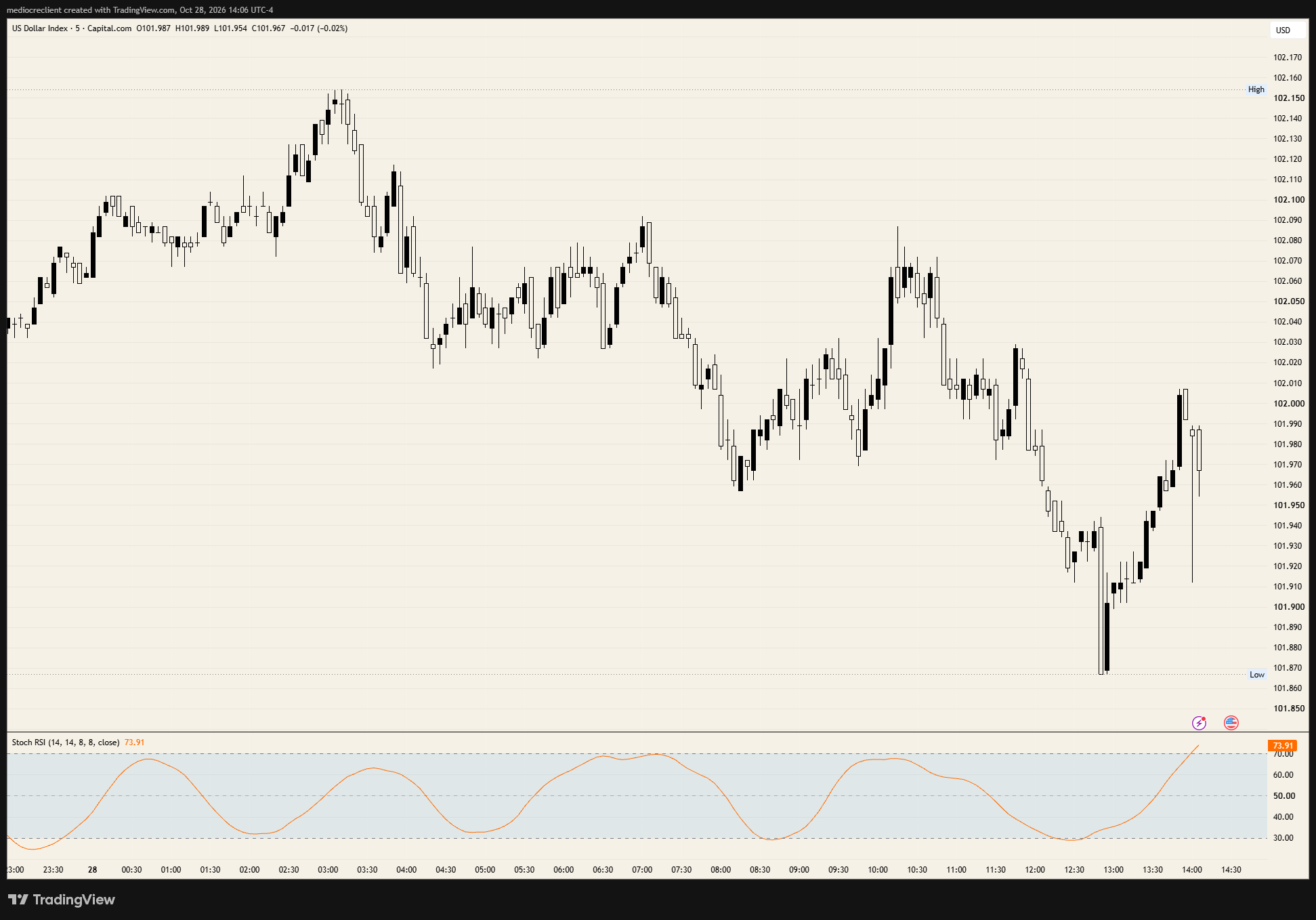
The Fed held at 3.75%-4.00% on Wednesday with two votes for a hike, which leaves December as the last meeting this year for the increase most officials projected. The Dollar Index dipped to just above 101.90 in the statement's five-minute bar and recovered inside it, short of the session low near 101.85 from before the decision. It's trading just under 102.00.
Fed Governor Cook and Cleveland Fed President Hammack voted to raise by a quarter-point, the kind of dissent MUFG had said would firm up bets on a December hike. The statement says inflation remains elevated and gives no timing for the next move, only that more information will help set the policy stance. The Dollar Index came out of it inside the range it traded before the decision.
In September, 16 of the Fed's 18 officials projected at least one more hike this year, and four pencilled in two. With October gone, December is the only meeting left for either, and two hikes there would take a half-point move, last made by the Fed in December 2022. Traders had a December hike near 80% priced before the decision, a bet on the 16 rather than the four.
On the calendar
Third-quarter Gross Domestic Product (GDP) and the September Personal Consumption Expenditures Price Index (PCE) come out on Thursday at 12:30 GMT. They're the first US figures since the hold to bear on December. The European Central Bank (ECB) decides at 13:15 GMT the same day and the Bank of Japan (BoJ) on Friday, for the Euro and Yen that make up about 71% of the index.
Fed Chair Warsh's press conference starts at 18:30 GMT on Wednesday. In Bangkok on October 16 he said he doesn't pre-judge meetings, and with two of his colleagues already voting to hike, his answers on December go straight to the pricing behind the Dollar Index.
On the charts
The index set its session high just above 102.15 in the first half of Wednesday, then fell to the low and won back about half of that drop before the statement. The decision bar's dip and recovery left it below where it started the day. Intraday momentum reached overbought on the climb into the decision.
DXY 5-minute chart
Fed FAQs
Monetary policy in the US is shaped by the Federal Reserve (Fed). The Fed has two mandates: to achieve price stability and foster full employment. Its primary tool to achieve these goals is by adjusting interest rates. When prices are rising too quickly and inflation is above the Fed’s 2% target, it raises interest rates, increasing borrowing costs throughout the economy. This results in a stronger US Dollar (USD) as it makes the US a more attractive place for international investors to park their money. When inflation falls below 2% or the Unemployment Rate is too high, the Fed may lower interest rates to encourage borrowing, which weighs on the Greenback.
The Federal Reserve (Fed) holds eight policy meetings a year, where the Federal Open Market Committee (FOMC) assesses economic conditions and makes monetary policy decisions. The FOMC is attended by twelve Fed officials – the seven members of the Board of Governors, the president of the Federal Reserve Bank of New York, and four of the remaining eleven regional Reserve Bank presidents, who serve one-year terms on a rotating basis.
In extreme situations, the Federal Reserve may resort to a policy named Quantitative Easing (QE). QE is the process by which the Fed substantially increases the flow of credit in a stuck financial system. It is a non-standard policy measure used during crises or when inflation is extremely low. It was the Fed’s weapon of choice during the Great Financial Crisis in 2008. It involves the Fed printing more Dollars and using them to buy high grade bonds from financial institutions. QE usually weakens the US Dollar.
Quantitative tightening (QT) is the reverse process of QE, whereby the Federal Reserve stops buying bonds from financial institutions and does not reinvest the principal from the bonds it holds maturing, to purchase new bonds. It is usually positive for the value of the US Dollar.
Related Articles