The information provided is of general nature only and does not take into account your personal objectives, financial situations or needs. Before acting on any information provided, you should consider whether the information is suitable for you and your personal circumstances and if necessary, seek appropriate professional advice. All opinions, conclusions, forecasts or recommendations are reasonably held at the time of compilation but are subject to change without notice. Past performance is not an indication of future performance. Go Markets Pty Ltd, ABN 85 081 864 039, AFSL 254963 is a CFD issuer, and trading carries significant risks and is not suitable for everyone. You do not own or have any interest in the rights to the underlying assets. You should consider the appropriateness by reviewing our TMD, FSG, PDS and other CFD legal documents to ensure you understand the risks before you invest in CFDs. These documents are available here.
Any references to Australian or international shares, sectors, indices, ETFs, crypto-related stocks or other instruments are provided for market commentary and watchlist purposes only and do not constitute a recommendation, offer or solicitation to buy, sell or hold any financial product or adopt any investment strategy. International markets may involve additional risks, including currency fluctuations, regulatory differences, market structure differences, reduced liquidity and higher volatility. Company-specific, sector-specific and macroeconomic risks may also affect performance.
Commentary on geopolitical developments, economic data, central bank decisions, earnings, policy changes and other global or financial market events is based on information available at the time of publication and may change without notice. Such events can lead to sudden market moves, price gaps, reduced liquidity, wider spreads and increased volatility, particularly in leveraged products such as CFDs. Forward-looking statements, expectations and scenario analysis are inherently uncertain and should not be relied on as guarantees of future market behaviour or outcomes.
Crude Oil barely moves on the Fed hold as Iran weighs a Qatari deal

- WTI barely moves on the Fed hold and stays near $102.00, up from below $100.00.
- US Crude Oil stocks fell 1.9 million barrels, and gasoline gained 3.9 million.
- Iran is expected to answer a Qatari draft deal to end the war by Friday.
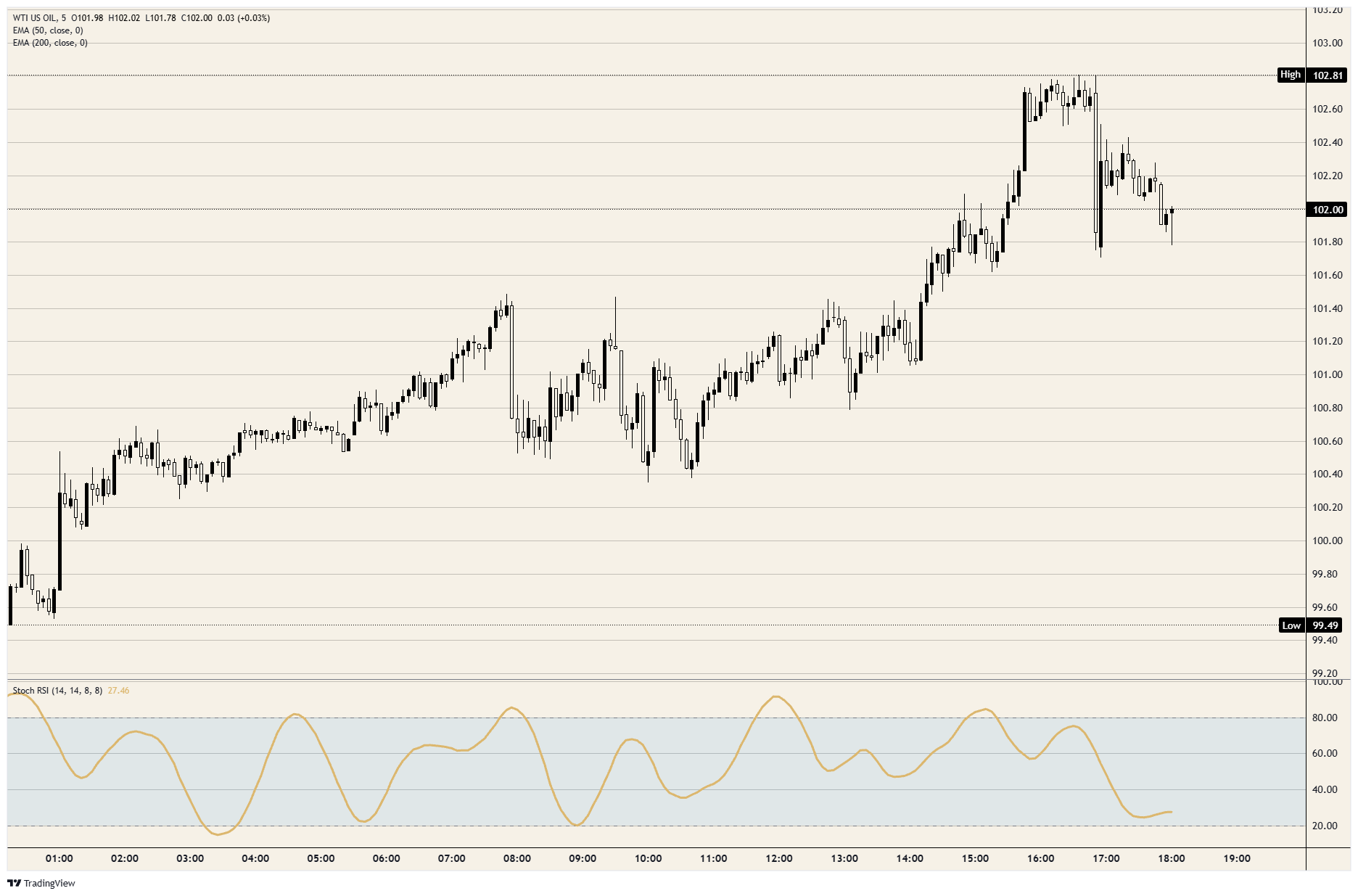
The Fed's hold matters less to Crude Oil than a Qatari draft deal to end the war, which Iran is expected to answer before the weekend. WTI barely moved on the statement and is trading near $102.00, below a session high short of $103.00 from before the decision.
Qatari mediators gave Iran the draft, and an official told Reuters on Wednesday that Tehran is considering it. The Wall Street Journal reported that Washington has told Gulf states to prepare for a possible renewed US campaign against Iran after the November 3 midterms. Either outcome changes how much Gulf Crude Oil reaches buyers, the supply WTI is priced against.
The Energy Information Administration (EIA) said US Crude Oil stocks, the barrels behind WTI, fell 1.9 million in the week to October 23 while gasoline stocks rose 3.9 million. The World Bank expects global supply to fall 5.2% in 2026, the most in over four decades outside 2020. On the same Wednesday, Abu Dhabi National Oil Company (ADNOC) told customers its pipeline around the Strait of Hormuz starts in early 2027.
On the calendar
Tehran's reply to the Qatari draft is expected before the weekend, with no day set. Thursday's 12:30 GMT advance estimate of third-quarter US Gross Domestic Product (GDP) is the week's main read on the US demand behind WTI.
Fed Chair Warsh's Wednesday press conference, at 18:30 GMT, is his first public comment since Fed officials went quiet on October 17. He called inflation uncomfortably high the day before. Whether he blames energy costs spreading into other prices bears on a December hike, which would fall on that same US demand.
On the charts
WTI started Wednesday just under $100.00 and has climbed for most of the session, with one of its larger steps in the bars after the EIA report. It gave back more than half of the climb since that report in a single five-minute bar before the decision. Intraday momentum has turned up from near oversold.
WTI spot 5-minute chart
Interest rates FAQs
Interest rates are charged by financial institutions on loans to borrowers and are paid as interest to savers and depositors. They are influenced by base lending rates, which are set by central banks in response to changes in the economy. Central banks normally have a mandate to ensure price stability, which in most cases means targeting a core inflation rate of around 2%. If inflation falls below target the central bank may cut base lending rates, with a view to stimulating lending and boosting the economy. If inflation rises substantially above 2% it normally results in the central bank raising base lending rates in an attempt to lower inflation.
Higher interest rates generally help strengthen a country’s currency as they make it a more attractive place for global investors to park their money.
Higher interest rates overall weigh on the price of Gold because they increase the opportunity cost of holding Gold instead of investing in an interest-bearing asset or placing cash in the bank. If interest rates are high that usually pushes up the price of the US Dollar (USD), and since Gold is priced in Dollars, this has the effect of lowering the price of Gold.
The Fed funds rate is the overnight rate at which US banks lend to each other. It is the oft-quoted headline rate set by the Federal Reserve at its FOMC meetings. It is set as a range, for example 4.75%-5.00%, though the upper limit (in that case 5.00%) is the quoted figure. Market expectations for future Fed funds rate are tracked by the CME FedWatch tool, which shapes how many financial markets behave in anticipation of future Federal Reserve monetary policy decisions.
Related Articles