The information provided is of general nature only and does not take into account your personal objectives, financial situations or needs. Before acting on any information provided, you should consider whether the information is suitable for you and your personal circumstances and if necessary, seek appropriate professional advice. All opinions, conclusions, forecasts or recommendations are reasonably held at the time of compilation but are subject to change without notice. Past performance is not an indication of future performance. Go Markets Pty Ltd, ABN 85 081 864 039, AFSL 254963 is a CFD issuer, and trading carries significant risks and is not suitable for everyone. You do not own or have any interest in the rights to the underlying assets. You should consider the appropriateness by reviewing our TMD, FSG, PDS and other CFD legal documents to ensure you understand the risks before you invest in CFDs. These documents are available here.
Any references to Australian or international shares, sectors, indices, ETFs, crypto-related stocks or other instruments are provided for market commentary and watchlist purposes only and do not constitute a recommendation, offer or solicitation to buy, sell or hold any financial product or adopt any investment strategy. International markets may involve additional risks, including currency fluctuations, regulatory differences, market structure differences, reduced liquidity and higher volatility. Company-specific, sector-specific and macroeconomic risks may also affect performance.
Commentary on geopolitical developments, economic data, central bank decisions, earnings, policy changes and other global or financial market events is based on information available at the time of publication and may change without notice. Such events can lead to sudden market moves, price gaps, reduced liquidity, wider spreads and increased volatility, particularly in leveraged products such as CFDs. Forward-looking statements, expectations and scenario analysis are inherently uncertain and should not be relied on as guarantees of future market behaviour or outcomes.
Euro slips below 1.1200 as hotter US inflation fuels Fed rate hike bets

- EUR/USD loses ground on Tuesday as stronger-than-expected US inflation boosts demand for the US Dollar.
- US consumer prices rose 0.4% in October, exceeding forecasts of 0.3%, while core inflation remains elevated.
- Markets now see a 99% chance of a Federal Reserve rate hike in December, reinforcing the monetary policy divergence with the Eurozone.
EUR/USD extends its decline on Tuesday, trading around 1.1190, down 0.28% on the day at the time of writing. The pair slips below the psychological 1.1200 level following the release of stronger-than-expected United States (US) inflation data, which reinforces expectations of further monetary tightening by the Federal Reserve (Fed) and supports the US Dollar (USD).
The US Consumer Price Index (CPI), published by the Bureau of Labor Statistics (BLS) on Tuesday, rose 0.4% MoM in October, exceeding market expectations of 0.3%, although slowing from September's 0.6% increase. Meanwhile, the Core CPI, which excludes volatile food and energy prices, increased 0.3%, above forecasts of 0.2% and matching the previous month's reading.
The stronger-than-expected inflation figures reinforce concerns about persistent price pressures in the US economy, strengthening the case for additional interest rate increases. The US Dollar Index (DXY), which measures the Greenback against a basket of six major currencies, gains 0.3% on Tuesday to trade around 102.00 at the time of press, putting additional pressure on EUR/USD.
According to the CME FedWatch tool, financial markets now assign a 99% chance to a 25-basis-point (bps) rate hike at the Fed's December meeting, compared with 84% just one day earlier. Such a move would bring the federal funds target range to 4.00%-4.25%.
These expectations are consistent with a Reuters survey conducted between November 6 and 10, in which all 101 economists anticipate a 25-basis-point increase at the December 9 meeting. However, uncertainty remains over the subsequent monetary policy trajectory, with 56 respondents expecting December to mark the final increase of the current tightening cycle, while 45 foresee at least two additional hikes.
Fed Governor Christopher Waller also reinforced the prospect of further tightening on Tuesday, indicating that he would support a 25-basis-point increase in December even if inflation moderated. He added that a stronger policy response could be necessary if monthly core inflation remained around 0.3% or higher, suggesting that a 50-basis-point increase should also be considered.
Meanwhile, the Euro (EUR) receives some support from improving sentiment toward European sovereign debt. The yield spread between French and German 10-year government bonds has narrowed to approximately 145 basis points, compared with around 175 basis points at its October peak. Nevertheless, political uncertainty and persistent budgetary challenges in France continue to limit the European currency's appeal.
On the monetary policy front, European Central Bank (ECB) Chief Economist Philip Lane indicated that another interest rate increase in December would be prudent if economic conditions remained broadly unchanged. He also expects Eurozone inflation to finish the year slightly above 4%, with underlying inflationary pressures potentially strengthening.
Despite the ECB's relatively hawkish signals, the stronger US inflation figures and the near-certainty of another Fed rate hike are currently favoring the US Dollar. The widening focus on persistent US price pressures could continue to weigh on EUR/USD as investors reassess the interest rate outlook on both sides of the Atlantic.
EUR/USD technical analysis
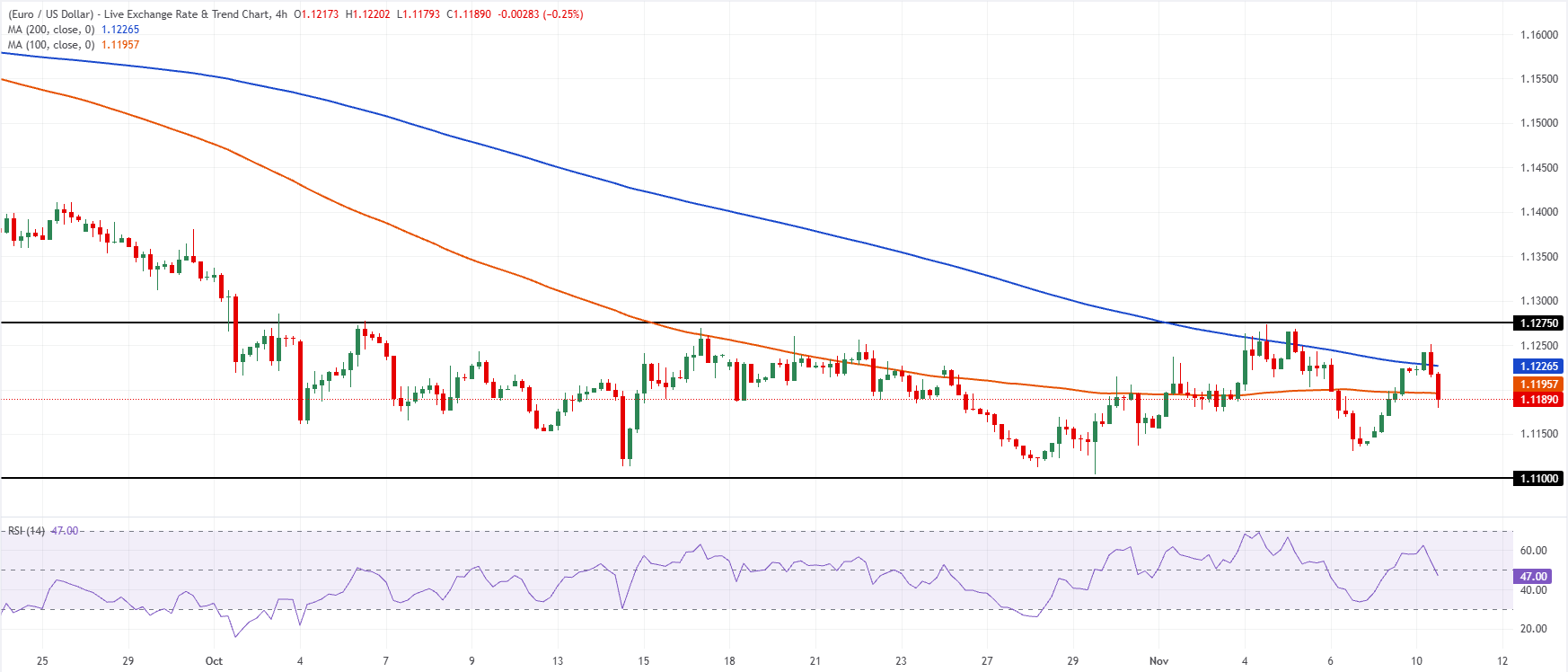
In the four-hour chart, EUR/USD trades at 1.1189, keeping a mildly bearish near-term bias as it holds below the 100-period simple moving average (SMA) at 1.1196 and the 200-period SMA at 1.1227. The pair’s inability to reclaim these overhead averages suggests rallies remain capped for now, while the Relative Strength Index (RSI) near 47 hints at fading momentum rather than outright oversold conditions.
On the topside, initial resistance is seen at the 100-period SMA around 1.1196, followed by the 200-period SMA near 1.1227, with a stronger barrier at the recent horizontal cap near 1.1275. On the downside, the next notable support aligns with the horizontal level around 1.1100, where buyers may look to defend the broader range if selling pressure extends.
(The technical analysis of this story was written with the help of an AI tool. Know more.)
Related Articles