
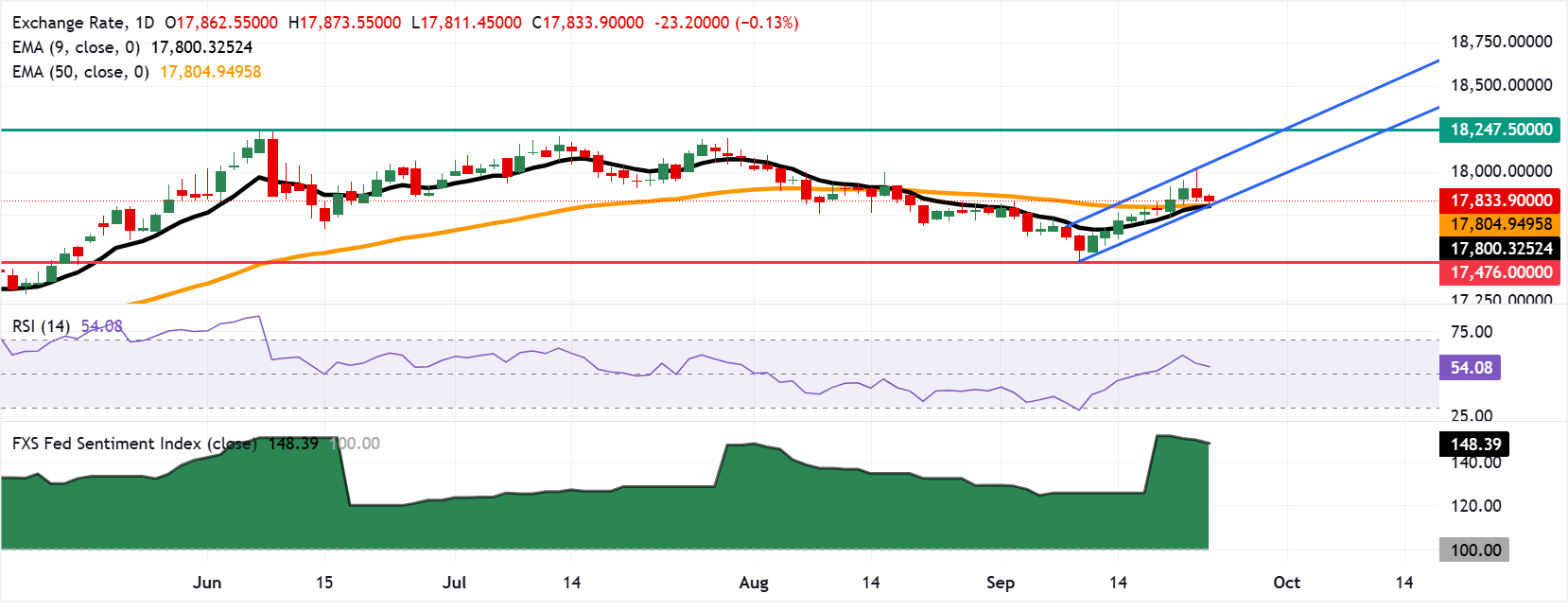
- USD/IDR may rise toward the upper boundary of the ascending channel at 18,060.
- The 14-day Relative Strength Index at 54.08 leans positive without being overbought.
- The pair could test the immediate support at the 50- and nine-day EMAs.
USD/IDR extends its losses for the second successive day, trading around 17,820 during Asian hours on Wednesday. Technical analysis of the daily chart suggests the pair remains within the ascending channel, indicating an ongoing bullish bias. Traders await the Bank Indonesia (BI) interest rate decision due later in the day.
The USD/IDR pair holds a mildly bullish near-term bias as spot remains above both the nine- and 50-day Exponential Moving Averages (EMAs). The 14-day Relative Strength Index (RSI) at 54.08 leans positive without reaching overbought territory, while the elevated FXS Fed Sentiment Index at 148.39 suggests external dollar-supportive factors continue to underpin the pair.
The USD/IDR pair may rebound and explore the region around the upper boundary of the ascending channel at 18,060, followed by the all-time high of 18,247, reached on June 8.
On the downside, the USD/IDR pair may test the immediate support at the 50-day and nine-day EMAs of 17,804 and 17,800, respectively, aligned with the lower boundary of the ascending channel. A successful break below the channel would put downward pressure on the pair to navigate the area around the four-month low of 17,476, recorded on September 9.
Indonesia fiscal discipline underpins Rupiah as Nazara pledges stable bank funding
Analysts at OCBC highlight Indonesia’s continued fiscal prudence, noting that “the January-August deficit stood at a relatively contained 0.93% of GDP.” They add that the authorities are also moving to safeguard financial stability via the banking system, with the government set to “maintain at least IDR200tn of funds in state-owned banks until July 2027.” According to OCBC, Finance Minister Suahasil Nazara has further reassured markets that “any subsequent withdrawal would be communicated carefully to avoid disrupting financial stability,” reinforcing expectations of policy continuity and disciplined fiscal management.
(The technical analysis of this story was written with the help of an AI tool. Know more.)
Risk sentiment FAQs
In the world of financial jargon the two widely used terms “risk-on” and “risk off'' refer to the level of risk that investors are willing to stomach during the period referenced. In a “risk-on” market, investors are optimistic about the future and more willing to buy risky assets. In a “risk-off” market investors start to ‘play it safe’ because they are worried about the future, and therefore buy less risky assets that are more certain of bringing a return, even if it is relatively modest.
Typically, during periods of “risk-on”, stock markets will rise, most commodities – except Gold – will also gain in value, since they benefit from a positive growth outlook. The currencies of nations that are heavy commodity exporters strengthen because of increased demand, and Cryptocurrencies rise. In a “risk-off” market, Bonds go up – especially major government Bonds – Gold shines, and safe-haven currencies such as the Japanese Yen, Swiss Franc and US Dollar all benefit.
The Australian Dollar (AUD), the Canadian Dollar (CAD), the New Zealand Dollar (NZD) and minor FX like the Ruble (RUB) and the South African Rand (ZAR), all tend to rise in markets that are “risk-on”. This is because the economies of these currencies are heavily reliant on commodity exports for growth, and commodities tend to rise in price during risk-on periods. This is because investors foresee greater demand for raw materials in the future due to heightened economic activity.
The major currencies that tend to rise during periods of “risk-off” are the US Dollar (USD), the Japanese Yen (JPY) and the Swiss Franc (CHF). The US Dollar, because it is the world’s reserve currency, and because in times of crisis investors buy US government debt, which is seen as safe because the largest economy in the world is unlikely to default. The Yen, from increased demand for Japanese government bonds, because a high proportion are held by domestic investors who are unlikely to dump them – even in a crisis. The Swiss Franc, because strict Swiss banking laws offer investors enhanced capital protection.