The information provided is of general nature only and does not take into account your personal objectives, financial situations or needs. Before acting on any information provided, you should consider whether the information is suitable for you and your personal circumstances and if necessary, seek appropriate professional advice. All opinions, conclusions, forecasts or recommendations are reasonably held at the time of compilation but are subject to change without notice. Past performance is not an indication of future performance. Go Markets Pty Ltd, ABN 85 081 864 039, AFSL 254963 is a CFD issuer, and trading carries significant risks and is not suitable for everyone. You do not own or have any interest in the rights to the underlying assets. You should consider the appropriateness by reviewing our TMD, FSG, PDS and other CFD legal documents to ensure you understand the risks before you invest in CFDs. These documents are available here.
Any references to Australian or international shares, sectors, indices, ETFs, crypto-related stocks or other instruments are provided for market commentary and watchlist purposes only and do not constitute a recommendation, offer or solicitation to buy, sell or hold any financial product or adopt any investment strategy. International markets may involve additional risks, including currency fluctuations, regulatory differences, market structure differences, reduced liquidity and higher volatility. Company-specific, sector-specific and macroeconomic risks may also affect performance.
Commentary on geopolitical developments, economic data, central bank decisions, earnings, policy changes and other global or financial market events is based on information available at the time of publication and may change without notice. Such events can lead to sudden market moves, price gaps, reduced liquidity, wider spreads and increased volatility, particularly in leveraged products such as CFDs. Forward-looking statements, expectations and scenario analysis are inherently uncertain and should not be relied on as guarantees of future market behaviour or outcomes.
Mexican Peso finds relief in Fed pause bets, but carry risks linger

- USD/MXN falls 0.44% to 18.41 as Peso buyers return.
- Mexico's 250-basis-point rate advantage faces pressure from future Fed hikes.
- US-Mexico trade uncertainty and upcoming Mexican inflation data remain key risks.
The Mexican Peso appreciates against the US Dollar amid speculation that the interest rate differential between Mexico and the US will remain unchanged, with the Federal Reserve projected to hold rates steady at the October meeting. The USD/MNX trades at 18.41, down 0.44%.
USD/MXN retreats toward 18.40 as October Fed hold expectations support the Peso
Recently, USD/MXN has recovered as the Federal Reserve (Fed) raised rates in September to 3.75%-4%, while the Bank of Mexico (Banxico) has finished its tightening cycle and is expected to hold rates at 6.50% in 2026 and 2027. This lifted the pair from around 16.95 towards the yearly high of 18.60 before settling at current exchange rates.
Even though the differential is 250 basis points, growing speculation that the Fed will hike in December and at least twice next year has reduced the Peso’s “carry trade” appeal, which has been supporting the emerging market currency.
Mexico’s President Claudia Sheinbaum said on Monday that during calls with US President Donald Trump, he insisted on pressuring Mexico to buy Natural Gas and to open PEMEX – Mexico’s Oil company – to investment by US companies.
Meanwhile, progress on a US-Mexico tariff and trade deal has halted, the Wall Street Journal (WSJ) reported in a note on October 15.
Ahead, Mexico’s docket will feature Retail Sales and October’s Mid-Month Inflation report.
In the US, there will be no speeches by Fed officials on the economic docket during October’s Federal Open Market Committee (FOMC) blackout period. However, economic data will still be released, including the ADP Employment Change 4-week average, jobless claims, and S&P Global Flash PMIs.
It’s worth noting that White House National Economic Adviser Kevin Hassett told CNBC that inflation “is needing some work.”
USD/MXN Price Forecast: Technical outlook
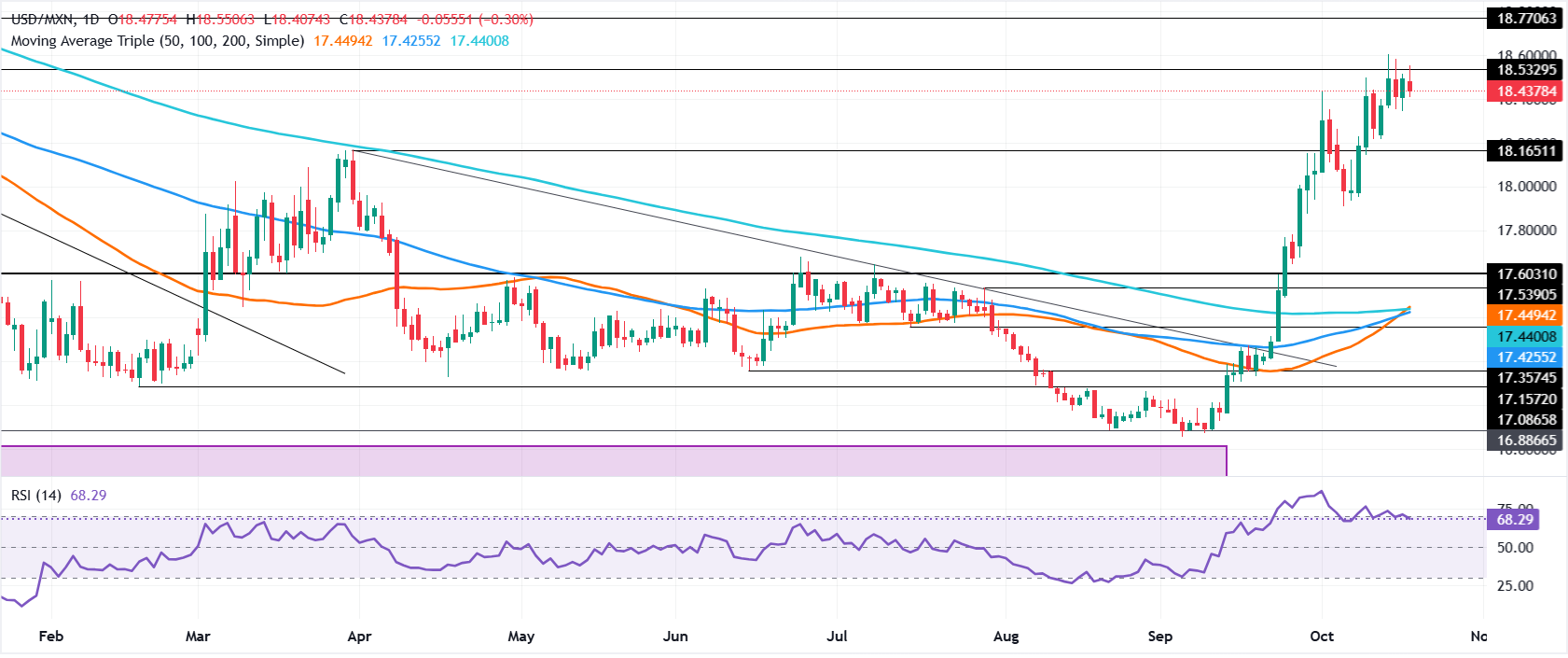
In the daily chart, USD/MXN trades at 18.4378, extending its advance well above the clustered 50/100/200-day Simple Moving Average (SMA) area around 17.4494 and the previously capping downward trend line, now turned support near 18.12. This positioning keeps the near-term bias decisively bullish, with price holding comfortably over all visible structural floors while the 14-day Relative Strength Index (RSI) at 68.29 stays in bullish territory, hinting at strong but gradually stretched upside momentum.
On the downside, initial support is seen around the former trend-line barrier near 18.12, which now acts as the first defensive level on pullbacks. Below that zone, the SMA cluster at roughly 17.45 is the next important base before the more distant horizontal support at 16.89, which together define the broader area that would need to give way to challenge the current bullish structure.
(The technical analysis of this story was written with the help of an AI tool. Know more.)
Mexican Peso FAQs
The Mexican Peso (MXN) is the most traded currency among its Latin American peers. Its value is broadly determined by the performance of the Mexican economy, the country’s central bank’s policy, the amount of foreign investment in the country and even the levels of remittances sent by Mexicans who live abroad, particularly in the United States. Geopolitical trends can also move MXN: for example, the process of nearshoring – or the decision by some firms to relocate manufacturing capacity and supply chains closer to their home countries – is also seen as a catalyst for the Mexican currency as the country is considered a key manufacturing hub in the American continent. Another catalyst for MXN is Oil prices as Mexico is a key exporter of the commodity.
The main objective of Mexico’s central bank, also known as Banxico, is to maintain inflation at low and stable levels (at or close to its target of 3%, the midpoint in a tolerance band of between 2% and 4%). To this end, the bank sets an appropriate level of interest rates. When inflation is too high, Banxico will attempt to tame it by raising interest rates, making it more expensive for households and businesses to borrow money, thus cooling demand and the overall economy. Higher interest rates are generally positive for the Mexican Peso (MXN) as they lead to higher yields, making the country a more attractive place for investors. On the contrary, lower interest rates tend to weaken MXN.
Macroeconomic data releases are key to assess the state of the economy and can have an impact on the Mexican Peso (MXN) valuation. A strong Mexican economy, based on high economic growth, low unemployment and high confidence is good for MXN. Not only does it attract more foreign investment but it may encourage the Bank of Mexico (Banxico) to increase interest rates, particularly if this strength comes together with elevated inflation. However, if economic data is weak, MXN is likely to depreciate.
As an emerging-market currency, the Mexican Peso (MXN) tends to strive during risk-on periods, or when investors perceive that broader market risks are low and thus are eager to engage with investments that carry a higher risk. Conversely, MXN tends to weaken at times of market turbulence or economic uncertainty as investors tend to sell higher-risk assets and flee to the more-stable safe havens.
Related Articles