The information provided is of general nature only and does not take into account your personal objectives, financial situations or needs. Before acting on any information provided, you should consider whether the information is suitable for you and your personal circumstances and if necessary, seek appropriate professional advice. All opinions, conclusions, forecasts or recommendations are reasonably held at the time of compilation but are subject to change without notice. Past performance is not an indication of future performance. Go Markets Pty Ltd, ABN 85 081 864 039, AFSL 254963 is a CFD issuer, and trading carries significant risks and is not suitable for everyone. You do not own or have any interest in the rights to the underlying assets. You should consider the appropriateness by reviewing our TMD, FSG, PDS and other CFD legal documents to ensure you understand the risks before you invest in CFDs. These documents are available here.
Any references to Australian or international shares, sectors, indices, ETFs, crypto-related stocks or other instruments are provided for market commentary and watchlist purposes only and do not constitute a recommendation, offer or solicitation to buy, sell or hold any financial product or adopt any investment strategy. International markets may involve additional risks, including currency fluctuations, regulatory differences, market structure differences, reduced liquidity and higher volatility. Company-specific, sector-specific and macroeconomic risks may also affect performance.
Commentary on geopolitical developments, economic data, central bank decisions, earnings, policy changes and other global or financial market events is based on information available at the time of publication and may change without notice. Such events can lead to sudden market moves, price gaps, reduced liquidity, wider spreads and increased volatility, particularly in leveraged products such as CFDs. Forward-looking statements, expectations and scenario analysis are inherently uncertain and should not be relied on as guarantees of future market behaviour or outcomes.
Japanese Yen recovers from three-week low as intervention risks meet broadly weaker USD

- USD/JPY drifts lower during the Asian session on Wednesday amid a combination of negative factors.
- Intervention risks prompt some JPY short-covering and weigh on spot prices amid fresh USD selling.
- Hopes for Iran diplomacy and sliding US bond yields weigh on the USD ahead of US election results.
The USD/JPY pair attracts some sellers during the Asian session on Wednesday, snapping a two-day winning streak to hit a near three-week top the previous day amid a combination of factors. Spot prices currently trade just below mid-158.00s, down around 0.20% for the day, as traders brace for some volatility stemming from US midterm election results.
Traders remain on high alert amid speculation that Japanese authorities will step in again to prop up the Japanese Yen (JPY), which, along with a weaker US Dollar (USD), exerts some downward pressure on the USD/JPY pair. Japan's Finance Minister Satsuki Katayama said on Monday that the joint FX statement with the US persists and that the government is prepared to act to curb excessive or disorderly weakness in the JPY.
Meanwhile, the optimism over a potential diplomatic resolution to end the US-Iran war undermines the safe-haven Greenback and contributes to the USD/JPY pair's offered tone. In fact, President Donald Trump told the Financial Times on Tuesday that the US has no immediate plans to strike Iran and we seem to be getting everything we want, prompting traders to price out the geopolitical risk premium and weighing on the USD.
Moreover, US government bond yields ease back down as investors monitor early midterm election results amid prospects of Republicans losing their majority in the House of Representatives and possibly in the Senate as well. This further keeps USD bulls on the defensive, though firming hawkish US Federal Reserve (Fed) expectations, bolstered by Tuesday's upbeat US labor market data, could limit deeper losses.
The Labor Department’s monthly Job Openings and Labor Turnover Survey (JOLTS) showed that hiring held relatively steady and job openings rose more than expected in September to 7.5 million from 7.2 million. Adding to this, energy-driven inflation risks back the case for further Fed policy tightening, which warrants some caution before positioning for a further depreciating move for the USD and the USD/JPY pair.
Apart from this, the persistently wide interest rate differential between the US and Japan might cap the lower-yielding JPY, making it prudent to wait for strong follow-through selling before confirming that spot prices have topped out in the near-term. Moving ahead, traders now look to the US ADP report on private-sector employment and the ISM Services PMI for short-term impetus later during the North American session.
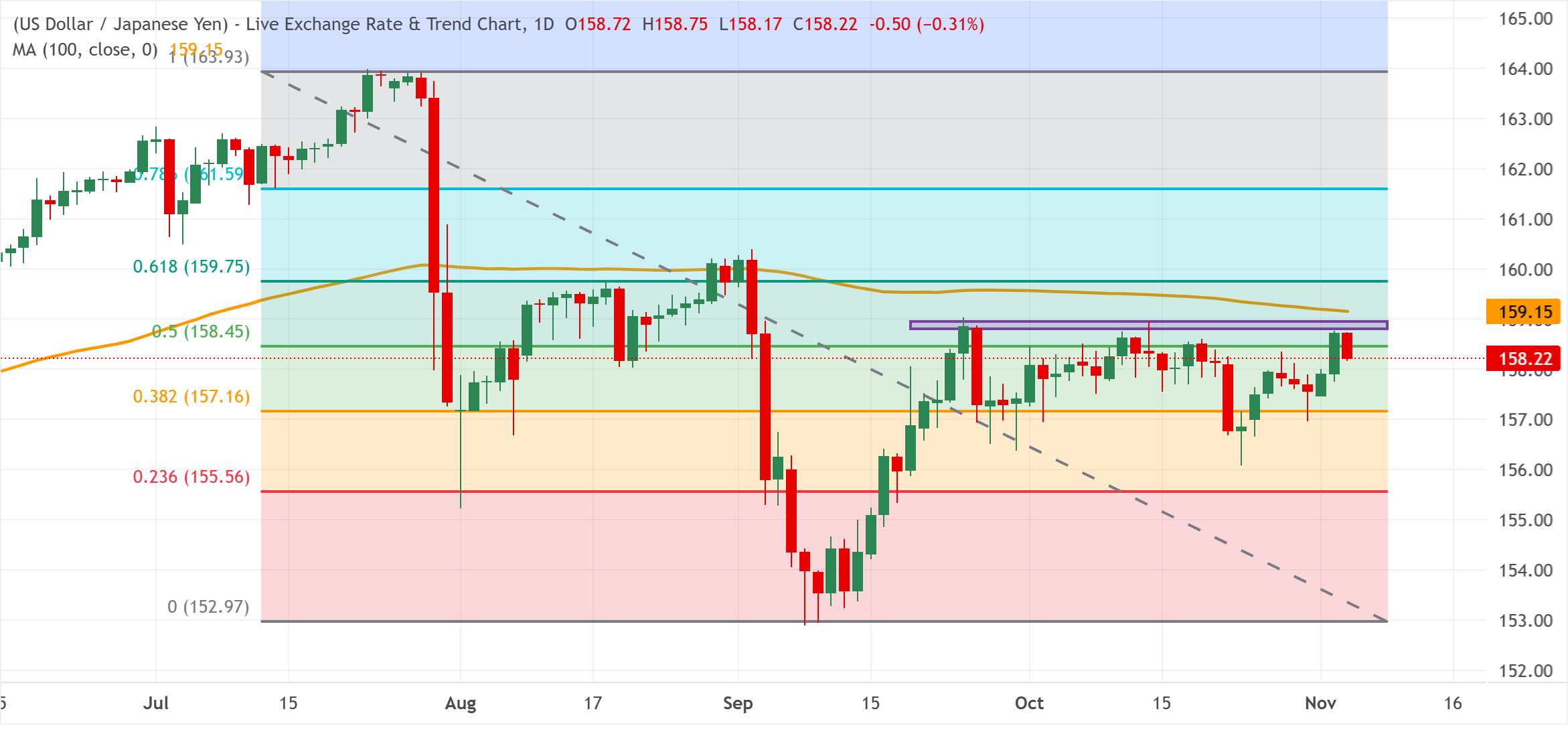
USD/JPY daily chart
Technical Analysis
The USD/JPY pair holds below the 100-day Simple Moving Average (SMA) at 159.15 and the 61.8% Fibonacci retracement at 159.75, which keeps the near-term bias capped and mildly bearish. Price is hovering just under the 50.0% retracement at 158.45, suggesting a pivotal barrier overhead that needs to be reclaimed for any sustainable recovery toward the upper Fibonacci band.
On the downside, initial support emerges at the 38.2% retracement at 157.16, ahead of deeper Fibonacci floors at 155.56 and the structural cycle low near 152.97, where stronger demand could be expected if selling pressure resumes.
(The technical analysis of this story was written with the help of an AI tool. Know more.)
Japanese Yen FAQs
The Japanese Yen (JPY) is one of the world’s most traded currencies. Its value is broadly determined by the performance of the Japanese economy, but more specifically by the Bank of Japan’s policy, the differential between Japanese and US bond yields, or risk sentiment among traders, among other factors.
One of the Bank of Japan’s mandates is currency control, so its moves are key for the Yen. The BoJ has directly intervened in currency markets sometimes, generally to lower the value of the Yen, although it refrains from doing it often due to political concerns of its main trading partners. The BoJ ultra-loose monetary policy between 2013 and 2024 caused the Yen to depreciate against its main currency peers due to an increasing policy divergence between the Bank of Japan and other main central banks. More recently, the gradually unwinding of this ultra-loose policy has given some support to the Yen.
Over the last decade, the BoJ’s stance of sticking to ultra-loose monetary policy has led to a widening policy divergence with other central banks, particularly with the US Federal Reserve. This supported a widening of the differential between the 10-year US and Japanese bonds, which favored the US Dollar against the Japanese Yen. The BoJ decision in 2024 to gradually abandon the ultra-loose policy, coupled with interest-rate cuts in other major central banks, is narrowing this differential.
The Japanese Yen is often seen as a safe-haven investment. This means that in times of market stress, investors are more likely to put their money in the Japanese currency due to its supposed reliability and stability. Turbulent times are likely to strengthen the Yen’s value against other currencies seen as more risky to invest in.
Related Articles