
- EUR/USD softens to near 1.1235 in Friday’ Asian session.
- Concerns about the French fiscal trajectory weigh on the Euro.
- Fed's Logan called for '50 bps or more' in rate hikes.
- US September employment data will be in the spotlight on Friday.
The EUR/USD pair declines to around 1.1235 during the Asian trading hours on Friday. The Euro (EUR) extends its downside on French fiscal concerns. The US jobs report for September will take center stage later on Friday.
French 10-year government bond yields retreat after reaching their highest level since 2002 in the previous session. This action came after the French government unveiled its 2027 budget amid deepening concern surrounding France’s fiscal outlook. Additionally, a renewed rise in oil prices on a prolonged US-Iran war is driving yields higher as elevated inflation.
"Clearly the market is not pricing for a hawkish Fed," said Prashant Newnaha, senior rates strategist at TD Securities. "This is a flight-to-safety move spurred on by developments in Europe. In this scenario expect the dollar index and the yen to strengthen at the same time,” Newnaha added.
Hawkish signals from the Federal Reserve (Fed) officials and an extended rise in US Treasury yields underpin the Greenback. Dallas Fed President Lorie Logan said on Thursday that the central bank will need to raise short-term borrowing costs by at least 50 basis points (bps) to turn monetary policy "modestly restrictive" and get inflation back on track to the Fed’s 2% target.
Markets are now pricing in nearly a 24.9% probability of a Fed rate hike in October and a 79.4% odds of an increase in December, according to the CME FedWatch Tool.
Traders await the US September employment data on Friday for more clues about the US interest rate outlook. The US Nonfarm Payrolls (NFP) is projected to show an increase of 90,000 job additions in September, while the Unemployment Rate is projected to stay unchanged at 4.1% during the same period. Any signs of weakening in the US labor market could drag the Greenback lower and act as a tailwind for the major pair.
Euro struggles to capitalise on ECB hawkishness as US Dollar resilience persists
Analysts at Rabobank argue that the “turnaround from expectations of Fed easing to Fed tightening can account for much of the USD’s strong performance during the summer and into last month.” They add that the “lacklustre performance of the EUR has also played a part in driving EUR/USD in the months since the war commenced,” noting that, just as the earlier “attraction of the single currency likely underpinned flows out of the USD during parts of 2025,” the Euro’s “inability to draw strength from the hawkish position of the ECB since the start of the Iran war has likely helped underpin the USD.”
According to Rabobank, this disconnect reflects mounting concerns on the European side. They point out that “even though the ECB brought forward its tightening cycle, and despite the resilience of the Eurozone economy this year, the market is concerned about growth risks in view of the Eurozone’s position as an energy importer.” In their view, “European political uncertainties are also likely contributing to the EUR’s lacklustre performance,” compounding the currency’s struggle to benefit from monetary policy support.
Logan’s hawkish tilt lifts Fed expectations and supports the Dollar
Fed’s Logan delivered a notably more hawkish message, with a FXS Speechtracker score of 9.2 versus a historical average of 8.1, underscoring a stronger tightening bias relative to the established baseline. The emphasis that higher long-term yields may partly reflect rising term premiums, thereby reducing the need for additional tightening, sits in tension with explicit calls for at least 50 bps more in rate hikes and several further moves to revive price stability, reinforcing a clear hawkish tone for the Dollar. Logan’s characterization of policy as not yet restrictive, alongside a strengthening economic expansion and balanced labor market, signals scope for further rate increases despite ongoing uncertainty about the terminal rate needed to secure 2% inflation.
The FXS Fed Sentiment Index rose by 1.68 points to 136.59, confirming a deeper move into hawkish territory well above the neutral 100 threshold. This upward shift in the FXS Fed Sentiment Index, aligned with the elevated FXS Speechtracker score, points to rising market expectations for additional Fed tightening, a supportive backdrop for the Dollar against major peers.
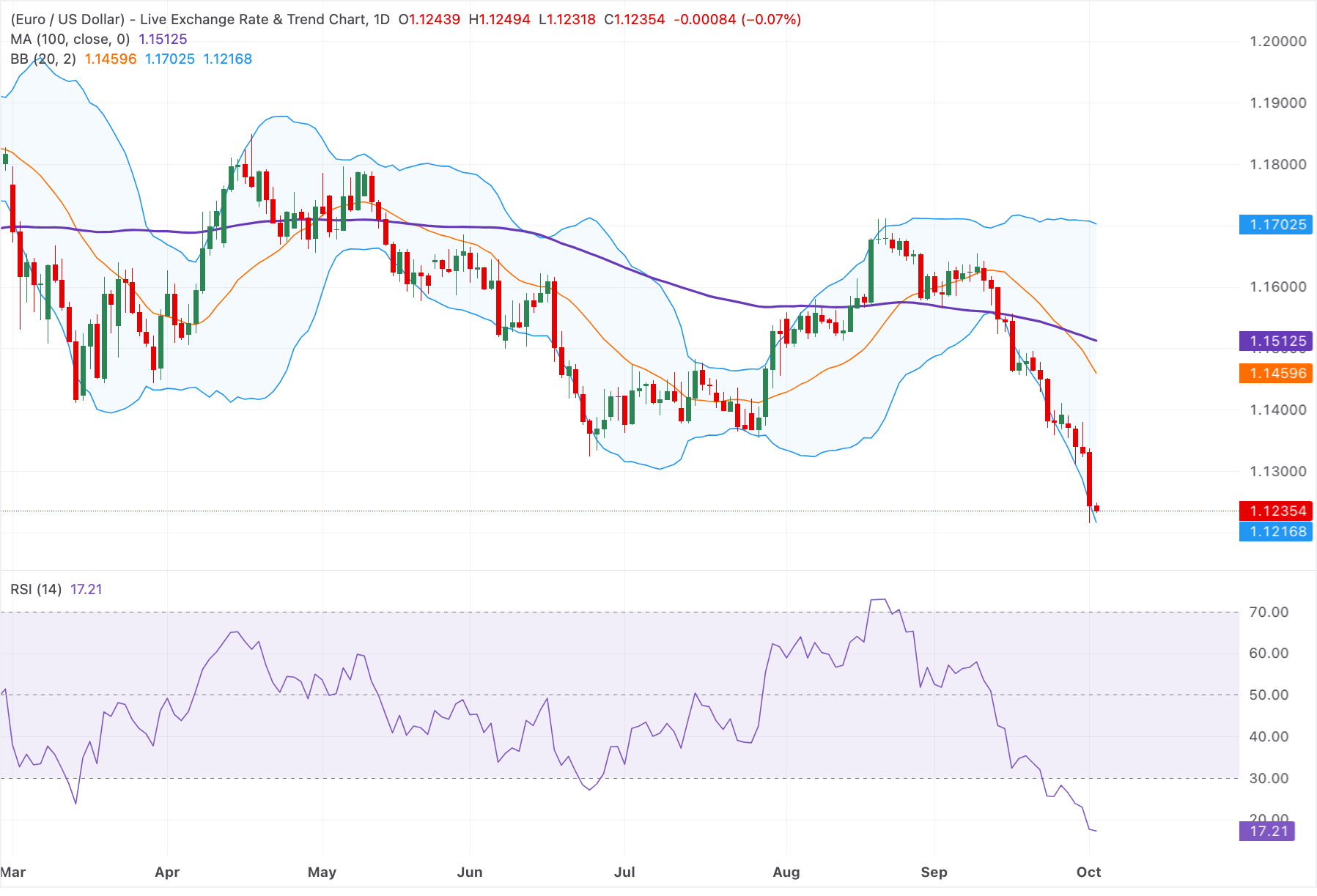
Technical Analysis: EUR/USD keeps a bearish vibe amid oversold conditions
In the daily chart, EUR/USD extends its slide well below the Bollinger Bands (20, 2) middle band and the 100-day simple moving average (SMA), which together suggest a firmly bearish near-term structure with the pair capped by layered overhead resistance. The price is now closer to the Bollinger lower band, while the Relative Strength Index (14) at 17.21 sits deep in oversold territory, hinting that downside momentum remains strong even as the risk of a corrective bounce increases.
On the topside, initial resistance emerges at the Bollinger middle band near 1.1460, followed by the 100-day SMA around 1.1515, with a more distant barrier at the Bollinger upper band near 1.1705, where stronger selling interest would be expected if recovery attempts gain traction. On the downside, immediate support is aligned with the Bollinger lower band at 1.1215; a sustained break beneath this floor would open the way for a continuation of the bearish trend, while holding above it could allow EUR/USD to consolidate before attempting to retest the nearby resistance band.
(The technical analysis of this story was written with the help of an AI tool. Know more.)
Euro FAQs
The Euro is the currency for the 20 European Union countries that belong to the Eurozone. It is the second most heavily traded currency in the world behind the US Dollar. In 2022, it accounted for 31% of all foreign exchange transactions, with an average daily turnover of over $2.2 trillion a day. EUR/USD is the most heavily traded currency pair in the world, accounting for an estimated 30% off all transactions, followed by EUR/JPY (4%), EUR/GBP (3%) and EUR/AUD (2%).
The European Central Bank (ECB) in Frankfurt, Germany, is the reserve bank for the Eurozone. The ECB sets interest rates and manages monetary policy. The ECB’s primary mandate is to maintain price stability, which means either controlling inflation or stimulating growth. Its primary tool is the raising or lowering of interest rates. Relatively high interest rates – or the expectation of higher rates – will usually benefit the Euro and vice versa. The ECB Governing Council makes monetary policy decisions at meetings held eight times a year. Decisions are made by heads of the Eurozone national banks and six permanent members, including the President of the ECB, Christine Lagarde.
Eurozone inflation data, measured by the Harmonized Index of Consumer Prices (HICP), is an important econometric for the Euro. If inflation rises more than expected, especially if above the ECB’s 2% target, it obliges the ECB to raise interest rates to bring it back under control. Relatively high interest rates compared to its counterparts will usually benefit the Euro, as it makes the region more attractive as a place for global investors to park their money.
Data releases gauge the health of the economy and can impact on the Euro. Indicators such as GDP, Manufacturing and Services PMIs, employment, and consumer sentiment surveys can all influence the direction of the single currency. A strong economy is good for the Euro. Not only does it attract more foreign investment but it may encourage the ECB to put up interest rates, which will directly strengthen the Euro. Otherwise, if economic data is weak, the Euro is likely to fall. Economic data for the four largest economies in the euro area (Germany, France, Italy and Spain) are especially significant, as they account for 75% of the Eurozone’s economy.
Another significant data release for the Euro is the Trade Balance. This indicator measures the difference between what a country earns from its exports and what it spends on imports over a given period. If a country produces highly sought after exports then its currency will gain in value purely from the extra demand created from foreign buyers seeking to purchase these goods. Therefore, a positive net Trade Balance strengthens a currency and vice versa for a negative balance.