The information provided is of general nature only and does not take into account your personal objectives, financial situations or needs. Before acting on any information provided, you should consider whether the information is suitable for you and your personal circumstances and if necessary, seek appropriate professional advice. All opinions, conclusions, forecasts or recommendations are reasonably held at the time of compilation but are subject to change without notice. Past performance is not an indication of future performance. Go Markets Pty Ltd, ABN 85 081 864 039, AFSL 254963 is a CFD issuer, and trading carries significant risks and is not suitable for everyone. You do not own or have any interest in the rights to the underlying assets. You should consider the appropriateness by reviewing our TMD, FSG, PDS and other CFD legal documents to ensure you understand the risks before you invest in CFDs. These documents are available here.
Any references to Australian or international shares, sectors, indices, ETFs, crypto-related stocks or other instruments are provided for market commentary and watchlist purposes only and do not constitute a recommendation, offer or solicitation to buy, sell or hold any financial product or adopt any investment strategy. International markets may involve additional risks, including currency fluctuations, regulatory differences, market structure differences, reduced liquidity and higher volatility. Company-specific, sector-specific and macroeconomic risks may also affect performance.
Commentary on geopolitical developments, economic data, central bank decisions, earnings, policy changes and other global or financial market events is based on information available at the time of publication and may change without notice. Such events can lead to sudden market moves, price gaps, reduced liquidity, wider spreads and increased volatility, particularly in leveraged products such as CFDs. Forward-looking statements, expectations and scenario analysis are inherently uncertain and should not be relied on as guarantees of future market behaviour or outcomes.
EUR/USD Price Forecast: Holds gains near 1.1230 on softer USD; bearish bias persists

- EUR/USD gains follow-through traction as the overnight slide in US bond yields weighs on the USD.
- Geopolitical risks and a hawkish Fed limit USD losses, while France’s debt crisis caps the Euro.
- The bearish technical setup also warrants caution before positioning for any further appreciation.
The EUR/USD pair attracts buyers for the second straight day, rising to the 1.1225-1.1230 area during the Asian session on Friday amid a weak US Dollar (USD). Spot prices, however, remain confined within a range held since the beginning of this month, warranting some caution for bulls.
President Donald Trump said on Thursday that the US would refrain from resuming military strikes on Iran before the November 3 midterm elections, which, along with the overnight slide in US bond yields, prompts some USD profit-taking. The geopolitical risk premium, however, remains in play amid the US-Iran standoff over Tehran's nuclear program. Moreover, the US Federal Reserve's (Fed) hawkish tilt should help limit deeper USD losses and cap the EUR/USD pair.
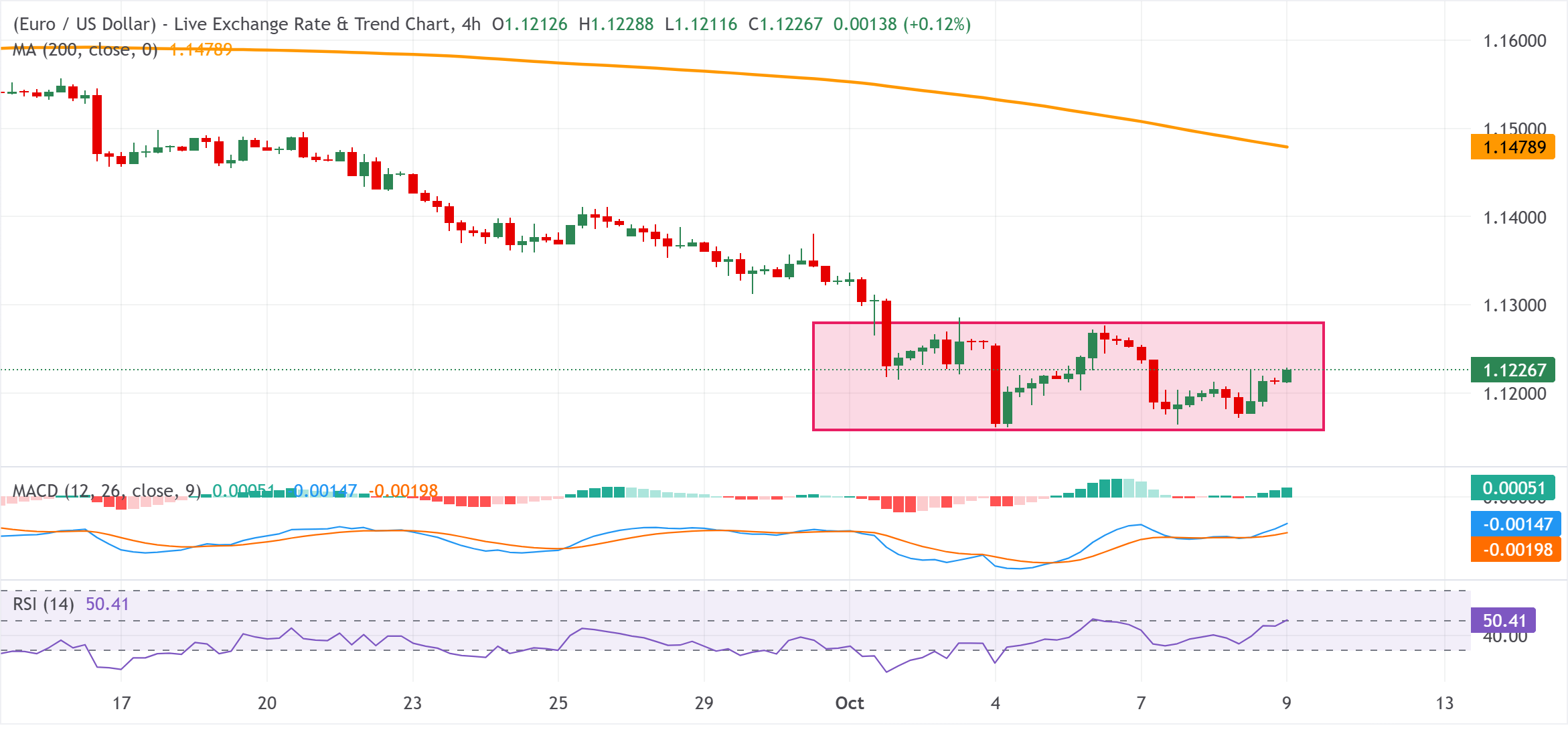
Furthermore, concerns about France’s deepening debt levels and political gridlock ahead of next year’s election might hold back traders from placing aggressive bullish bets on the shared currency. This, along with a bearish technical setup, suggests that strong follow-through buying is needed to confirm that the EUR/USD pair has formed a near-term bottom and is positioned for an extension of this week's modest recovery from the 1.1160 region, or the lowest level since May 2025.
Against the backdrop of a fall from the August monthly swing high, the recent range-bound price action might still be categorized as a bearish consolidation phase. Moreover, the Relative Strength Index (RSI) around 50.4 signals neutral momentum after recovering from oversold readings, while the Moving Average Convergence Divergence (MACD) has turned modestly positive, hinting at a potential pause rather than a clear reversal against the prevailing overhead resistance.
Hence, any subsequent move up is more likely to confront stiff resistance near the 1.1280 region, or the top boundary of the trading range. This is closely followed by the 1.1300 mark, which, if cleared, could trigger a short-covering rally to the next relevant hurdle near the 1.1355-1.1360 zone. The move up, however, might still be seen as a selling opportunity and runs the risk of fizzling out rather quickly amid the underlying bullish sentiment surrounding the USD.
Nevertheless, the broader setup reinforces a broader downside structure. On the downside, weakness below the 1.1200 mark will expose the trading range support near the 1.1160 region. Failure to defend the said area will be seen as a fresh trigger for bearish traders and set the stage for deeper losses.
(The technical analysis of this story was written with the help of an AI tool. Know more.)
EUR/USD 4-hour chart
Euro FAQs
The Euro is the currency for the 20 European Union countries that belong to the Eurozone. It is the second most heavily traded currency in the world behind the US Dollar. In 2022, it accounted for 31% of all foreign exchange transactions, with an average daily turnover of over $2.2 trillion a day. EUR/USD is the most heavily traded currency pair in the world, accounting for an estimated 30% off all transactions, followed by EUR/JPY (4%), EUR/GBP (3%) and EUR/AUD (2%).
The European Central Bank (ECB) in Frankfurt, Germany, is the reserve bank for the Eurozone. The ECB sets interest rates and manages monetary policy. The ECB’s primary mandate is to maintain price stability, which means either controlling inflation or stimulating growth. Its primary tool is the raising or lowering of interest rates. Relatively high interest rates – or the expectation of higher rates – will usually benefit the Euro and vice versa. The ECB Governing Council makes monetary policy decisions at meetings held eight times a year. Decisions are made by heads of the Eurozone national banks and six permanent members, including the President of the ECB, Christine Lagarde.
Eurozone inflation data, measured by the Harmonized Index of Consumer Prices (HICP), is an important econometric for the Euro. If inflation rises more than expected, especially if above the ECB’s 2% target, it obliges the ECB to raise interest rates to bring it back under control. Relatively high interest rates compared to its counterparts will usually benefit the Euro, as it makes the region more attractive as a place for global investors to park their money.
Data releases gauge the health of the economy and can impact on the Euro. Indicators such as GDP, Manufacturing and Services PMIs, employment, and consumer sentiment surveys can all influence the direction of the single currency. A strong economy is good for the Euro. Not only does it attract more foreign investment but it may encourage the ECB to put up interest rates, which will directly strengthen the Euro. Otherwise, if economic data is weak, the Euro is likely to fall. Economic data for the four largest economies in the euro area (Germany, France, Italy and Spain) are especially significant, as they account for 75% of the Eurozone’s economy.
Another significant data release for the Euro is the Trade Balance. This indicator measures the difference between what a country earns from its exports and what it spends on imports over a given period. If a country produces highly sought after exports then its currency will gain in value purely from the extra demand created from foreign buyers seeking to purchase these goods. Therefore, a positive net Trade Balance strengthens a currency and vice versa for a negative balance.
Related Articles