
- AUD/USD holds losses as the US Dollar gains on persistent energy-driven US inflation concerns.
- Traders await US September jobs data, with Nonfarm Payrolls projected to slow to 90,000 additions.
- CBA expects RBA rate hikes have paused, but November’s meeting remains live depending on upcoming inflation data.
AUD/USD remains subdued for the fifth consecutive day, trading around 0.6930 during the Asian hours on Friday. The pair loses ground as the US Dollar (USD) receives strong support from persistent inflation concerns stemming from elevated energy costs, alongside market expectations of higher US interest rates.
Ahead of Friday’s release of the US September employment data, traders are paying close attention for signals regarding the future direction of Federal Reserve monetary policy. Economists project Nonfarm Payrolls to show an addition of 90,000 jobs, marking a slowdown from the 162,000 recorded in the previous month, while the Unemployment Rate is expected to remain unchanged at 4.1%.
Meanwhile, Matt Comyn, chief executive of Australia's largest bank, Commonwealth Bank (CBA), noted that while CBA believes the Reserve Bank of Australia has finished hiking interest rates for now, the board's November meeting remains "live" with another rise still a possibility. Speaking with the ABC's Alan Kohler, he emphasized that the RBA's next move will heavily depend on the quarterly inflation data scheduled for release at the end of the month.
RBA seen staying patient as Commerzbank flags still-elevated inflation
Commerzbank’s Volkmar Baur acknowledges that “there’s no question that inflation is still too high, and it will take a while before it returns to the middle of the target range,” but argues that the Reserve Bank of Australia is unlikely to respond with further rapid tightening. Pointing to the lagged impact of previous rate hikes and emerging weakness in the real estate sector, he suggests the RBA will prefer to wait and assess the effects of policy already in place, leaving the Australian Dollar without significant additional support from near-term rate increases.
Technical Analysis:
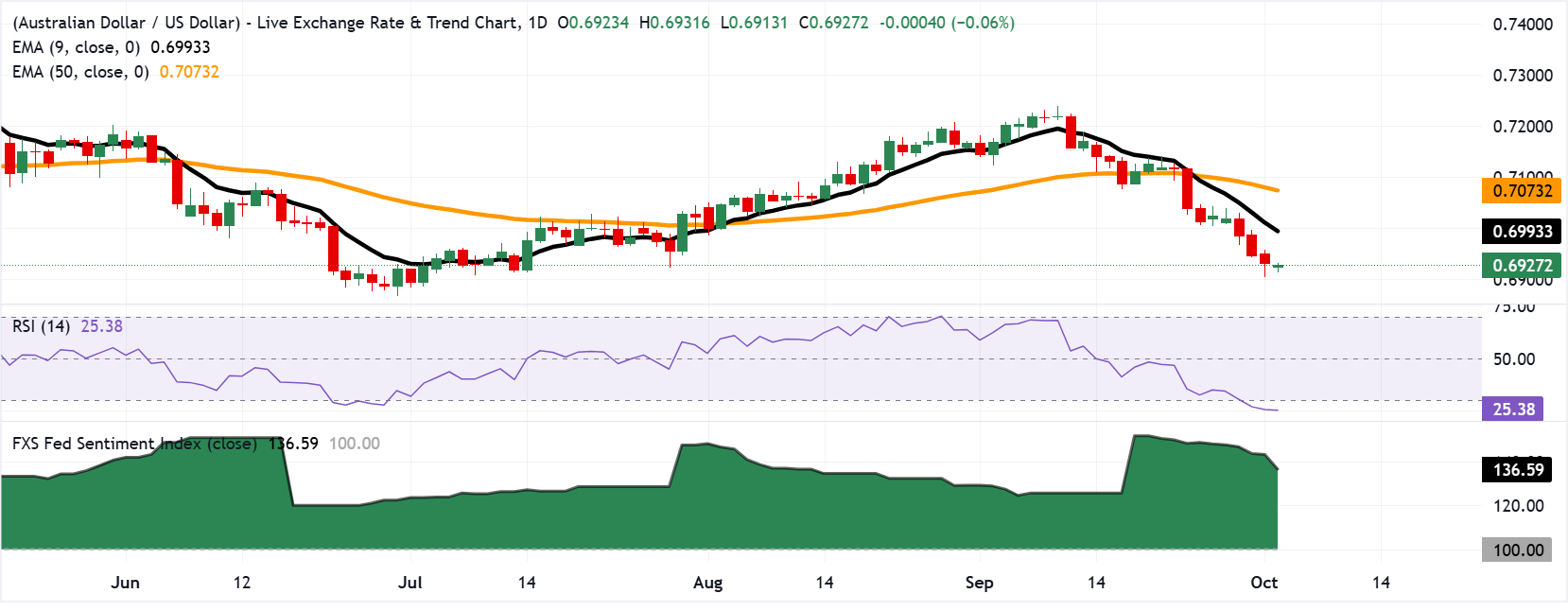
In the daily chart, AUD/USD trades at 0.6930, extending its decline below both the nine- and 50-period Exponential Moving Averages (EMAs), which together hint at a bearish near-term bias with the pair capped by clustered dynamic resistance overhead. The 14-day Relative Strength Index (14) has slid into oversold territory near 25, suggesting selling pressure is stretched but, as long as price holds under these moving averages, rebounds are likely to be corrective rather than trend-changing.
On the topside, immediate resistance emerges at the nine-period EMA around 0.6993, followed by a more significant barrier at the 50-period EMA near 0.7073, where sellers would be expected to reassert control if tested. On the downside, the current price around 0.6927 acts as a short-term pivot, while a more meaningful structural support sits at the horizontal level of 0.6667, where a deeper extension of the downtrend could look for a base if the present slide continues.
(The technical analysis of this story was written with the help of an AI tool. Know more.)
Australian Dollar FAQs
One of the most significant factors for the Australian Dollar (AUD) is the level of interest rates set by the Reserve Bank of Australia (RBA). Because Australia is a resource-rich country another key driver is the price of its biggest export, Iron Ore. The health of the Chinese economy, its largest trading partner, is a factor, as well as inflation in Australia, its growth rate and Trade Balance. Market sentiment – whether investors are taking on more risky assets (risk-on) or seeking safe-havens (risk-off) – is also a factor, with risk-on positive for AUD.
The Reserve Bank of Australia (RBA) influences the Australian Dollar (AUD) by setting the level of interest rates that Australian banks can lend to each other. This influences the level of interest rates in the economy as a whole. The main goal of the RBA is to maintain a stable inflation rate of 2-3% by adjusting interest rates up or down. Relatively high interest rates compared to other major central banks support the AUD, and the opposite for relatively low. The RBA can also use quantitative easing and tightening to influence credit conditions, with the former AUD-negative and the latter AUD-positive.
China is Australia’s largest trading partner so the health of the Chinese economy is a major influence on the value of the Australian Dollar (AUD). When the Chinese economy is doing well it purchases more raw materials, goods and services from Australia, lifting demand for the AUD, and pushing up its value. The opposite is the case when the Chinese economy is not growing as fast as expected. Positive or negative surprises in Chinese growth data, therefore, often have a direct impact on the Australian Dollar and its pairs.
Iron Ore is Australia’s largest export, accounting for $118 billion a year according to data from 2021, with China as its primary destination. The price of Iron Ore, therefore, can be a driver of the Australian Dollar. Generally, if the price of Iron Ore rises, AUD also goes up, as aggregate demand for the currency increases. The opposite is the case if the price of Iron Ore falls. Higher Iron Ore prices also tend to result in a greater likelihood of a positive Trade Balance for Australia, which is also positive of the AUD.
The Trade Balance, which is the difference between what a country earns from its exports versus what it pays for its imports, is another factor that can influence the value of the Australian Dollar. If Australia produces highly sought after exports, then its currency will gain in value purely from the surplus demand created from foreign buyers seeking to purchase its exports versus what it spends to purchase imports. Therefore, a positive net Trade Balance strengthens the AUD, with the opposite effect if the Trade Balance is negative.