The information provided is of general nature only and does not take into account your personal objectives, financial situations or needs. Before acting on any information provided, you should consider whether the information is suitable for you and your personal circumstances and if necessary, seek appropriate professional advice. All opinions, conclusions, forecasts or recommendations are reasonably held at the time of compilation but are subject to change without notice. Past performance is not an indication of future performance. Go Markets Pty Ltd, ABN 85 081 864 039, AFSL 254963 is a CFD issuer, and trading carries significant risks and is not suitable for everyone. You do not own or have any interest in the rights to the underlying assets. You should consider the appropriateness by reviewing our TMD, FSG, PDS and other CFD legal documents to ensure you understand the risks before you invest in CFDs. These documents are available here.
Any references to Australian or international shares, sectors, indices, ETFs, crypto-related stocks or other instruments are provided for market commentary and watchlist purposes only and do not constitute a recommendation, offer or solicitation to buy, sell or hold any financial product or adopt any investment strategy. International markets may involve additional risks, including currency fluctuations, regulatory differences, market structure differences, reduced liquidity and higher volatility. Company-specific, sector-specific and macroeconomic risks may also affect performance.
Commentary on geopolitical developments, economic data, central bank decisions, earnings, policy changes and other global or financial market events is based on information available at the time of publication and may change without notice. Such events can lead to sudden market moves, price gaps, reduced liquidity, wider spreads and increased volatility, particularly in leveraged products such as CFDs. Forward-looking statements, expectations and scenario analysis are inherently uncertain and should not be relied on as guarantees of future market behaviour or outcomes.
Australian Dollar holds gains above 0.6950 as Fed hike bets fade, Chinese data loom

- AUD/USD gains momentum to around 0.6970 in Monday’s early Asian session.
- Fed’s Warsh gives no hint on October policy decision.
- RBA’s Kent says neutral rate is rising, questions if policy is restrictive enough.
The AUD/USD pair gathers strength to near 0.6970 during the early Asian session on Monday. Fading expectations for a Federal Reserve (Fed) rate hike weigh on the US Dollar (USD) against the Australian Dollar (AUD).
Remarks from Fed officials signaling no urgency to tighten policy further helped stabilize Treasury yields and undermine the Greenback. Fed Chairman Kevin Warsh spoke at the International Monetary Fund (IMF) event on Friday, saying that he does not "prejudge" interest-rate decisions, giving no preview of whether the central bank will hike or hold short-term rates steady at its upcoming October 27-28 meeting.
According to the CME FedWatch Tool, markets are now pricing in nearly 83.9% odds that the US central bank will leave rates unchanged later this month, up from 49% a month earlier.
Early Monday, Reserve Bank of Australia (RBA) Assistant Governor Chris Kent stated that there is reasonable evidence that neutral rates are rising in Australia and abroad. Kent is confident policy is somewhat restrictive but questioned whether it is restrictive enough.
Traders await the release of the Chinese economic data, including Gross Domestic Product (GDP), Industrial Production and Retail Sales later on Monday. If the reports show stronger-than-expected outcome, this could boost the China-proxy Aussie as China is a major trading partner of Australia.
Aussie downside bias builds as AUD/USD breaks recent range
Strategists at UOB Group note that the recent slide in AUD/USD has shifted the technical tone more negatively over the 1–3 week horizon. They recall that as of last Wednesday, with the pair trading near 0.6980, they had expected AUD “is likely to trade between 0.6935 and 0.7020.” However, that range has since given way: “Two days ago, AUD rose to 0.7015 and then fell. Yesterday, AUD fell further and broke below 0.6935 with a low of 0.6895.”
UOB highlights that “while downward momentum is increasing, it is not strong for now.” Even so, “the bias for AUD is on the downside, but any decline may not reach the June low of 0.6865.” On the topside, the bank flags that “a breach of 0.6980 would suggest that AUD is more likely to range-trade rather than declining further.”
Warsh flags investment surge and AI demand risks while avoiding policy pre-commitment
Fed Chair Warsh delivered a moderately constructive but cautious message, with a 5.6/10 FXS Speechtracker score undershooting the 6.1/10 historical average and signaling slightly softer conviction relative to the established baseline. The admission of being “over-scarred” by the Global Financial Crisis underscores a persistent risk-averse bias even as Warsh highlights a structural growth and investment surge driven by “good policies,” while stressing that upcoming October and December meetings will be the true “crystallizing moment” for decisions on output, employment, and inflation. Warsh’s focus on AI as a near-term demand catalyst with uncertain employment effects, plus the refusal to pre-judge meetings, keeps policy optionality wide open and tempers any immediate hawkish read-through for the Dollar.
The FXS Fed Sentiment Index was unchanged on the speech, with a 0.00-point move leaving the index at 127.51, firmly in hawkish territory despite the slightly softer FXS Speechtracker score. The static but elevated FXS Fed Sentiment Index level suggests markets still price a broadly hawkish Fed reaction function, even as Warsh’s tone leans more data-dependent and risk-aware at the margin.
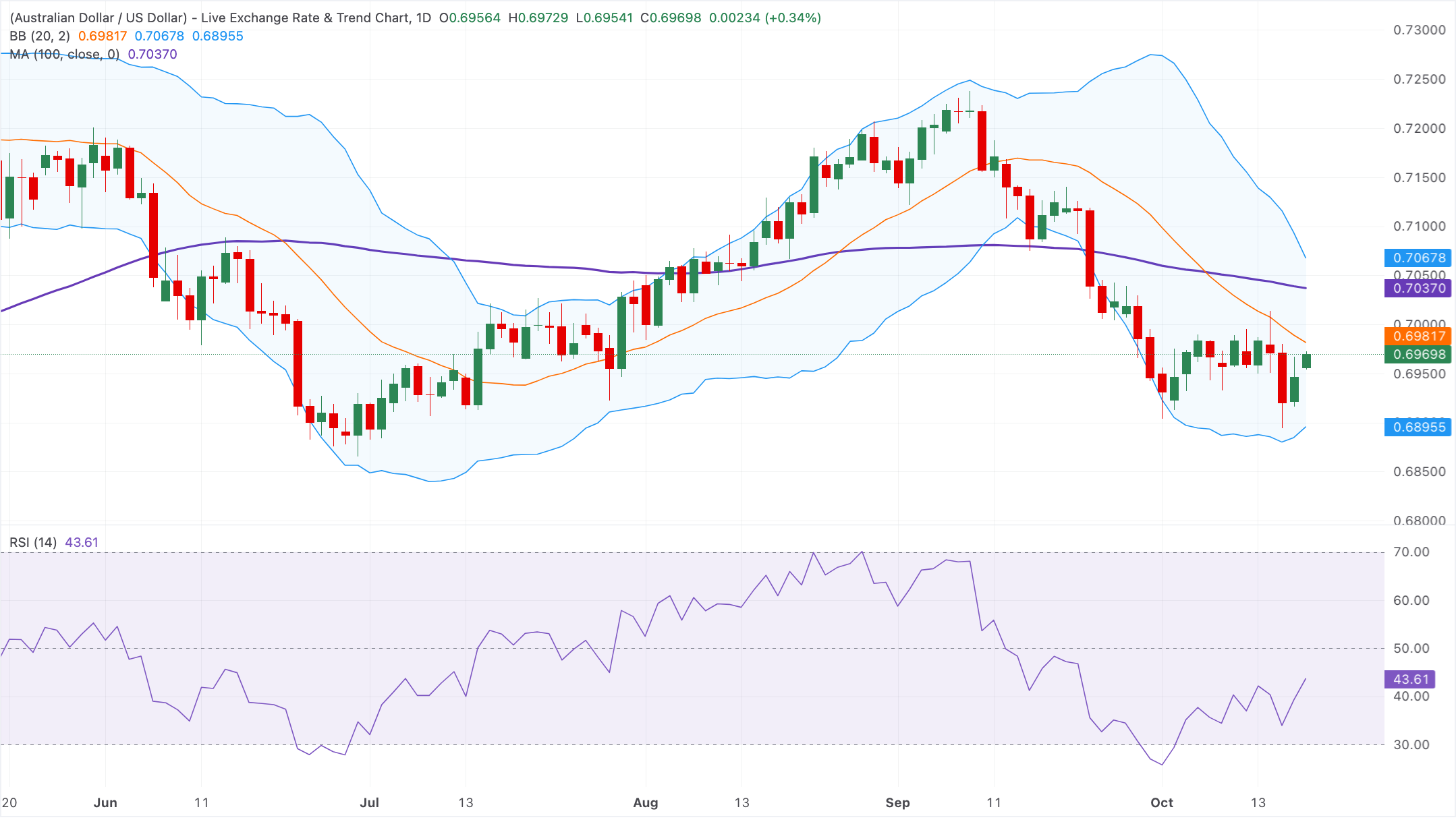
Technical Analysis: AUD/USD retains a negative tone below the 100-day SMA
In the daily chart, AUD/USD holds a bearish near-term bias as spot remains under the 100-day Simple Moving Average (SMA) and below the 20-day Bollinger middle band, now immediate resistance. Price is sliding along the lower half of the Bollinger envelope, while the 14-day Relative Strength Index near 44 hints at lingering downside pressure rather than oversold capitulation.
On the topside, initial resistance is located at the Bollinger middle band around 0.6982, followed by the 100-day SMA at 0.7035, with the Bollinger upper band near 0.7070 capping any stronger recovery attempts. On the downside, the next notable support is the Bollinger lower band, coming in close to 0.6896, where sellers could hesitate if the decline extends.
(The technical analysis of this story was written with the help of an AI tool. Know more.)
Australian Dollar FAQs
One of the most significant factors for the Australian Dollar (AUD) is the level of interest rates set by the Reserve Bank of Australia (RBA). Because Australia is a resource-rich country another key driver is the price of its biggest export, Iron Ore. The health of the Chinese economy, its largest trading partner, is a factor, as well as inflation in Australia, its growth rate and Trade Balance. Market sentiment – whether investors are taking on more risky assets (risk-on) or seeking safe-havens (risk-off) – is also a factor, with risk-on positive for AUD.
The Reserve Bank of Australia (RBA) influences the Australian Dollar (AUD) by setting the level of interest rates that Australian banks can lend to each other. This influences the level of interest rates in the economy as a whole. The main goal of the RBA is to maintain a stable inflation rate of 2-3% by adjusting interest rates up or down. Relatively high interest rates compared to other major central banks support the AUD, and the opposite for relatively low. The RBA can also use quantitative easing and tightening to influence credit conditions, with the former AUD-negative and the latter AUD-positive.
China is Australia’s largest trading partner so the health of the Chinese economy is a major influence on the value of the Australian Dollar (AUD). When the Chinese economy is doing well it purchases more raw materials, goods and services from Australia, lifting demand for the AUD, and pushing up its value. The opposite is the case when the Chinese economy is not growing as fast as expected. Positive or negative surprises in Chinese growth data, therefore, often have a direct impact on the Australian Dollar and its pairs.
Iron Ore is Australia’s largest export, accounting for $118 billion a year according to data from 2021, with China as its primary destination. The price of Iron Ore, therefore, can be a driver of the Australian Dollar. Generally, if the price of Iron Ore rises, AUD also goes up, as aggregate demand for the currency increases. The opposite is the case if the price of Iron Ore falls. Higher Iron Ore prices also tend to result in a greater likelihood of a positive Trade Balance for Australia, which is also positive of the AUD.
The Trade Balance, which is the difference between what a country earns from its exports versus what it pays for its imports, is another factor that can influence the value of the Australian Dollar. If Australia produces highly sought after exports, then its currency will gain in value purely from the surplus demand created from foreign buyers seeking to purchase its exports versus what it spends to purchase imports. Therefore, a positive net Trade Balance strengthens the AUD, with the opposite effect if the Trade Balance is negative.
Related Articles