

Quick search
CLOSE+
Thank you! Your submission has been received!
This is the moment Australian markets listen. Eight times a year, the Reserve Bank of Australia’s cash rate decision can move the AUD, reshape the ASX 200 and reset expectations across the economy.

The Reserve Bank of Australia (RBA) is Australia’s central bank. Under the modernised mandate set out in the 2024 Reserve Bank Act amendments, its primary role is to support price stability and full employment in the Australian economy. It does that mainly through monetary policy, including setting the cash rate target, which is the interest rate banks charge each other for overnight loans.
For traders, the RBA matters because its decisions can ripple through every Australian-linked asset. A change in the cash rate, or even a shift in the Governor’s tone, can move the value of the AUD, reprice the ASX 200 and change expectations for sectors including banking, mining and real estate.

| Event | Frequency | Timing | Why it matters |
|---|---|---|---|
Anthropic Artificial intelligence | ~US$350 billion | Nasdaq | Rumoured |
Databricks AI and data | ~US$134 billion | Nasdaq | Expected |
Firmus Technologies AI infrastructure | ~A$6 billion | ASX | Expected |
Greencross Pet care & veterinary | ~A$4 billion plus | ASX | Rumoured |
OpenAI Artificial intelligence | ~US$850 billion | Nasdaq | Expected |
Rokt E-commerce adtech | ~US$7.9 billion | Nasdaq and ASX CDI | Expected |
SpaceX Aerospace and AI | ~US$1.5 trillion | Nasdaq | Expected |
Stripe Fintech | ~US$140 billion | NYSE/Nasdaq | Rumoured |
How a rate decision moves markets
By the time the cash rate reaches the screen at 2:30 PM, a lot of the move may already have been priced in. Understanding the six-stage path of an RBA decision helps traders see what may already be reflected before the announcement, and what could still shift in the hours that follow.

The RBA’s economists assess the latest readings on inflation, employment, wages and global conditions.

The Monetary Policy Board weighs the data, internal forecasts and market expectations behind closed doors.

The cash rate target is published at 2:30 PM AEST, alongside a short statement on the Board’s reasoning.

At 3:30 PM AEST, the Governor takes questions. The tone often matters as much as the rate itself.

Two weeks later, the minutes are released, revealing how close the call was and what could shift next time.

Every February, May, August and November, the Statement on Monetary Policy updates the RBA’s forecasts.
Trading IPOs with CFDs
IPO listing day is often defined by large sentiment swings and thin price history. That combination can make traditional buy-and-hold exposure harder to manage. CFDs let traders take a view on either side of the move, size positions precisely and act quickly as the story develops.
Trade the initial surge or the post-hype correction. CFDs let you take a position in either direction from listing day onward.
IPO volatility tends to compress into the first days and weeks. CFDs are well suited to these shorter, event-driven windows
Stop loss and limit orders can help define your risk beforeentry, which matters when price discovery is still unfolding.
Access share CFDs across US and Australian markets, including names like Rokt and Firmus Technologies, from one account.

Access US and Australian share CFDs with fast execution, competitive pricing, and built-in risk management tools.


From AI infrastructure to pet care, semiconductors, and gold exploration, here are the five top candidates most likely to list on the ASX in 2026.
What is an Initial public offering (IPO)?
Firmus Technologies is building AI-powered data centre infrastructure in Tasmania, and it may be one of the most strategically positioned tech companies in Australia right now.
Firmus is an Nvidia Cloud Partner and has joined the GPU maker's Lepton marketplace. The company has designed its modular, liquid-everywhere AI Factory platform to evolve with Nvidia's latest architectures, including Nvidia Spectrum-X Ethernet networking.
A September 2025 raise of A$330m closed at a post-money valuation of A$1.85 billion for the company. By November 2025, after a further A$500m raise, that valuation had trebled to approximately A$6 billion.
A subsequent A$100m investment from Maas Group in early 2026 confirmed the November valuation. Firmus is reported to be contemplating an ASX IPO within the next 12 months and, given the A$6 billion private valuation, any public raise is expected to be well above A$1 billion.
With Australia's growing demand for sovereign AI compute capacity and Tasmania's cool climate and renewable energy advantage for large-scale data centre operations, Firmus stands as one of the largest-scale ASX IPO candidates in 2026.
However, although market interest in Firmus appears to be growing, timing is everything when it comes to IPOs. Watch for confirmation of exact IPO timing, AI data centres sentiment, and whether Nvidia signals deepening its involvement as a strategic anchor investor post-listing.
Sydney-founded Rokt has quietly become one of Australia's most valuable private tech companies. The e-commerce adtech platform aimed at helping brands monetise the “transaction moment” is now valued at ~US$7.9 billion.
A term sheet prepared by MA Financial projected an exit share price of US$72 under base-case scenarios, when shares are freed from escrow in November 2027.
Rokt is expected to potentially dual-list in the US and on the ASX in 2026, possibly as soon as the first half of the year. IG The most widely discussed structure is a primary Nasdaq listing with an ASX CDI (CHESS Depositary Interest) structure for Australian investors, rather than a full dual listing.
Rokt’s revenue for the year ending August 2025 is projected at US$743m (up 48% year-over-year), with EBITDA forecast at US$100m and a gross profit margin of approximately 43%. It is currently projected to cross the $US1 billion annual revenue milestone by August 2026.
Amazon, Live Nation, and Uber are all reported to be Rokt customers, and the company has expanded rapidly across North America and Europe.
Whether Rokt opts for a primary Nasdaq listing with an ASX CDI structure, or a full dual listing, could significantly affect liquidity and local investor access.
Greencross, the business behind Petbarn, City Farmers, and Greencross Vets, is preparing to relist on the ASX after being taken private by US private equity firm TPG in 2019.
TPG currently owns 55% of Greencross, while AustralianSuper and the Healthcare of Ontario Pension Plan (HOOPP) hold the remaining 45%.
The company reported revenue of A$2 billion for the 2025 financial year, a modest increase from A$1.95 billion in 2024. TPG paid A$675 million in equity value for the business in 2019; it sold a 45% stake in 2022 at a valuation of more than A$3.5 billion. The proposed IPO implies a valuation of more than A$4 billion.
TPG is targeting an initial public offering of at least A$700 million. The IPO will mark Greencross's return to the ASX after an eight-year absence. TPG's relatively small raise size suggests the firm is banking on strong aftermarket performance before fully exiting.
TPG's exit timeline announcement is still a watch for whether a 2026 IPO is on the cards. And whether the company pursues a traditional IPO or a trade sale, which remains an alternative path.
Morse Micro is a Sydney-based semiconductor company developing Wi-Fi HaLow chips designed for IoT applications across agriculture, logistics, smart cities, and industrial monitoring.
Morse Micro held a Series C round in September 2025, raising US$88 million, followed in November 2025 by a US$32 million pre-IPO raise, taking total funding to over A$300 million.
It is targeting an ASX listing in the next 12–18 months. The Series C was led by Japanese chip giant MegaChips and the National Reconstruction Fund Corporation.
Global IoT device connections forecast to exceed 30 billion by 2030, and Morse Micro would be a rare ASX-listed pure-play semiconductor company, which could attract significant interest from tech-focused fund managers.
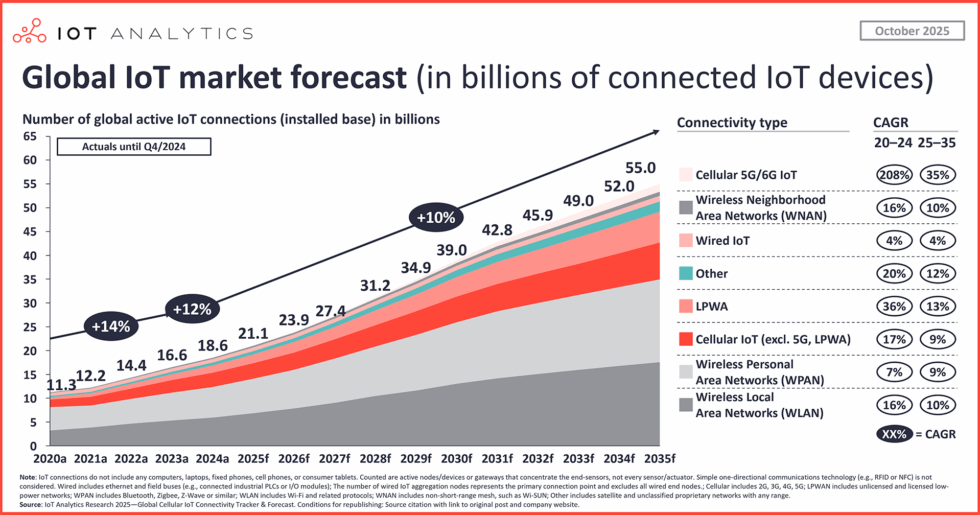
Morse Micro’s Revenue traction with tier-one hardware partners ahead of listing is a watch, and whether the company seeks a concurrent US listing given the depth of US semiconductor investor appetite.
Bison Resources is a newly incorporated US-focused gold and precious metals explorer currently in the middle of its ASX IPO.
The offer closes on 20 March 2026, with an ASX listing targeted for mid-April 2026. At an indicative market capitalisation of A$13.25 million on full subscription, Bison is the most speculative name on this list by a significant margin.
The company holds four exploration projects in north-east Nevada, within the Carlin Trend (one of the world's most prolific gold-producing belts), responsible for approximately 75% of US gold output.
The IPO seeks to raise A$4.5 to A$5.5 million (22.5 to 27.5 million shares at A$0.20 per share). The team has prior experience at Sun Silver (ASX: SS1) and Black Bear Minerals, giving it a track record in ASX junior mining listings out of Nevada.
Global IPOs: What are the biggest IPOs happening globally in 2026?
Australia's 2026 IPO calendar spans the full risk spectrum. A Nvidia-backed AI infrastructure play, a billion-dollar e-commerce platform, and a junior gold explorer with its IPO already underway.
Each candidate reflects a different stage of maturity and a different investor profile. Together, they suggest the ASX could see a meaningful injection of new listings across sectors that have been largely absent from the local market in recent years.

The global initial public offering (IPO) market saw a resurgence in 2025. Proceeds increased 39% to US$171.8 billion across 1,293 listings, the sharpest annual rebound since the post-pandemic boom.
That momentum is now building into 2026 for what some financial analysts speculate could be the biggest IPO year in history.
A handful of mega-cap private companies, including SpaceX, OpenAI, and Anthropic, are exploring going public this year, with combined valuations that could exceed US$3 trillion.
SpaceX revenue reportedly hit US$15 billion in 2025, with analysts projecting an increase to US$22-24 billion in 2026. The company has been cash-flow positive for years, driven largely by its Starlink satellite broadband network.
Following its February 2026 all-stock acquisition of Elon Musk's AI company xAI, the combined entity also encompasses Grok AI and the social media platform X (Twitter).
Leading financial analysts have reported SpaceX is targeting a mid-2026 listing. Its next funding round is estimated to raise around US$50 billion, putting its initial market cap at US$1.5 trillion, which would make it the second-highest IPO valuation of all time.
This valuation would mean SpaceX would trade at 62–68 times projected 2026 sales. A steep premium that requires massive growth assumptions around Starlink and longer-term space-based AI ambitions.
OpenAI, the company behind ChatGPT, now reports more than 800 million weekly active users of its groundbreaking AI product.
Originally a nonprofit research lab, it has restructured into a for-profit entity developing large language models for consumer, enterprise, and developer applications.
OpenAI is reportedly targeting a Q4 2026 IPO, finalising a US$100 billion-plus funding round (its largest ever), which would put its valuation at US$850 billion.
However, OpenAI still needs to overcome some near-term hurdles to achieve the potential associated with such a high valuation.
It projects US$14 billion in losses in 2026 and does not expect profitability before 2029. It is facing intensified competition from Google Gemini and other AI startups cutting into its market share, and Elon Musk has filed a lawsuit against the company seeking up to US$134 billion in damages.
While OpenAI has leaned into consumer products, Anthropic has built its business around enterprise adoption. Roughly 80% of its revenue comes from business customers, and eight of the Fortune 10 are now Claude users.
Anthropic closed a US$30 billion funding round in February 2026 at a US$350 billion valuation, more than double its US$183 billion valuation from five months earlier.
Anthropic’s annualised revenue has been growing at 10x per year since 2024, well outpacing OpenAI’s growth of 3.4x per year. If this trend continues, Anthropic revenue could pass OpenAI by mid-2026. However, since July 2025, Anthropic’s growth rate has slowed down to 7x per year.
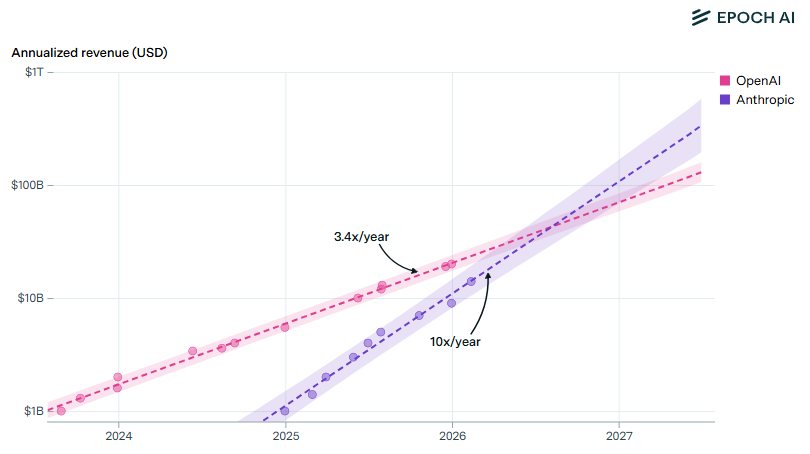
Anthropic has engaged law firm Wilson Sonsini to begin IPO preparations, and the recent appointment of former Microsoft CFO Chris Liddell to its board signals a governance push ahead of a potential late-2026 listing.
The company is not yet profitable, but its enterprise-heavy revenue mix and rapid growth trajectory make it one of the most closely watched IPO candidates this year.
Stripe processed US$1.4 trillion in total payment volume in 2024, roughly 1.3% of global GDP. Half the Fortune 100 now use Stripe, and recent moves into stablecoins and AI-to-AI "agentic commerce" payments are expanding its addressable market.
Stripe remains one of the most anticipated fintech IPOs globally, but the company has shown a lack of urgency to list in the past. Co-founder John Collison said at Davos in January 2026 that Stripe was "still not in any rush."
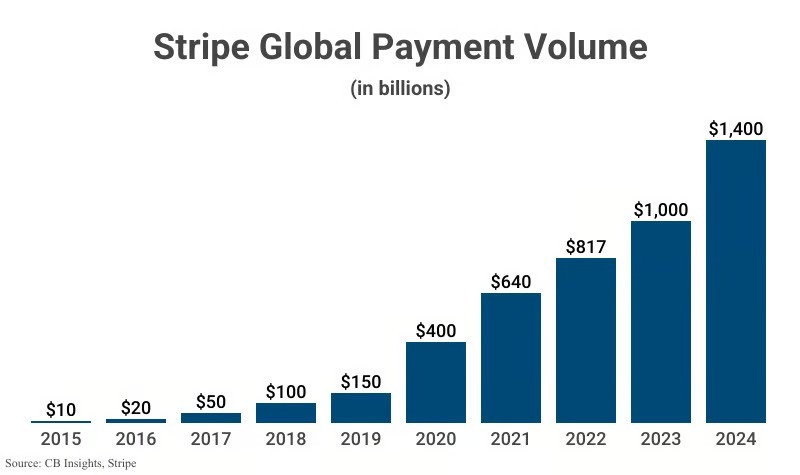
Rather than pursuing an IPO, Stripe has conducted tender offers every six months at rising valuations, providing employee liquidity without surrendering control.
These frequent tenders effectively function as a private-market alternative to going public. However, a traditional IPO is still on the cards in 2026, with the company's February tender offer valuing it at US$140 billion or more, and profitability since 2024 removing one of the key barriers to listing.
Databricks completed a US$5 billion funding round in February 2026 at a US$134 billion valuation.
The company's annualised revenue exceeded US$5.4 billion in January 2026, growing a massive 65% year-on-year, with AI products generating US$1.4 billion.
CEO Ali Ghodsi has said the company is prepared to go public "when the time is right," with most analysts expecting a H2 2026 listing. At US$134 billion, Databricks is valued at more than twice publicly traded rival Snowflake (~US$58 billion).
2026 has the potential to be the biggest IPO year by valuation in history. With the most likely candidates, SpaceX and Databricks, matching the total valuation of all 2025 IPOs on their own.
If major AI players like OpenAI and Anthropic, as well as world-leading payment fintech Stripe, also list before the end of the year, 2026 could see over US$3 trillion in total value added to global markets through IPOs alone.

From tech disruptors to defence contractors, some of the market's most talked-about companies start their public journey through an initial public offering (IPO). For traders, these initial public listings can represent a unique trading environment, but also a period of heightened uncertainty.
An IPO is when a company offers its shares to the public for the first time.
Before performing an IPO, shares in the company are typically only held by founders, early employees, and private investors. Going public makes the shares available to be purchased by anyone.
Depending on the size of the company, it will usually list its public shares on the local stock exchange (for example, the ASX in Australia). However, some large-valuation companies choose to only list on a global stock exchange, like the Nasdaq, no matter where their main headquarters is located.
For traders, IPOs are generally the first opportunity to gain exposure to a company’s stock. They can create a unique environment with increased volatility and liquidity, but also carry heightened risk, given the limited price history and sensitivity to sentiment swings.
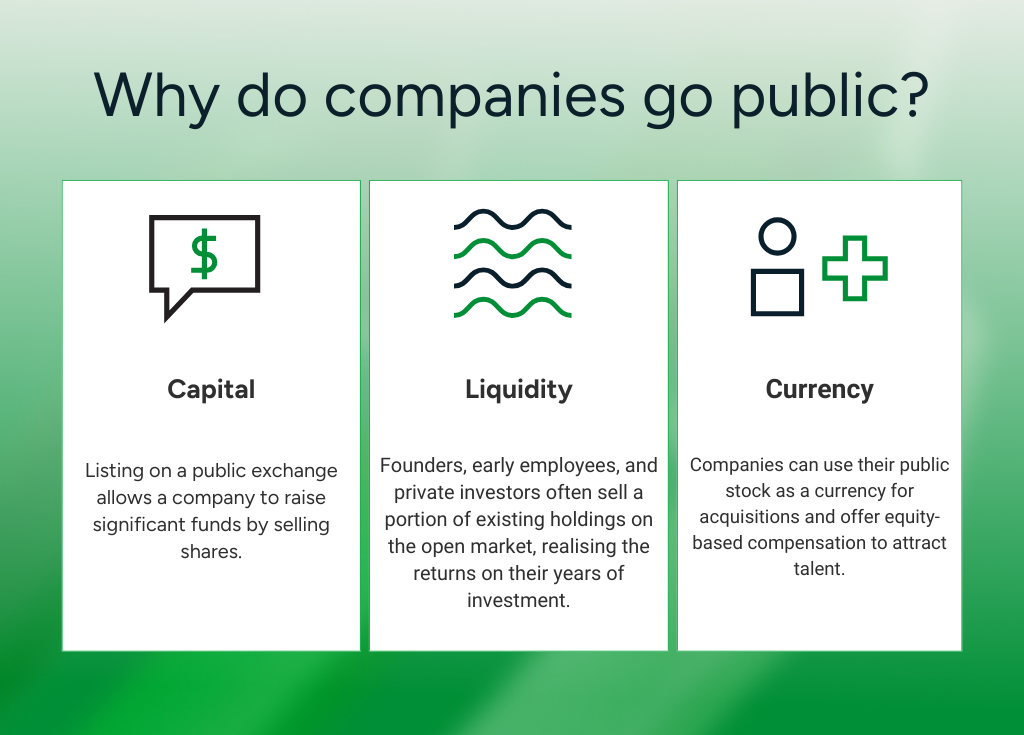
The biggest driver to perform an IPO is to access more capital. Listing on a public exchange means the company can raise significant funds by selling shares.
It also provides liquidity for existing shareholders. Founders, early employees, and private investors often sell a portion of their existing holdings on the open market, realising the returns on their years of support.
Beyond the monetary benefits, going public means companies can use their stock as currency for acquisitions and offer equity-based compensation to attract talent. And a public valuation provides a transparent benchmark, which is useful for strategic positioning and future fundraising.
However, it does come with trade-offs. Public companies must comply with ongoing disclosure and reporting obligations, and pressure from public shareholders can become a barrier to long-term progress if many are focused on short-term performance.
While the specifics vary by jurisdiction, going from a private company to a public listing generally involves the following stages:
The company first selects the underwriter (typically an investment bank) to manage the offering. Together, they assess the company's financials, corporate structure, and market positioning to determine the best approach for going public. It is the heavy planning stage to make sure the company is actually ready to go public.
Once everything is prepared, the underwriters conduct a thorough due diligence check and then lodge the required disclosure documents with the relevant regulator. These documents give a detailed disclosure to the regulator about the company, its management, and its proposed offering. In Australia, this is typically a prospectus lodged with ASIC; in the US, a registration statement filed with the SEC.
Executives at the company and underwriters will then present the investment case to institutional investors and market analysts in a “roadshow”. This showcase is designed to gauge demand for the stock and help generate interest. Institutional investors can register their interest and valuation of the IPO, which helps inform the initial pricing.
Based on feedback from the roadshow and current market conditions, the underwriters set the final share price and determine the number of shares to be issued. Shares are allocated on the ‘primary market’ to investors participating in the offer (before the stock is listed publicly on the secondary market). This process sets the pre-market price, which effectively determines the company’s initial public valuation.
On listing day, the company’s shares begin trading on the chosen stock exchange, officially opening the secondary market. For most traders, this is the first point at which they can trade the stock, either directly or through derivatives such as Share CFDs.
Once listed, the company becomes subject to strict reporting and disclosure requirements. It must communicate regularly with shareholders, publish its financial results, and comply with the governance standards of the exchange on which it is listed.
For most traders, participating in an IPO comes once shares have listed and begun trading on the secondary market.
Once shares are live on the exchange, investors can buy the physical shares directly through a broker or online exchange, or they can use derivatives such as Share CFDs to take a position on the price without owning the underlying asset.
The first few days of IPO trading tend to be highly volatile. Traders should ensure they have taken appropriate risk management measures to help safeguard against potential sharp price swings.
IPOs mark when a company becomes investable to the public. They can offer early access to high-growth companies and create a unique trading environment driven by elevated volatility and market interest.
For traders, understanding how the process works, what drives pricing and post-IPO performance, and how to weigh potential rewards against the risks of trading newly listed shares is essential before taking a position.
References to companies, IPO candidates, valuations, exchanges, sectors and markets are illustrative only, based on publicly available information at the time of publication, and may change without notice. A proposed listing may be delayed, amended or cancelled, and inclusion on this page does not imply that a company will list, or that any share or CFD will be available to trade through GO Markets.