

The information provided is of general nature only and does not take into account your personal objectives, financial situations or needs. Before acting on any information provided, you should consider whether the information is suitable for you and your personal circumstances and if necessary, seek appropriate professional advice. All opinions, conclusions, forecasts or recommendations are reasonably held at the time of compilation but are subject to change without notice. Past performance is not an indication of future performance. Go Markets Pty Ltd, ABN 85 081 864 039, AFSL 254963 is a CFD issuer, and trading carries significant risks and is not suitable for everyone. You do not own or have any interest in the rights to the underlying assets. You should consider the appropriateness by reviewing our TMD, FSG, PDS and other CFD legal documents to ensure you understand the risks before you invest in CFDs. These documents are available here.
Any references to Australian or international shares, sectors, indices, ETFs, crypto-related stocks or other instruments are provided for market commentary and watchlist purposes only and do not constitute a recommendation, offer or solicitation to buy, sell or hold any financial product or adopt any investment strategy. International markets may involve additional risks, including currency fluctuations, regulatory differences, market structure differences, reduced liquidity and higher volatility. Company-specific, sector-specific and macroeconomic risks may also affect performance.
Commentary on geopolitical developments, economic data, central bank decisions, earnings, policy changes and other global or financial market events is based on information available at the time of publication and may change without notice. Such events can lead to sudden market moves, price gaps, reduced liquidity, wider spreads and increased volatility, particularly in leveraged products such as CFDs. Forward-looking statements, expectations and scenario analysis are inherently uncertain and should not be relied on as guarantees of future market behaviour or outcomes.
The Kiwi defies hot US inflation as Fed pause bets weaken the USD

- NZD/USD gains 0.55% to 0.5652 as the Greenback retreats.
- October Fed hike odds remain at 16% despite elevated inflation.
- NZ CPI could reshape RBNZ tightening expectations ahead of October's meeting.
The New Zealand Dollar ended the week on a higher note against the US Dollar, up 0.55% to 0.5652, as the Greenback weakened amid investors' skepticism about a Fed hike in October despite the US docket featuring red-hot inflation.
NZD/USD closes higher as October Fed hike skepticism shifts attention toward NZ inflation
US data revealed on Friday was mostly ignored by market participants. Even though the Fed revealed that Industrial Production in September grew 0.7% MoM above estimates and August’s 0.1% expansion, the focus was on inflation.
The release of US consumer inflation data, which exceeded estimates of 3.6% at 3.7% YoY, and on the producer front at 6.3% YoY, up a full percentage point from forecasts of 5.3%, did not raise the odds of a Fed October rate increase, as might have been expected.
The probability of a Fed rate hike is 16%, according to Prime Terminal data. Still, this favors further downside in NZD/USD, as US interest rates are 125 basis points higher than in New Zealand.
Several Fed officials, although penciling in two hikes for 2026, with the first having happened a month ago, said patience is needed, implying that a hike in Decembers is most likely than this month. Others, like Cleveland Fed Beth Hammack, have expressed concern that inflation has remained stubbornly high for five and a half years, above the 2% goal.
At the same time, Fed Chair Kevin Warsh disappointed investors by failing to provide guidance on future interest rates during a speech at the IMF forum on Friday, even though he acknowledged the strength of the US economy.
In New Zealand, the economic docket remained light but for the next week, the Trade Balance is expected on October 18, followed by the Consumer Price Index (CPI) for Q3 on a quarterly and yearly basis.
If next week's New Zealand CPI comes hotter than expected, this could prompt investors to fully price in an RBNZ rate hike at the October 28 meeting, with odds at 85% for a hold and 40 basis points of further tightening towards the end of the year.
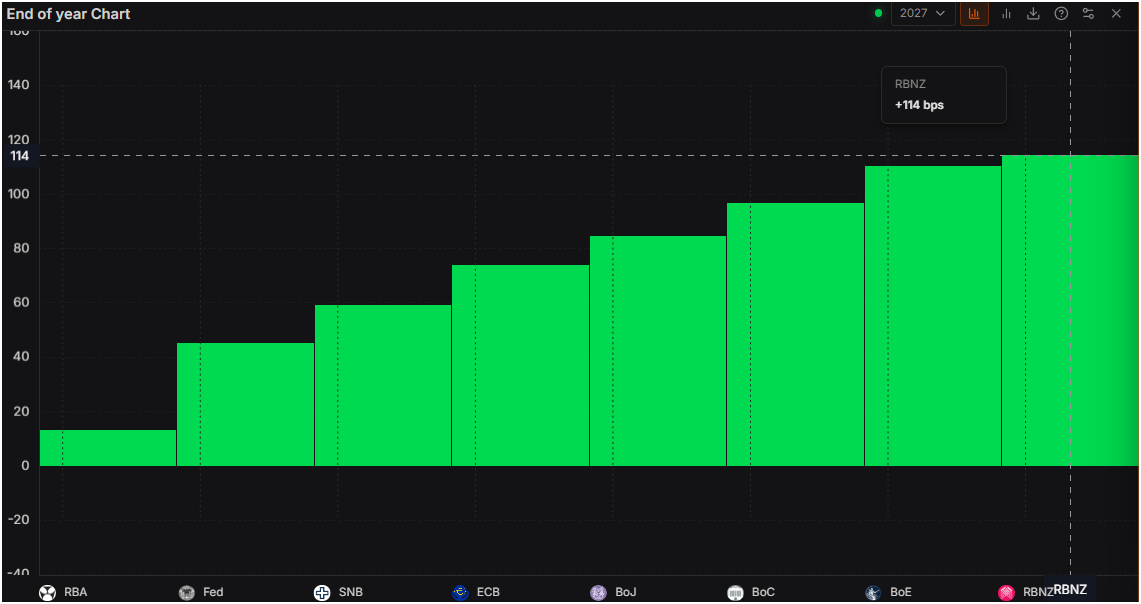
Of note, for 2027, money markets had priced in 114 basis points of tightening towards the end of the year, reflecting the more hawkish central bank amongst the major currencies.
NZD/USD Price Forecast: Technical outlook
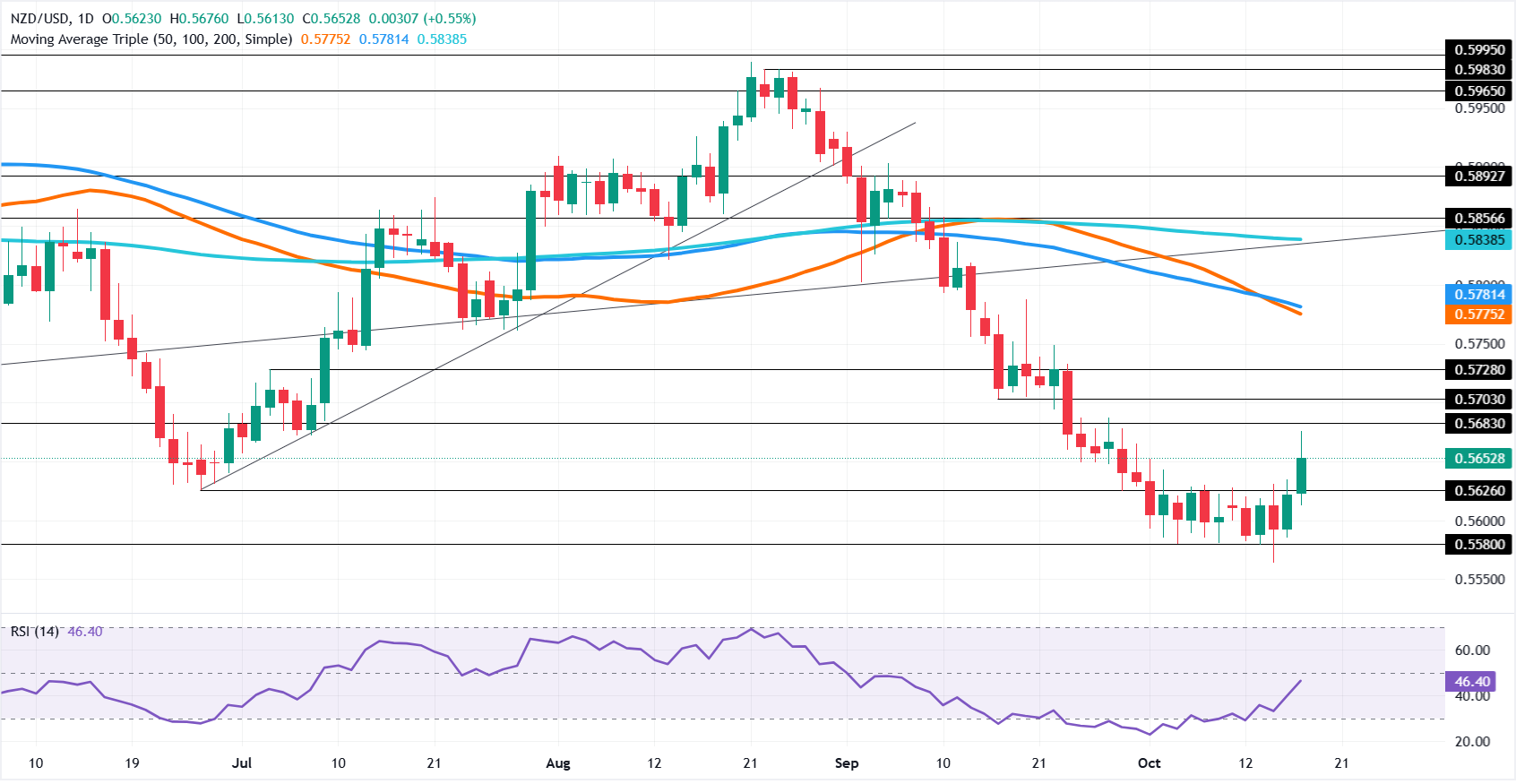
The NZD/USD price action shows that the pair bottomed around 0.5580-0.5600, triggering a rally to an 11-day high of 0.5674 before settling at current levels.
Even though all the daily Simple Moving Averages (SMAs) indicate a bearish bias, the Relative Strength Index (RSI) suggests that momentum is shifting bullishly, an indication that, although the downtrend is in place, we could be witnessing an early stage of a reversal.
If NZD/USD reclaims 0.5750, this could pave the way for a move toward the confluence of the 50- and 100-day SMAs, each at 0.5775-0.5781. This could open the door to challenge the 200-day SMA above the 0.5800 milestone at 0.5838.
For a bearish continuation, the NZD/USD must drop below the October 14 swing ow of 0.5564, towards the 0.5500 mark.
New Zealand Dollar FAQs
The New Zealand Dollar (NZD), also known as the Kiwi, is a well-known traded currency among investors. Its value is broadly determined by the health of the New Zealand economy and the country’s central bank policy. Still, there are some unique particularities that also can make NZD move. The performance of the Chinese economy tends to move the Kiwi because China is New Zealand’s biggest trading partner. Bad news for the Chinese economy likely means less New Zealand exports to the country, hitting the economy and thus its currency. Another factor moving NZD is dairy prices as the dairy industry is New Zealand’s main export. High dairy prices boost export income, contributing positively to the economy and thus to the NZD.
The Reserve Bank of New Zealand (RBNZ) aims to achieve and maintain an inflation rate between 1% and 3% over the medium term, with a focus to keep it near the 2% mid-point. To this end, the bank sets an appropriate level of interest rates. When inflation is too high, the RBNZ will increase interest rates to cool the economy, but the move will also make bond yields higher, increasing investors’ appeal to invest in the country and thus boosting NZD. On the contrary, lower interest rates tend to weaken NZD. The so-called rate differential, or how rates in New Zealand are or are expected to be compared to the ones set by the US Federal Reserve, can also play a key role in moving the NZD/USD pair.
Macroeconomic data releases in New Zealand are key to assess the state of the economy and can impact the New Zealand Dollar’s (NZD) valuation. A strong economy, based on high economic growth, low unemployment and high confidence is good for NZD. High economic growth attracts foreign investment and may encourage the Reserve Bank of New Zealand to increase interest rates, if this economic strength comes together with elevated inflation. Conversely, if economic data is weak, NZD is likely to depreciate.
The New Zealand Dollar (NZD) tends to strengthen during risk-on periods, or when investors perceive that broader market risks are low and are optimistic about growth. This tends to lead to a more favorable outlook for commodities and so-called ‘commodity currencies’ such as the Kiwi. Conversely, NZD tends to weaken at times of market turbulence or economic uncertainty as investors tend to sell higher-risk assets and flee to the more-stable safe havens.
Related Articles