
IPO와 알아야 할 사항

이는 '비공개' 기업이 '공개' 기업으로 전환되는 지점입니다. 시장은 OpenAI, SpaceX, 그리고 새로운 ASX 상장 후보들의 내부를 처음으로 제대로 들여다보게 됩니다.

IPO란 무엇인가요?

기업공개(IPO)는 비상장 기업이 처음으로 일반 대중에게 주식을 제공하는 것을 말합니다. IPO 전에는 주식이 보통 창업자, 초기 직원, 사모 투자자에게만 보유되지만, 상장하면 더 넓은 시장에서 해당 주식에 접근할 수 있게 됩니다.

트레이더에게 IPO는 한 기업의 주식에 직접 노출될 수 있는 첫 기회일 수 있습니다. IPO는 높은 변동성과 관심이 집중되는 독특한 환경을 만들 수 있지만, 가격 이력이 제한적이고 투자 심리가 빠르게 변할 수 있어 더 높은 위험도 수반합니다.

4.35%

2025년 글로벌 IPO 조달액, 전년 대비 39% 증가

2 to 3%

2026년 주요 IPO 후보 기업의 합산 추정 가치

8

2025년 글로벌 상장 건수, 팬데믹 이후 호황기 이후 가장 큰 반등

글로벌 거래소의 예정 IPO

회사추정 가치거래소상태
Anthropic
Artificial intelligence
~US$350 billionNasdaqRumoured
Databricks
AI and data
~US$134 billionNasdaqExpected
Firmus Technologies
AI infrastructure
~A$6 billionASXExpected
Greencross
Pet care & veterinary
~A$4 billion plusASXRumoured
OpenAI
Artificial intelligence
~US$850 billionNasdaqExpected
Rokt
E-commerce adtech
~US$7.9 billionNasdaq and ASX CDIExpected
SpaceX
Aerospace and AI
~US$1.5 trillionNasdaqExpected
Stripe
Fintech
~US$140 billionNYSE/NasdaqRumoured
출처: 2026년 4월 21일 기준 공개된 회사 발표, 거래소 자료, 신뢰할 수 있는 언론 보도 및 시장 논평. 추정 가치, 거래소 및 상장 상태는 참고용일 뿐이며 사전 통지 없이 변경될 수 있습니다.

미국 IPO 후보 기업

SpaceX, OpenAI, Anthropic 등

더 읽기

ASX IPO 후보 기업

Firmus Technologies, Greencross 등

더 읽기

상장 절차는 어떻게 진행되나요

이사회 회의실에서 거래소 현장까지

상장일이 되면 기관투자자들은 보통 이미 해당 기업을 평가한 상태입니다. 6단계 과정을 이해하면 트레이더는 주식이 더 넓은 시장에서 거래되기 전에 어떤 요인이 이미 가격에 반영되었을 수 있는지 파악할 수 있습니다.

준비

회사는 재무 상태, 지배구조 및 시장 포지셔닝을 평가할 주관사를 선정합니다.

등록

주관사는 실사를 수행하고 관련 규제기관에 공시 서류를 제출합니다.

로드쇼

경영진은 기관투자자와 애널리스트에게 회사를 설명합니다. 이 단계에서 수요가 형성되고 가격 기대치가 설정되며, 이는 개인 트레이더가 해당 주식을 보기 전입니다.

Media conference

로드쇼 피드백을 바탕으로 주관사는 최종 주가를 정하고 발행할 주식 수를 결정합니다.

Meeting minutes

주식은 선택된 거래소에서 거래를 시작합니다. 대부분의 트레이더에게 이는 해당 주식을 거래할 첫 기회입니다.

Quarterly statement

상장 이후 회사는 정기적으로 재무 실적을 발표하고 해당 거래소의 지배구조 기준을 충족해야 합니다.

CFD로 IPO 거래하기

CFD가 IPO 변동성에 적합한 이유

IPO 상장일은 큰 투자심리 변동과 제한적인 가격 이력으로 특징지어지는 경우가 많습니다. 이러한 조합은 전통적인 매수 후 보유 방식의 노출 관리를 더 어렵게 만들 수 있습니다. CFD는 트레이더가 가격 움직임의 양방향에 대해 견해를 취하고, 포지션 규모를 정밀하게 조절하며, 상황 전개에 빠르게 대응할 수 있게 합니다.

롱 또는 숏 포지션

초기 급등 또는 열기 이후 조정을 거래하세요. CFD를 통해 상장일 이후 어느 방향으로든 포지션을 취할 수 있습니다.

더 짧은 투자 기간

IPO 변동성은 보통 첫 며칠과 몇 주에 집중되는 경향이 있습니다. CFD는 이러한 짧고 이벤트 중심적인 기간에 적합합니다.

내장형 리스크 도구

손절매와 지정가 주문은 진입 전에 위험을 정의하는 데 도움이 될 수 있으며, 가격 발견이 아직 진행 중일 때 특히 중요합니다.

미국 및 호주 시장 커버리지

하나의 계좌로 Rokt 및 Firmus Technologies와 같은 종목을 포함한 미국 및 호주 시장의 주식 CFD에 접근하세요.

IPO 순간을 거래할 준비가 되셨나요?

빠른 체결, 경쟁력 있는 가격, 내장형 리스크 관리 도구로 미국 및 호주 주식 CFD에 접근하세요.

IPO 순간을 거래할 준비가 되셨나요?

빠른 체결, 경쟁력 있는 가격, 내장형 리스크 관리 도구로 미국 및 호주 주식 CFD에 접근하세요.

시작하기

뉴스 및 분석

US Earnings
AI
Defence, disruption and big finance: 3 names worth watching this earnings season

So here is the thing: April’s US earnings season is arriving in a market that still feels anything but normal. As GO Markets explains in The global US earnings playbook: The essential guide for traders, this reporting period is landing after a real shift in what markets care about. It is no longer just about chasing growth at any cost. It is about what the numbers are saying beneath the surface.

And in 2026, those signals are colliding with a high-friction backdrop:

  1. Geopolitical conflict: Ongoing tension in the Middle East
  2. Oil supply shock: Brent crude above US$100
  3. The Fed: A central bank still boxed in by sticky inflation

The durability pivot

Yes, AI is still the market’s main story but it's still the flashy engine getting most of the attention. But underneath that, there is a quieter move towards companies that look built to hold up better when conditions get harder.

When rates are uncertain and energy markets are under pressure, names like JPMorgan Chase and the major defence contractors start to carry more weight. They are not replacing the AI narrative, rather, they are becoming part of the way traders read risk appetite, earnings durability and, ultimately, where the market is looking for something more solid to hold on to.

! Important: Reporting schedules can change without notice. Reporting dates and release times are from company investor relations calendars where marked Confirmed; otherwise they are GO Markets estimates. Consensus EPS, revenue and analyst-range data are from third-party market consensus sources, as of 7 April 2026 (AEDT). Company guidance, backlog and operating metrics are from the latest company filings or results presentations unless stated otherwise. Figures and schedules may change without notice.
$JPM | Q1 2026 REPORTING PERIOD

JPMorgan Chase & Co.

NYSE | Financial Services | 14 Apr 2026
Reported

Global Release Countdown (BMO)

RELEASE LIVE
Reported EPS
US$5.94
Reported Revenue
US$50.54bn
Market Intelligence: $JPM

Analysis: JPM price drivers and scenarios

NII guidance
~US$103 billion
Full year | US$95 billionn ex:markets
ROTCE target
17%
Possible return on tangible common equity
Analyst range
US$5.02-5.70
Low to high estimate spread
AVG
LOW US$5.02 AVG US$5.39 HIGH US$5.70

The analyst spread of US$0.68 signals genuine disagreement about how the rate environment is flowing through to margins. A result above consensus but below the high end estimate may produce a muted reaction. A result above US$5.70 may shift the discussion.

Key swing factors for the result

Net interest income (NII)
The clearest macro lever. It reflects the gap between lending rates and deposit costs.
Guidance: US$103 billion for the full year
Return on tangible common equity (ROTCE)
A scale check. It indicates whether JPM is converting scale into efficiency. 17% is the benchmark.
Target: 17% ROTCE
Trading and investment banking
Strong Q1 growth was expected in fees and markets revenue. These lines can offset softness in lending, and stronger-than-expected performance here may shift the narrative away from rate sensitivity.
Watch: investment banking (IB) fees versus the prior quarter
Expense discipline
A bank can beat the EPS estimate and still sell off if expense growth is running too hot. Pairing the EPS result with the expense trajectory gives a fuller read on whether the beat is durable.
Watch: Expense outlook commentary
Trade Execution: $JPM

Earnings reaction framework: Q1 2026

Bull case
EPS above US$5.70, NII on track | ROTCE at or above 17%
The result comes in above the top of the analyst range. NII guidance holds or is revised higher. IB fees and markets revenue show strong Q1 growth. Expense commentary is constructive.
Possible reaction: momentum and repositioning
Base case
EPS between US$5.39 and US$5.70, NII in line | ROTCE near target
The result beats consensus but stays within the expected range. NII tracks guidance. The tone of the conference call may matter more than the headline number. The first move may fade if guidance is unchanged.
Possible reaction: muted or mixed initial response
Bear case
EPS below US$5.39 | NII misses | Expense growth surprises
The result comes in at or below the consensus midpoint. NII guidance is cut or qualified. Expense growth comes in above market expectations. IB or markets revenue disappoints.
Possible reaction: earnings multiple repricing

Reaction trigger to watch: The market response in the first 30 minutes after the result may indicate which scenario traders are leaning towards. A move above the prior session high on volume may support the bull case. A fade back into the range after an initial pop may point to the base case. A break below the prior session low on volume may suggest the bear case is gaining traction.

Sentiment Analysis · JPMorgan Chase

Interactive scenario analysis: $JPM

Select earnings outcome
Growth momentum

AI-linked offset, beat supported by NII and ROTCE

Stronger-than-expected demand for AI-related industrial lending may offset softer mortgage activity. Management maintains guidance as NII remains resilient in higher-for-longer conditions. IB fees and markets revenue may provide additional support. ROTCE at or above 17% would suggest the bank is converting scale into earnings efficiently.
EPS Outcome
Above US$5.70
NII Signal
On track
ROTCE
At or above 17%
Likely Reaction
Momentum may build

Sources & Data Methodology Sources: Reporting dates and release times are from company investor relations calendars where marked Confirmed; otherwise they are GO Markets estimates. Consensus EPS, revenue and analyst-range data are sourced from Bloomberg and Earnings Whispers, as at 7 April 2026 (AEDT). Company guidance, backlog and operating metrics are sourced from the latest company filings, results presentations or investor relations materials unless stated otherwise. Any scenario analysis reflects GO Markets analysis. Figures and schedules may change without notice.

From credit to defence

If JPMorgan gives the market an early read on the consumer, credit quality and business activity, the defence names may be telling a different story. This is the point where the focus may start to shift from the credit cycle to government-backed demand.

In a market still shaped by geopolitical risk, that matters. Long-dated programs can help support revenue visibility, even when the broader outlook looks less certain. That is one reason the sector remains on the watchlist.

$LMT | Q1 2026 REPORTING PERIOD

Lockheed Martin Corp.

NYSE | Aerospace | Defense | 23 Apr 2026
Confirmed

Global Release Countdown (BMO)

00:00:00:00
Reported EPS
US$6.44
Reported Revenue
US$18bn
AU | ASIA 23 Apr | 9:20 pm
US | LATAM 23 Apr | 7:20 am
Market Intelligence: $LMT

Analysis: LMT price drivers and scenarios

Order backlog
US$194 billionn
Record visibility
Book-to-bill
1.2x
Orders outpacing sales
Analyst range
US$6.90-7.10
Low to high estimate spread
AVG
LOW ~US$6.90 AVG ~US$6.94 HIGH US$7.10+

The consensus sits near the lower end of the analyst range. That positioning may leave room for upside if backlog growth and F-35 delivery timelines support execution. A print near the high end, above US$7.10, may extend the move, although the reaction would still depend on guidance and margins.

Key swing factors for the result

Backlog visibility
Primary evidence of demand. Book-to-bill above 1.2x would support full-year guidance and the production ramp.
Backlog: US$194 billion record
Free cash flow (FCF)
Defence stocks are often assessed on cash conversion. The market may look for confirmation of the US$6.5 billion floor.
Guide: US$6.5 billion - $6.8 billion
Missile segment growth
PrSM and THAAD deliveries remain key watchpoints. Strong space margins may help offset softness in aeronautics.
Watch: Fire Control margins
Margin pressure
Pension charges and production inflation remain risks. An earnings beat may fade if operating margins contract.
Watch: segment operating margin
Trade Execution: $LMT

Earnings reaction framework: Q1 2026

Bull case
EPS above US$6.70, backlog visibility confirmed | FCF guide holds
The result clears the upper half of the analyst range. Management reaffirms or raises the full-year FCF outlook. Strong Missiles and Fire Control (MFC) margins help offset any aeronautics supply chain lag.
Possible reaction: momentum may build and positioning may improve
Base case
EPS between US$6.30 and US$6.70 | Backlog steady at about US$194 billion
The result aligns with the US$6.38 consensus. F-35 delivery pace remains on track but offers no meaningful upside surprise. The market may wait for more specific segment guidance on the conference call.
Possible reaction: muted or mixed initial response
Bear case
EPS below US$6.30 | FCF guide qualified, margin contraction
The result falls towards the bottom of the analyst spread. Management cites further software delays or program losses. The FCF trajectory narrows towards the lower end of previous expectations.
Possible reaction: the share price may come under pressure

Reaction trigger to watch: The market response in the first 30 minutes after the result may indicate which scenario traders are leaning towards. A move above the prior session high on volume may support the bull case. A fade back into the range after an initial pop may point to the base case. A break below the prior session low on volume may suggest the bear case is gaining traction.

Sentiment Analysis · Lockheed Martin

Interactive scenario analysis: $LMT

Select earnings outcome
Backlog confirmed

Backlog and FCF confirmation may support continuation

EPS clears the top of the analyst range. Backlog holds at or above US$194 billion and book-to-bill stays above 1.2, which would suggest orders are replenishing faster than revenue is being recognised. FCF guidance holds within the stated range.
EPS outcome
Above US$7.00
Backlog signal
Above US$194 billion
FCF guide
Holds or improves
Likely reaction
Continuation may follow

Sources & Data Methodology Sources: Reporting dates and release times are from company investor relations calendars where marked Confirmed; otherwise they are GO Markets estimates. Consensus EPS, revenue and analyst-range data are sourced from Bloomberg and Earnings Whispers, as at 7 April 2026 (AEDT). Company guidance, backlog and operating metrics are sourced from the latest company filings, results presentations or investor relations materials unless stated otherwise. Any scenario analysis reflects GO Markets analysis. Figures and schedules may change without notice.

Not all defence names are the same

Lockheed Martin and Northrop Grumman may sit in the same defence bucket, but the market does not always read them the same way. Lockheed is more closely tied to the F-35 and current air combat demand. Northrop is more closely linked to next-generation programs such as the B-21 Raider and Sentinel.

That gives this section its contrast. One is often read through the lens of current defence demand. The other is more closely tied to longer-cycle strategic modernisation.

$NOC | Q1 2026 REPORTING PERIOD

Northrop Grumman Corp.

NYSE | Defense | Space Systems | 21 Apr 2026
Confirmed

Global Release Countdown (BMO)

00:00:00:00
Reported EPS
US$6.14
Reported Revenue
US$9.8 bn
AU | ASIA 21 Apr | 10:30 pm
US | LATAM 21 Apr | 8:30 am
Market Intelligence: $NOC

Analysis: NOC price drivers and scenarios

Consensus EPS
US$6.96
Quarterly analyst average
Order Backlog
US$95.7 billion
Record revenue visibility
FY 2026 EPS guide
US$27.40-US$27.90
Full-year 2026 outlook
AVG
LOW ~US$6.90 AVG ~US$6.96 HIGH US$7.20+

The consensus sits near the lower end of the analyst range. That offers a quick visual for whether the result is merely in line or strong enough to ease the guidance concerns that weighed on the stock after its last update. A result above US$7.20 may shift the conversation more materially.

Key swing factors for the result

Book-to-bill ratio
Currently at 1.10, suggesting orders are still running ahead of revenue recognition. This remains an important signal for multi-year growth visibility in defence.
Watch: 1.10 target
Guidance reset risk
Management’s guidance previously came in below market expectations. The market may be sensitive to any further softening in the 2026 outlook.
Watch: guidance commentary
Program concentration
The B-21 Raider and Sentinel carry outsized execution sensitivity. Updates on production ramp and funding may be the clearest drivers of sentiment for the stock.
Watch: B-21 and Sentinel updates
Capacity investment
Higher capital expenditure (capex) supports the industrial base over the longer term, but it may pressure near-term margins. Watch for signs that current investment is weighing on earnings power.
Watch: operating margins
Trade Execution: $NOC

Earnings reaction framework: Q1 2026

Bull case
EPS above US$6.30, backlog expansion above US$96 billion | Free cash flow (FCF) guidance raised
The result comes in above the cited threshold. Management says B-21 Raider production is ahead of schedule, with improving margins. Sentinel program restructuring costs remain below baseline expectations. International awards lift the book-to-bill ratio above 1.15.
Possible reaction: momentum may improve
Base case
EPS between US$6.00 and US$6.20, backlog steady at about US$95.7 billion
The result is broadly in line with the cited range. FCF targets for 2026 are reaffirmed but not expanded. Market focus shifts to organic sales growth metrics and segment operating margins. The initial reaction may depend on the timing of B-21 milestone payments.
Possible reaction: little reaction
Bear case
EPS below US$5.95 | margin pressure, guidance narrowed
The result lands near the low end of the analyst spread. Management flags higher infrastructure costs for Sentinel or delays in restricted space segment awards. Margin pressure in Aeronautics persists, and the 2026 revenue guide narrows towards the US$43.5 billion floor.
Possible reaction: shares may weaken

Reaction trigger to watch: The market response in the first 30 minutes after the result may indicate which scenario traders are leaning towards. A move above the prior session high on volume may support the bull case. A fade back into the range after an initial pop may point to the base case. A break below the prior session low on volume may suggest the bear case is gaining traction.

Sentiment Analysis · Northrop Grumman

Interactive scenario analysis: $NOC

Select earnings outcome
Stealth momentum

B-21 momentum, stronger execution and FCF support

EPS clears US$6.15. Management confirms a production capacity agreement for the B-21 Raider. Sentinel restructuring reaches Milestone B on schedule. Record backlog visibility and higher FCF guidance towards US$3.5 billion may support broader repositioning.
EPS outcome
Above US$6.15
B-21 Signal
Acceleration
FCF guide
$3.5 billionn range
Likely reaction
Momentum rally

Sources & Data Methodology Sources: Reporting dates and release times are from company investor relations calendars where marked Confirmed; otherwise they are GO Markets estimates. Consensus EPS, revenue and analyst-range data are sourced from Bloomberg and Earnings Whispers, as at 7 April 2026 (AEDT). Company guidance, backlog and operating metrics are sourced from the latest company filings, results presentations or investor relations materials unless stated otherwise. Any scenario analysis reflects GO Markets analysis. Figures and schedules may change without notice.

Bottom line

In a market shaped by geopolitical risk and shifting rate expectations, companies with visible demand and longer-cycle revenue may continue to attract attention. But sentiment can still turn quickly if valuations are stretched, rate expectations shift again, or tensions in the Middle East ease.

That is why the story still needs to be tested against the numbers, not just the narrative. GO Markets will be analysing more companies throughout this earnings season. For more updates, visit our earnings page, follow our social media channels, or check the weekly newsletters.

Your next earnings setup starts here

Stay ahead of major beats, misses, and market surprises. Log in to your terminal, open a new account, or explore our dedicated earnings academy.

Need help? Contact our support team

GO Markets
April 7, 2026
US Earnings
Shares
The global US earnings playbook: The essential guide for traders

If you have been watching markets over the past year, you will have noticed that the "growth at any cost" era has effectively hit a wall. The April 2026 earnings cycle arrives at a moment when the market's focus has undergone a structural reorientation. It is not just about profit and loss statements anymore. It is about the signals sitting behind them.

With interest rate uncertainty lingering and geopolitical shocks pushing oil above US$100, the playbook has shifted from AI hype toward institutional resilience and the industrialisation of compute. For traders in Australia, Asia and Latin America, these results may act as a mood ring for global risk appetite and the emerging security supercycle.

Important - Dates, Times and Figures

All earnings dates marked as confirmed or estimated should be verified against current company investor relations calendars before you act on them. Reporting schedules can change without notice due to corporate decisions, regulatory requirements or exchange timetable adjustments.

The mechanics: How the timing works across time zones

The US earnings season does not arrive as a smooth drip. It arrives in waves. For non-US traders, the primary challenge is the overnight gap: major results land while you are away from your desk and can move index CFDs before your local market opens. Before market open (BMO) and after market close (AMC) matter just as much as the numbers themselves. The timing changes how quickly markets react, when liquidity is available and whether the first move has already happened before your session begins.

Why BMO and AMC matter

A BMO result hits before the US cash market opens, so price discovery happens in pre-market trading where liquidity is thinner and moves can be exaggerated. An AMC result hits after close, meaning the reaction is compressed into a short pre-market window the following morning. Understanding which window your company reports in is as important as understanding what it reports.

Institutional Grade Performance

Master the Markets with MetaTrader 5

Trade hundreds of instruments with superior speed and advanced technical analysis. Harness full EA functionality to execute your strategy.

Need to access your terminal? Log in to Client Portal

The key themes for Q1

For this cycle, the market is no longer rewarding AI mentions alone. It is looking for return on investment (ROI) proof. The four thematic snapshots below help explain where attention is likely to sit as results come through. Each theme has its own section with company cards that can be updated each quarter.

T1
Theme 1 — Institutional anchors

Defence against volatility

These companies are often watched as relative defensives during energy shocks and inflation spikes, although they remain exposed to normal share-price risk. When macro uncertainty rises, money has historically rotated toward businesses with contracted revenue, government-linked demand or pricing power that is not dependent on the consumer cycle — but past rotation patterns do not guarantee future performance.

JPM
JPMorgan Chase
Tuesday, 14 April Confirmed
Watch For

Net interest margin (NIM) under higher for longer rates, and whether AI spending remains cost neutral.

LMT
Lockheed Martin
Wednesday, 22 April Estimated
Watch For

F-35 delivery schedules and the company's ability to absorb tariff related costs on supply chain inputs.

NOC
Northrop Grumman
Monday, 27 April Confirmed
Watch For

B-21 Raider production progress and the conversion of its reported US$95.7 billion backlog into recognised revenue.

T2
Theme 2 — Tangible capital

EVs and energy

As parts of tech slow, investors have been rotating toward tangible, capital-intensive businesses. The energy transition and the infrastructure required to support AI data centre power demand have put utilities and energy companies in an unusual position: they are now growth stocks with defensive characteristics — though all remain subject to ordinary equity and sector risk.

TSLA
Tesla
Thursday, 23 April Confirmed
Watch For

The strategic shift from EV margins toward robotaxi and energy storage as the new growth narrative.

NEE
NextEra Energy
Friday, 24 April Estimated
Watch For

Data centre power demand and progress on its reported 30 GW contracted backlog as utilities face new infrastructure pressure.

XOM
Exxon Mobil
Wednesday, 29 April Estimated
Watch For

Permian and Guyana volume growth, and cash flow resilience during the Hormuz supply disruption.

T3
Theme 3 — The hardware invoice phase

AI infrastructure

This is the engine room of the S&P 500 and the part of the market most tied to whether AI capital expenditure is generating measurable returns. The question the market is now asking is not whether these companies are spending on AI. It is whether the spending is translating into capacity utilisation and revenue that justifies the multiple.

MSFT / GOOGL
Microsoft and Alphabet
Monday, 27 April Estimated
Watch For

Azure and Cloud capacity constraints against heavy AI capital expenditure. The gap between spending and utilisation is the market's primary concern.

NVDA
NVIDIA
Wednesday, 27 May Estimated
Watch For

Blackwell GPU demand and gross margin sustainability as the product cycle matures and competition intensifies.

T4
Theme 4 — K-shaped recovery

Consumer platforms and devices

This theme tests the K-shaped consumer recovery: higher-income cohorts remain more resilient while lower-income cohorts face continued pressure from elevated borrowing costs and energy prices. Ad revenue and device upgrade cycles are the clearest indicators of where on the K-curve the consumer sits.

META / AMZN
Meta and Amazon
28 to 29 April Estimated
Watch For

AI-driven ad click improvements against Reality Labs spending and retail logistics costs as the profitability test for non-core investment.

AAPL
Apple
Thursday, 30 April Estimated
Watch For

iPhone upgrade cycle momentum and the Apple Intelligence rollout in China as the first real-world test of AI-driven hardware demand.

Analysis checklist: how to read each result

Use this structure for every company on your watchlist. A headline beat is common. The bigger market move often comes from how the market translates the details sitting behind the number.

1
Projected consensus

This is the bar for earnings per share (EPS) and revenue. Small beats may already be priced in. The market often sets a whisper number above the published consensus, so a technically positive result can still disappoint.

2
The call focus

Identify the single variable analysts are most focused on this cycle: capital expenditure versus margins, inventory turnover, customer growth rate, or contract backlog conversion.

3
The translation

A beat, meet or miss each carries a different market dynamic.

Beat Matters most when forward guidance is credible. Without it, the initial move may reverse.
Meet Often shifts focus to the tone of the call, particularly language around capacity or outlook.
Miss Can be treated as the start of a trend and trigger a sharp repricing of valuation multiples.

The recency bias problem

The emotional trap many traders fall into is recency bias. Because the Magnificent 7 have led markets for so long, it can feel as though they are still the only trade that matters. That assumption deserves to be tested.

It's worth asking: Is the obvious trade already priced for perfection?

2026 is shaping up as a year of proof. Companies that spent heavily on AI over the past two years are now being asked to show the return. The market is no longer rewarding the announcement of AI investment. It is rewarding the evidence of AI-driven revenue outcomes.

A better framing question for each result is this: are you reacting to a headline, or are you assessing the company's role in the physical AI supply chain or as a potential volatility hedge? Those are very different analytical tasks, and they tend to produce very different positioning decisions.

What to watch next

Three time horizons, three distinct signals. Update these each cycle with the most relevant near-term catalyst, the sector rotation to watch, and the longer-horizon dispersion theme.

Next Two Weeks
Consumer health barometer

Watch the 31 March Nike report as a lead indicator for consumer discretionary health. Footwear and apparel demand signals tend to front-run broader retail sentiment.

Next 30 Days
Bank lending and industrial demand

Focus shifts to the major banks. If loan demand tied to industrial and infrastructure projects remains firm, the earnings cycle may have support beyond the tech sector.

Next 60 Days
Wider dispersion between winners and losers

Watch for dispersion to widen. The companies converting heavy capital expenditure into measurable revenue outcomes may separate clearly from those that cannot.

Client & Education Portal

Follow the US Reporting Season

Stay ahead of major beats, misses, and market surprises. Log in to your terminal, open a new account, or explore our dedicated earnings academy.

Need help? Contact our support team

GO Markets
March 31, 2026
The Fed enters April with rates at 3.50% to 3.75%, Brent crude above US$100 and inflation pressures still not fully solved. March CPI, payrolls, Q1 GDP and the 28 to 29 April FOMC could determine whether rate cuts stay on hold for much of 2026.
Central Banks
Geopolitical events
Fed watch April 2026: Oil, inflation and the FOMC explained

Here is the situation as April begins. A war is affecting one of the world's most important oil chokepoints. Brent crude is trading above US$100. And the Federal Reserve (Fed), which spent much of 2025 engineering a soft landing, is now facing an inflation threat driven less by wages, services or the domestic economy, and more by energy. It is watching an oil shock.

The Fed funds rate sits at 3.50% to 3.75%. The next Federal Open Market Committee (FOMC) meeting is on 28 and 29 April and the key question for markets is not whether the Fed will cut, it is whether the Fed can cut, or whether the energy shock may have shut that door for much of 2026.

A heavy run of major data releases lands in April. The March consumer price index (CPI), non-farm payrolls (NFP) and the advance estimate of Q1 gross domestic product (GDP) are the three that matter most. But the FOMC statement on 29 April may be the release that sets the tone for the rest of the year.

Fed Funds Rate

3.50%–3.75%

Next FOMC

28–29 April 2026

Brent crude

Above US$100

Key data events

12 major releases

Growth: Business activity and demand

Think about what the US economy looked like coming into this year: AI-driven capital expenditure (capex) was a major part of the growth narrative, corporate investment intentions looked firm and the One, Big, Beautiful Bill Act was already in the mix. On paper, the growth story looked solid.

Then the Strait of Hormuz situation changed the calculus. Not because the US is a net energy importer, it is not, and that structural insulation matters. But what is good for US energy producers can still squeeze margins elsewhere and weigh on global demand. The 30 April advance Q1 gross domestic product (GDP) estimate is now likely to be read through two lenses: how strong was the economy before the shock, and what it may signal about the quarters ahead.

Key dates (AEST)

2
Apr
US international trade in goods and services (February)
Bureau of Economic Analysis  ·  10:30 pm AEDT
Medium
30
Apr
Q1 GDP — advance estimate
Bureau of Economic Analysis  ·  10:30 pm AEST
High

What markets look for

  • Resilience in Q1 GDP despite the elevated interest rate environment and early energy cost pressures
  • Trade balance movements linked to shifting global tariff frameworks
  • Business investment intentions following passage of the "One Big Beautiful Bill Act"
  • Early signs of capacity constraints emerging in technology-heavy sectors

How this data may move markets

Scenario Treasuries USD Equities
Stronger than expected growth Yields rise Firmer Mixed - depends on inflation read
Softer growth/GDP miss Yields fall Softer Risk off if stagflation narrative builds

Labour: Payrolls and employment

February's jobs report was, depending on how you read it, either a blip or a warning sign. Non-farm payrolls (NFP) fell by 92,000, unemployment edged up to 4.4% and the official line was that weather played a role. That may be true but here is what also happened. The labour market suddenly looked a little less convincing as the main argument for keeping rates elevated.

The 3 April employment report for March is now genuinely consequential. A bounce back to positive payroll growth would probably steady nerves and a second consecutive soft print, particularly against a backdrop of higher energy prices, would start to build a very uncomfortable narrative for the Fed. It would be looking at slower jobs growth and an inflation threat at the same time. That is not a comfortable place to be.

Key dates (AEST)

3
Apr
March employment situation (NFP and unemployment rate)
Bureau of Labor Statistics  ·  10:30 pm AEDT
High
30
Apr
Q1 employment cost index
Bureau of Labor Statistics  ·  10:30 pm AEST
Medium

What markets look for

  • A return to positive payroll growth, or confirmation that February's softness was the start of a trend
  • Stabilisation or further movement in the unemployment rate from 4.4%
  • Average hourly earnings growth relative to core inflation — the wage-price dynamic the Fed watches closely
  • Weekly initial jobless claims as a real-time signal of whether layoff activity is rising

Inflation: CPI, PPI and PCE

Here is the uncomfortable truth about where inflation sits right now. Core personal consumption expenditures (PCE), the Fed's preferred gauge, was already running at 3.1% year on year in January, before any oil shock had fed through. The Fed had not fully solved its inflation problem, rather, it had slowed it down. That is a different thing.

And now, on top of a not-quite-solved inflation problem, oil prices have moved sharply higher. Energy prices can feed into the consumer price index (CPI) relatively quickly, through petrol, transport and logistics costs that can eventually show up in the price of nearly everything. The 10 April CPI print for March is probably the most important single data release of the month, it is the one that may tell us whether the energy shock is already showing up in the numbers the Fed watches.

Key dates (AEST)

10
Apr
Consumer price index (CPI) — March
Bureau of Labor Statistics  ·  10:30 pm AEST
High
14
Apr
Producer price index (PPI) — March
Bureau of Labor Statistics  ·  10:30 pm AEST
Medium
30
Apr
Personal income and outlays incl. PCE price index — March
Bureau of Economic Analysis  ·  10:30 pm AEST
High

What markets look for

  • Monthly CPI acceleration driven by energy and shelter components — the two stickiest inputs
  • PPI as a forward-looking signal: producer cost pressure tends to feed into consumer prices with a lag
  • PCE trends relative to the Fed's 2% target, particularly the core reading that strips out food and energy
  • Any sign that AI-related pricing power is feeding into corporate margins in ways that sustain elevated core readings

How this data may move markets

Scenario Treasuries USD Gold
Cooling core inflation Yields fall Softer Supportive
Sticky or rising inflation Yields rise Firmer Headwind

Policy, trade and earnings

April is also the start of US earnings season, and this quarter's results carry an unusual amount of weight. Investors have been pouring capital into AI infrastructure on the basis that returns are coming. The question is when. With geopolitical volatility driving a rotation away from growth-oriented technology and towards energy and defence, JPMorgan Chase's 14 April earnings will be read as much for what management says about the macro environment as for the numbers themselves.

Then there is the FOMC meeting on 28 and 29 April. After the early-April run of data, including NFP, CPI and producer price index (PPI), the Fed will have more than enough information to update its language. Whether it signals that rate cuts could remain on hold through 2026, or whether it leaves the door slightly ajar, may be the most consequential communication of the quarter.

Geopolitical volatility has already pushed investors to reassess growth-heavy positioning. The estimated US$650 billion AI infrastructure buildout is also coming under heavier scrutiny on return on investment. If earnings season disappoints on that front, and if the FOMC signals a prolonged hold, the combination could test risk appetite heading into May.

Monitor this month (AEST)

  • 14 April - JPMorgan Chase Q1 earnings

    The first major bank to report. Management commentary on credit conditions, consumer spending, and the macro outlook will set the tone for financial sector earnings and broader market sentiment.

  • 15 April - Bank of America Q1 earnings

    A read on consumer credit conditions and household financial health, particularly relevant given rising energy costs and the 4.4% unemployment rate.

  • 28-29 April - FOMC meeting and policy statement

    The month's most consequential event. The statement and any updated forward guidance may effectively confirm whether rate cuts remain a possibility for 2026.

  • Ongoing - Strait of Hormuz tanker traffic

    A live indicator of energy supply risk. Any escalation or resolution carries immediate implications for oil prices, inflation expectations, and the Fed's options.

  • Ongoing - Sovereign AI export restrictions

    Developing policy around technology export curbs may affect capital expenditure plans for US technology firms, with knock-on implications for growth and employment in the sector.

The Bigger Picture

Geopolitical volatility has forced a rotation into energy and defence at the expense of growth oriented technology positions. The estimated US$650 billion AI infrastructure buildout is increasingly being scrutinised for returns on investment. If earnings season disappoints on that front, and if the FOMC signals a prolonged hold, the combination could test risk appetite heading into May.

Big US data release ahead? Stay focused.
Open an account · Log in
GO Markets
March 30, 2026
Market insights
AI
Top 5 semiconductor stocks in Asia: AI's biggest beneficiaries

Asia dominates the global semiconductor supply. Five companies, spanning Taiwan, South Korea, and Japan, sit at the critical juncture of the AI buildout, controlling everything from fabrication to the equipment that makes chips possible. 

Quick facts

  • TSMC delivered $90 billion in revenue in 2024, with a 59% gross margin and shares up 55% in 2025.
  • Advantest shares doubled (+102%) in 2025 as AI-driven chip testing demand surged.
  • SK Hynix is Nvidia's primary HBM supplier, positioning it at the centre of the AI accelerator boom.

1. Taiwan Semiconductor Manufacturing Co. (TSM)

TSMC is the world's largest contract chip manufacturer, producing advanced semiconductors for Apple, Nvidia, AMD, and Qualcomm. As a pure-play foundry, it leads in 5-nanometer (5nm) and 3- nanometer (3nm) chip production, with smaller nodes in development.

The company posted $90 billion in revenue for 2024 with a 59% gross margin and 36% return on equity. 

Shares delivered a total return of 55% in 2025, with analysts forecasting a further ~30% revenue increase in 2026, underpinned by its $100 billion US expansion programme.

The key risk for the company is its geopolitical exposure, with Taiwan Strait tensions remaining the sector's most-watched tail risk.

What to watch

  • US expansion progress: Any delays, cost blowouts, or political friction concerning TSMC's $100 billion Arizona investment could weigh on sentiment.
  • Customer order visibility: Watch for any guidance updates from Apple, Nvidia, or AMD on chip orders, as TSMC's revenue is highly concentrated among a handful of clients.
  • Geopolitical developments: Any escalation of Taiwan Strait tensions could trigger sharp moves regardless of fundamentals.
  • Next-node ramp: Progress on 2nm production and yield rates will be a key signal for TSMC's ability to maintain its technology lead.

2. Samsung Electronics (KR:005930)

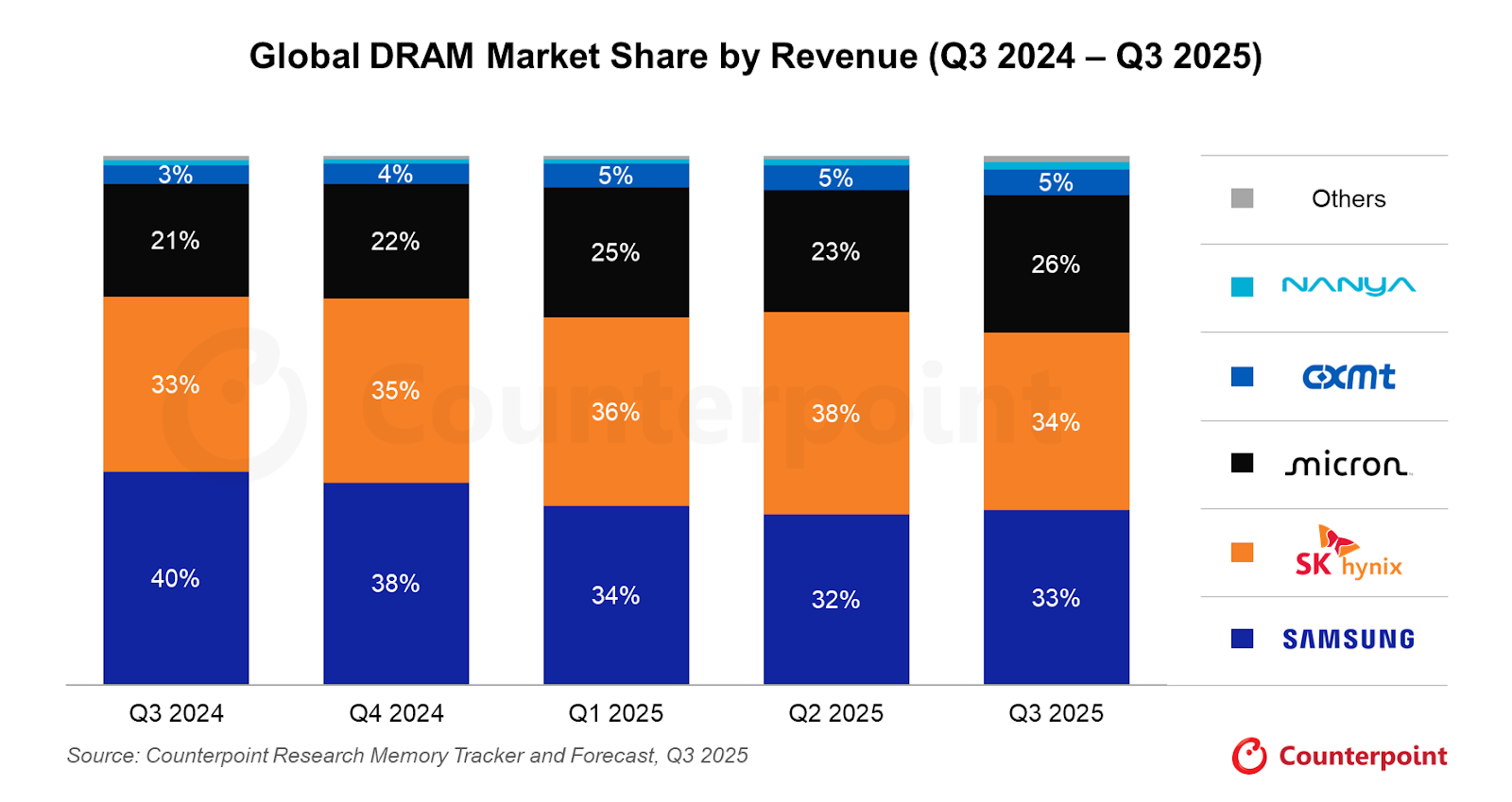
Samsung is one of the few companies globally that both designs and fabricates chips at scale. It competes across DRAM, NAND flash, and logic chip segments, and remains a core supplier to global tech giants.

Samsung's wide scope is a strength, but also a complexity. Its memory division faces margin pressure from inventory cycles, while its foundry business continues to lag TSMC in leading-edge yields. 

The AI-driven memory boom may provide a tailwind, though execution in HBM production has been slower than local rival SK Hynix.
What to watch

  • HBM qualification progress: Samsung has been working to qualify its HBM3E chips with Nvidia. Any confirmation of a major supply win could be a meaningful catalyst.
  • Memory pricing trends: DRAM and NAND spot prices could be an indicator of Samsung's margin trajectory.
  • Foundry yield improvements: Samsung's logic foundry business has struggled with yields at advanced nodes; any credible progress here could re-rate the division.
  • Management guidance: Following a period of earnings volatility, clarity on capex plans and divisional targets at upcoming results will be closely watched.
Source: Counterpoint research

3. Advantest (ATEYY)

Tokyo-based Advantest makes testing equipment used to verify chips meet performance and quality standards. 

It supplies to Samsung, Intel, Nvidia, Qualcomm, and Texas Instruments, allowing it to benefit from chip industry growth broadly, regardless of which foundry wins market share.

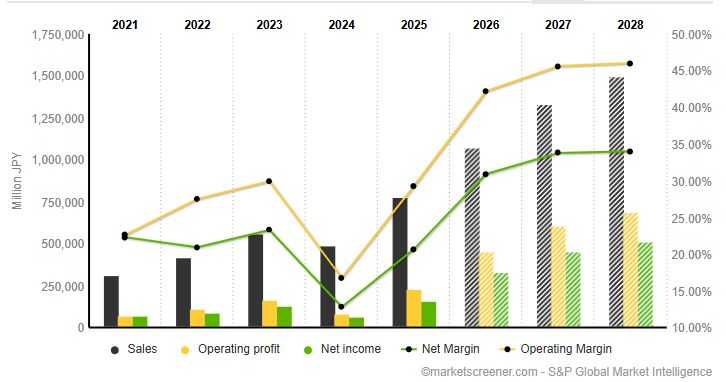
Advantest shares doubled in 2025 (+102%), and it raised its sales forecast by 21.8% and earnings forecast by 70.6% for the year ending March 2026.
What to watch

  • Order backlog updates: Any contraction in Advantest's backlog could be an early warning sign after the strong 2025 run.
  • AI chip testing demand: As chips grow more complex, testing time per chip increases. Monitor whether AI accelerator volumes from TSMC and Samsung start to drive outsized testing demand.
  • FY2026 guidance: The next forecast update will be critical in confirming whether 2025's upgrade cycle has further to run.
Advantest projected income statement | MarketScreener

4. Tokyo Electron (T:8035)

Tokyo Electron is among the world's largest suppliers of semiconductor production equipment, specialising in deposition, etching, and cleaning tools. 

Every major chipmaker, including TSMC, Samsung, and SK Hynix, depends on TEL's systems to scale production.

As chipmakers invest billions to expand capacity, TEL's order book grows. The risk lies in potential US export restrictions on advanced equipment sales to China, which remains one of the primary revenue segments for the company.

What to watch

  • US export control policy: China accounts for a significant portion of TEL's revenue. Any tightening of equipment export rules is the most immediate risk to watch.
  • Chipmaker capex announcements: TSMC, Samsung, and SK Hynix's capital expenditure plans for 2026 directly translate into equipment orders. Any cuts could flow through to TEL's order book.
  • New tool adoption cycles: Monitor whether TEL's next-generation deposition and etch tools are being adopted at leading-edge fabs.

5. SK Hynix (KR:000660)

SK Hynix is the world's second-largest memory chip maker and has emerged as arguably the clearest AI-era beneficiary in the memory space. 

It is Nvidia's primary supplier of High Bandwidth Memory (HBM) chips, the specialised memory used in AI accelerators like the H100 and B200.

HBM demand has driven a dramatic re-rating of SK Hynix's revenue profile and market standing. With AI infrastructure spending showing little sign of slowing heading into 2026, the company's HBM franchise could remain a key differentiator. 

However, capacity constraints and the risk of Samsung and Micron closing the HBM gap are the primary concerns to watch.

What to watch

  • Nvidia supply relationship: Any shift in Nvidia's supplier mix toward Samsung or Micron could be a key risk event.
  • HBM4 development: The race to next-generation HBM is already underway. Watch for updates on SK Hynix's HBM4 readiness and whether it can maintain its lead.
  • Conventional memory pricing: SK Hynix still derives meaningful revenue from standard DRAM and NAND. Spot price trends could be a gauge of the broader memory cycle.

Bottom line

TSMC, SK Hynix, Samsung, Advantest, and Tokyo Electron collectively control the chokepoints of the AI buildout. 

The expected increase in AI infrastructure may support demand, but investors should weigh the risks carefully. 

Geopolitical exposure, US export restrictions, and the pace of HBM competition could all move the needle.

Ready to trade beyond the majors?

Open an account · Log in

GO Markets
March 20, 2026
Market insights
Technology
Beyond Nvidia: 5 AI stocks to watch in 2026

So, here’s the thing...

If you have been following the tech story for the last decade, you have been trained to look at a very specific, very small patch of real estate in Northern California. But as we sit here in early 2026, the "connect-the-dots" moment for investors is this: the AI trade has stopped being about shiny software demos in Palo Alto and has started being about the physical industrialisation of compute.

Want to know more? Read our 2026 AI playbook

What changed, and why it matters

We have entered the "Year of Proof". The world’s largest companies, the hyperscalers, are projected to spend a staggering US$650 billion on capital expenditures this year. But here’s the part most people miss: that money is not staying in Silicon Valley. It’s flowing to the "picks and shovels" players in Idaho, Washington, Colorado and even overseas.

If you want to understand where the actual return on investment (ROI) may be landing this earnings season, you have to look outside the 650 area code. The shift from AI hype to AI industrialisation is changing the map.

The full AI stack: from capex to consulting — GO Markets

Five companies · AI infrastructure play · 2026

The full AI stack: from capex to consulting

Infrastructure builders compared to the implementation bridge across the AI value chain


Note: Hyperscalers shown as 2026 CapEx spend. Accenture shown as cumulative advanced AI bookings ($11.5B through Q1 FY2026), reflecting its role as the adoption layer rather than the infrastructure layer.
Infrastructure (2026 CapEx projected) Implementation bridge (cumulative AI bookings)

Hyperscaler CapEx: Early 2026 analyst estimates, midpoint of ranges. Amazon approx. 100% YoY, Alphabet approx. 100%, Meta approx. 87%, Microsoft approx. 50%.
Accenture: Cumulative advanced AI bookings $11.5B through Q1 FY2026. Q1 AI bookings $2.2B (up 76% YoY), AI revenue $1.1B (up 120% YoY) across 1,300+ clients.

Five companies shaping the next phase of AI

Micron Technology (MU), Boise, Idaho

Micron is the "memory backbone" of the current cycle. While everyone was watching the chip designers, many overlooked the fact that AI chips are far less useful without high-bandwidth memory (HBM). Micron is currently viewed by some analysts as a strong buy because its capacity is reportedly sold out through the end of 2026. Analysts are also eyeing a 457% jump in earnings per share (EPS) as the memory cycle reaches what some describe as a robust peak.

Microsoft (MSFT), Redmond, Washington

Microsoft is the enterprise backbone of this transition. It has moved beyond simple chatbots and is now building what analysts call "Intelligence Factories". While the stock has faced pressure recently over capacity constraints, underlying demand for Azure AI is reportedly still running ahead of capacity. The broader bull case is that Microsoft is moving into "Agentic AI", systems that do not just talk to users but may also execute multi-step business workflows.

Which Asian companies are betting big on artificial intelligence?

Amazon (AMZN), Seattle, Washington

Amazon is playing a long-term game of vertical integration. To reduce its reliance on expensive third-party hardware, it’s building its own AI chips in-house. Amazon Web Services (AWS) remains the primary driver of profitability, and the company is using its retail data to train specialised models that many Silicon Valley start-ups may struggle to replicate.

Palantir Technologies (PLTR), Denver, Colorado

If Micron provides the memory and Microsoft the platform, Palantir provides the "operating system" for the modern AI factory. The company has posted strong momentum, with US commercial sales recently growing 93% year over year. It’s often framed as a bridge between raw data and corporate profitability, which remains a key focus for investors in 2026.

Accenture (ACN), Dublin, Ireland

You cannot just "plug in" AI. Businesses often need to redesign processes around it, and that’s where Accenture comes in.

The company is viewed as an implementation bridge, with one analyst arguing that "GenAI needs Accenture" to move from pilot programs to production though the cautionary angle is that the AI story has not fully excited investors here yet because consulting revenue can take longer to show up than chip sales.

What could happen next?

The chart maps the three time horizons likely to shape the next phase of the AI industrialisation trade.

In the near term, markets are still reacting to chipmaker earnings, guidance, and any signs of capacity strain. Over the next month, attention shifts to the real-world inputs behind AI growth, especially power, financing, and infrastructure. By the 60-day window, the key question is whether AI spending is broadening into a wider market re-rating or running ahead of near-term returns.

Across all three periods, the focus is the same: proof. Investors are looking for signs that AI capital expenditure is translating into real demand for energy, land, and industrial capacity. That is why updates from companies tied to power and data centre buildout matter more than ever.

What could happen next — GO Markets

Scenario planning · March 2026

What could happen next

Three time horizons, three scenarios to watch across the AI industrialisation cycle


Next 2 weeks

Chipmaker reports

Possible

Market volatility continues as traders digest the latest reports from chipmakers like Micron

Upside scenario

"Bulletproof" guidance from remaining infrastructure names triggers a sector-wide relief rally

Watch for

Any mention of "capacity constraints" or "supply bottlenecks" in earnings calls

Next 30 days

Energy and rates

Possible

Focus shifts to "real economy" energy players like NextEra that power the data centres

Downside scenario

Rising oil prices from Middle East conflict act as a tax on tech margins, rotating into defensives

Action point

Monitor Fed language on rates. Higher for longer makes $650B capex bills far more expensive to finance

Next 60 days

The great dispersion

Possible

Market rewards companies with real AI revenue and punishes those still stuck in experimentation

Upside scenario

NextEra Energy (NEE) data centre announcements in late April/May trigger a utility renaissance rally

Downside scenario

An "air pocket" in profits occurs where debt-funded investment outpaces revenue gains

Watch

May reports from Texas Pacific Land (TPL) — is data centre land demand still "red hot"?

Action point

Review your portfolio for geographic diversity. The AI story is now a global power race

The psychological trap

The emotional trap many traders fall into right now is recency bias. You have seen NVIDIA and the "Magnificent 7" win for so long that it feels like they are the only way to play this. But the "obvious" trade is often the one that has already been priced in. Before acting, ask yourself: "Am I buying this stock because I understand its role in the physical AI supply chain, or because I’m afraid of missing the next leg of a rally that started two years ago?"

Ready to trade beyond the majors?
Open an account · Log in

Disclaimer: This content is general information only and should not be relied on as personal financial advice or a recommendation to buy, sell, or hold any financial product. References to companies or themes, including AI-related stocks, are illustrative only. Share and derivative markets can move sharply, and concentrated sectors such as AI and technology may experience elevated volatility, valuation risk, and liquidity risk. If you trade derivatives such as CFDs, leverage can magnify both gains and losses. Past performance is not a reliable indicator of future performance.

GO Markets
March 19, 2026
Market insights
Technology
Top 5 AI stocks in Asia: which companies are betting big on artificial intelligence?

While all eyes are on the US AI narrative dominated by Nvidia, Microsoft, and Google, Asia has quietly been moving on AI and is home to some of the world’s most aggressive AI bets.

Quick facts

  • SoftBank has committed $41 billion to OpenAI, securing approximately an 11% ownership stake.
  • Alibaba plans to invest more than $50 billion in AI infrastructure over the coming years.
  • Baidu's Core AI-powered business revenue grew 48% year over year in Q4, with ~70% of search results now AI-generated.

1. SoftBank Group (TYO: 9984)

SoftBank is the most AI-committed company in Asia by capital deployed and ambition. CEO Masayoshi Son has declared the company in "total offence mode," having completed a $41 billion investment into OpenAI for approximately an 11% ownership stake. 

Son has also launched a $100 billion initiative aimed at building a vertically integrated AI semiconductor champion (Project Izanagi), repositioning SoftBank as an "AI-era industrial holding company." 

SoftBank's fortunes are now deeply tied to the success of OpenAI and Son's ability to execute his semiconductor plan that puts it in direct competition with established players.

What to monitor

  • OpenAI's trajectory: Any shift in OpenAI's competitive position, valuation, or path to profitability has direct implications for SoftBank's balance sheet.
  • Project Izanagi progress: Watch for partner announcements, funding milestones, and whether Son can attract the engineering and manufacturing talent needed.
  • Arm Holdings performance: SoftBank also has a listed stake in Arm. Arm's data centre and AI chip licensing momentum is worth tracking.
  • Debt levels and Vision Fund exposure: SoftBank carries significant leverage. Rising interest rates or a correction in AI valuations could pressure the group's net asset value.

2. Alibaba Group (BABA)

Alibaba has committed more than US$50 billion to AI infrastructure, making it one of the largest AI capex programmes in the world. 

Its Qwen family of large language models underpins a rebuilt AI-focused cloud platform, and the company has partnered with Nvidia on physical AI projects. 

Alibaba Cloud is also the leading cloud provider in China. The key commercial question is whether Alibaba's can convert this cloud leadership into durable revenue growth.

However, it will have to navigate ongoing regulatory scrutiny in China and competition from local rivals like Huawei and ByteDance.

What to monitor

  • Cloud AI revenue growth: The clearest signal of whether the $50 billion investment is translating into commercial traction.
  • Qwen model adoption: Enterprise and developer uptake of the Qwen model family could be an indicator of Alibaba's AI platform stickiness.
  • Regulatory environment: Beijing's approach to large tech platforms and any renewed regulatory action could disrupt execution and sentiment.
  • US-China tech tensions: Nvidia partnership activity and access to advanced AI chips could be affected by further export controls.

3. Baidu (BIDU)

Baidu has made the most visible AI transformation of any company on this list. It has released a 2.4 trillion parameter omni-modal model (ERNIE 5.0) with approximately 70% of its search results now delivered as AI-generated rich media. 

Beyond search, its Apollo Go robotaxi service is now partnering with Uber to expand into Dubai and the UK.

Its Core AI-powered business generated RMB 11.3 billion in Q4 revenue, up 48% YoY. The question now is whether that momentum is sustainable and whether the robotaxi business can scale economically.

What to monitor

  • ERNIE monetisation: Watch for updates on enterprise API revenue and advertising yield improvements driven by AI-generated search.
  • Apollo Go expansion: Rider volume growth and cost per ride will indicate whether unit economics are improving.
  • Search market share: Competition from ByteDance and emerging AI-native search alternatives in China is a potential structural risk.

4. Tencent Holdings (HK: 0700)

Tencent's AI play is to allocate its GPU capacity to itself. This allows it to convert AI directly into efficiency gains across its ecosystem. 

With WeChat's 1.4 billion users providing an unmatched data engine, Tencent is embedding AI across gaming, payments, cloud, and search in a way that is difficult to replicate. 

This approach also offers greater resilience against AI chip export restrictions, since the compute stays internal.

The AI upside here is arguably underappreciated because it is embedded rather than a separate segment, which could also mean the market may find it harder to isolate and value that contribution.

What to monitor

  • Advertising revenue trends: The most measurable near-term AI benefit is from ad targeting improvements translating into sustained advertising revenue growth.
  • WeChat ecosystem AI integration: Watch for new AI-native features within WeChat, including search, mini-programs, and payments, as signals of platform deepening.
  • Regulatory and geopolitical risk: Tencent operates under ongoing scrutiny from Chinese regulators and faces restrictions in some Western markets.

5. Kakao (KRX: 035720)

Kakao is South Korea's dominant AI and internet platform, operating KakaoTalk, which is used by approximately 95% of South Koreans.

It is one of the most aggressively AI-focused non-Chinese tech companies in Asia, investing heavily in LLM development and AI-native services. 

The domestic dominance of KakaoTalk provides a captive distribution platform for AI products in a way few companies outside China can match. The key question is whether Kakao can monetise that distribution advantage before global competitors close the gap.

What to monitor

  • KakaoAI product rollouts: New AI-native features within KakaoTalk and Kakao's broader service suite are the most direct signal of commercial AI progress.
  • Cloud division growth: Kakao's cloud business is the infrastructure layer for its AI ambitions. Revenue growth and enterprise customer additions are key metrics.
  • LLM competitive positioning: Monitor how Kakao's models benchmark against global and regional peers, and whether Korean enterprise customers are adopting them at scale.
  • Corporate governance: Kakao has faced governance-related scrutiny in recent years; any developments here could affect sentiment independently of AI progress.

Bottom line

Asia's AI landscape is far more complicated than a simple "follow the AI spend" narrative suggests. 

China's top companies are innovating rapidly but operate under regulatory and geopolitical constraints. Japan's SoftBank is making the biggest single bet, but at a level of concentration risk that demands scrutiny. And South Korea's Kakao offers a differentiated, lower-geopolitical-risk angle.

The AI push in Asia is real. But the range of outcomes across these five names is wide, making it pivotal to understand each company's specific exposure and risk profile, not just its AI narrative.

GO Markets
March 19, 2026

면책 고지:

회사, IPO 후보, 가치 평가, 거래소, 섹터 및 시장에 대한 언급은 설명 목적일 뿐이며, 게시 시점에 공개적으로 이용 가능한 정보를 기반으로 하고 사전 통지 없이 변경될 수 있습니다. 예정된 상장은 지연, 수정 또는 취소될 수 있으며, 이 페이지에 포함되었다고 해서 해당 회사가 상장되거나 특정 주식 또는 CFD가 GO Markets를 통해 거래 가능하다는 의미는 아닙니다.